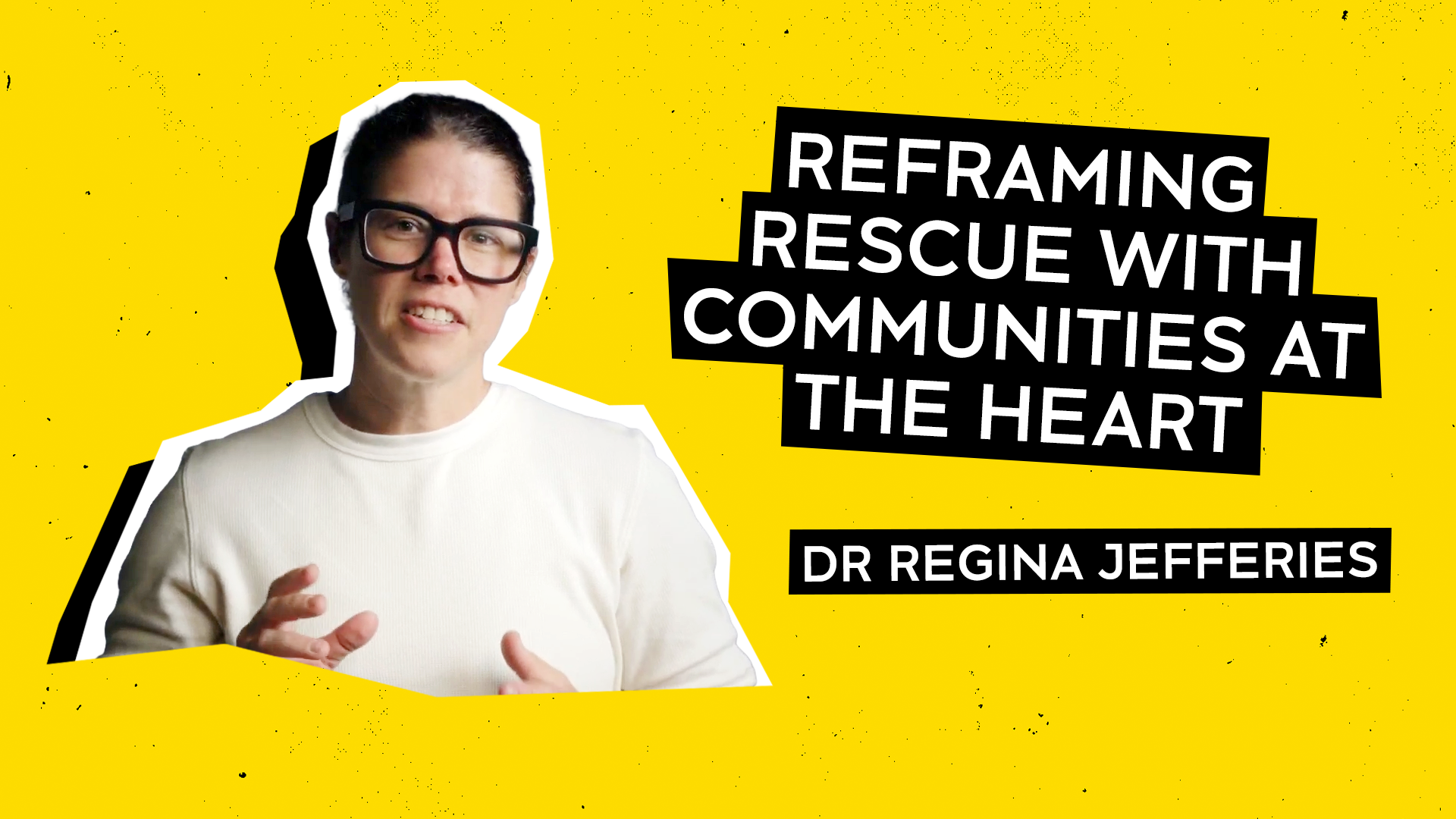
Reframing rescue with communities at the heart with Dr Regina Jefferies
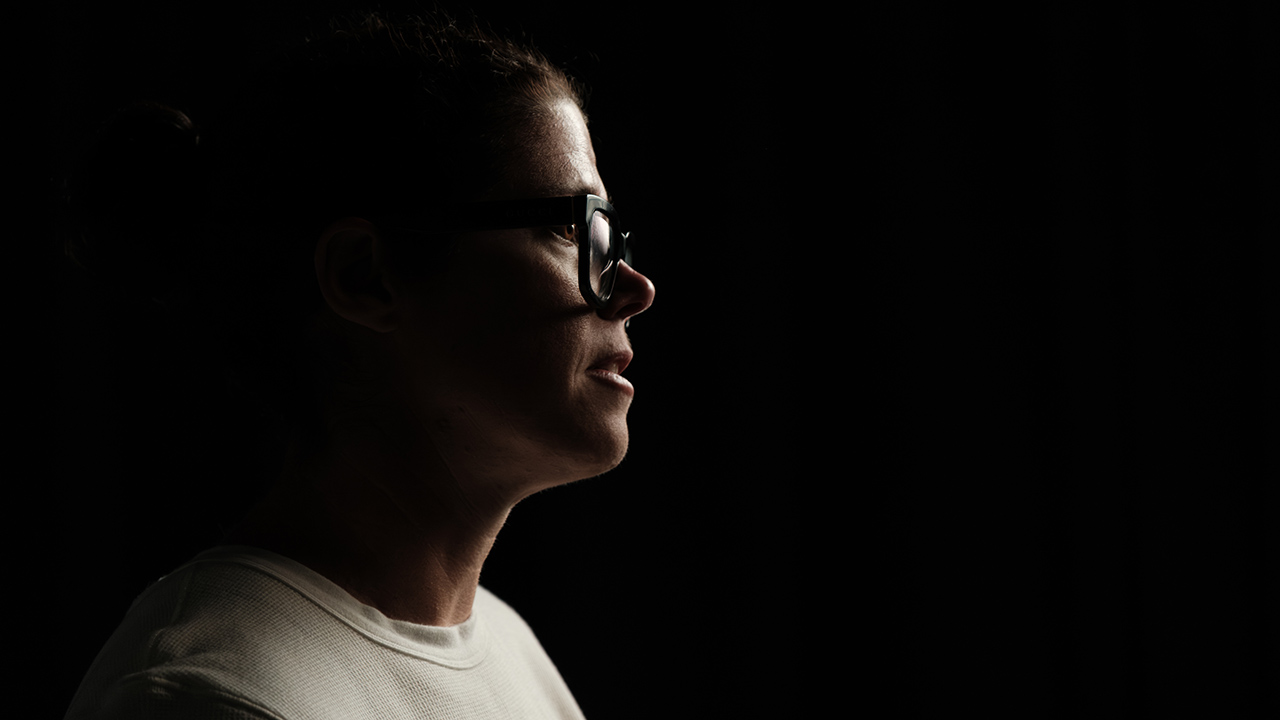
We can – and should – flip the script to think about evacuation as forced movement. That subtle shift opens us up to ways of preventing and responding to disasters that are attentive to people’s experience and knowledge of their own communities.
As natural disasters increase in frequency and severity, we are all at risk of one day having our homes and our lives being in danger from fire or flood. Right now, we are seeing an unprecedented level of people needing rescue in the midst of disaster. But rescue shouldn’t just be after the point of no return, when people must evacuate their homes because hazardous conditions overwhelm communities.
Listen to Dr Regina Jefferies, a human rights and refugee lawyer, on how recognising the broad scope of who tends to be a first responder in a disaster, and what it means to truly save people, could offer a fairer, kinder chance of rescue.
Transcript
Regina Jefferies: When you think about the term rescue, certain things come to mind, and that is typically that someone's coming in helping another person who is not able to help themselves, and is taking them from one place that is full of danger to another. A big part of the work that I'm doing currently is reframing this entirely, and it's moving away from this idea of rescue, because evacuation or moving someone from one place to another, or not moving them from one place to another, it involves the idea of human agency, and it involves forced movement. And so if we think about it as only rescue, it's like, oh, that's inevitable. Like, of course, that's good. We need to rescue someone from danger, move them somewhere else. But what that does is actually prevent us from seeing what people are capable of, what their particular context is, and what things we could have done before that became necessary to potentially prevent the need for that movement. So we really need to think about people on both sides of the equation, not just emergency services personnel, but what capabilities communities have or could have if they were properly funded and supported to be able to take steps to maybe prevent the need for movement.
Benjamin Law: G'day, you're listening to one big idea presented by the University of New South Wales, Centre for ideas. I'm writer and broadcaster Benjamin Law, and I can't wait to talk to seven incredible women whose research and ideas are changing the game in fields from the environment to education, quantum physics to cancer research.
Now, First Nations, people on this continent have been sharing ideas and knowledge for 10s of 1000s of years. They're humanity's first astronomers, first agriculturalists, first architects, first inventors. And together, those indigenous nations constitute the oldest continuing civilization the planet has ever known. So we're really grateful to the elders of the Gadigal of the Eora nation, where we're recording this podcast, that we can continue sharing knowledge here on Aboriginal land. And if you're a listener who's Aboriginal or Torres Strait Islander, we extend that gratitude to you too.
Each episode, I'll be interviewing a different UNSW academic, learning more about the person behind the big idea. And today I'm sitting down with a lawyer and Laureate postdoctoral fellow at the Kaldor Centre for International Refugee Law, and ARC laureate evacuations research hub at UNSW, who specialises in international human rights law and international refugee law, and I'm really looking forward to talking to her about a practical and profound question we'll need to increasingly ask ourselves, how do we rescue people from disasters without removing them from their homes? Dr Regina Jefferies, welcome to One Big Idea.
Regina Jefferies: Thank you for having me.
Benjamin Law: I'm so interested in your background story, your origin story, in a way, why were you so interested in human rights law and international refugee law? What was the thing that appealed to you about that field?
Regina Jefferies: I mean, for me, I grew up in a regional town in Texas in the United States. And so I'd always been interested in broader events, political events. And I think part of it was like familial influence. My dad was quite into history, etc. And I've always been a person who's wanted to contribute in some way to society, to help people, and honestly, going to law school, I attended law school in Arizona in 2005 is when I graduated. And being in that space and seeing what was happening on the ground then, in terms of people who were seeking a better life, people who were struggling, dying in the desert, etc. That was really sort of transformative for me, and began, sort of my journey towards working with people in an organising capacity. And so that was really seeing those things firsthand, really influenced me and set me, I guess, on the path that I'm on today in terms of working with people in really difficult circumstances who are forced to move, or who have chosen to move because the circumstances that they were living in were so poor that that they felt like that was the only choice.
Benjamin Law: So here in Australia, let's talk about disasters, because this feels like a very relevant conversation well across this warming planet, but here in Australia, especially where it's the driest continent on the planet, we know cyclones, we know floods, we know droughts, but of course, they are intensifying, and that's having a real effect on our communities. Right?
So the intersection between. And the knowledge that you bring from a legal background about refugee rights and human rights international law with disasters, what is that intersection? And what are you researching right now?
Regina Jefferies: That's a great question. I mean, it seems on first glance that okay, why is this refugee lawyer now talking about disasters? But really at its core, the work that I've done historically and now is about whether and why people move, and how they're forced to move, or how they're unable to move, so how they're forced, essentially to remain in place, because not everyone can move, who may need or want to move.
Our law and policy basically has to recognise what is involved in that, and has to give people essentially enough flexibility that they're able to do what's best for them, their community, within a particular context. It's not something that you can necessarily just legislate from top down. It's not necessarily something that you can just say, you know, you can't move. I mean, there are rights involved in that context as well. So, so it seems, on first glance, maybe not as connected, but, but it really, really is.
Benjamin Law: Yeah, when you explain it like that, it feels logical and inevitable that these kinds of conversations intersect. At the top of this conversation, I brought up this question, how do we rescue people from disasters without removing them from their homes? And I almost want to, like break down that question in and of itself, because first of all, the idea of rescuing people, the idea of rescue often means you're taking them from somewhere to a place of safety, right? But then the complicated factor in all of this is like, well, what if the place of danger is their home? And how do you work around that? Because people are attached to their home and want to be at home as well. Can you? Can you kind of explore this with me and break down that those assumptions and that question.
Regina Jefferies: Absolutely. I mean, you're asking a lawyer to get really down and dirty with words about language. So I mean, first of all, absolutely, when you think about the term rescue, certain things come to mind, and that is typically that someone's coming in, helping another person who is not able to help themselves, and is taking them from one place that is full of danger to another. A big part of the work that I'm doing currently is reframing this entirely, and it's moving away from this idea of rescue because evacuation or moving someone from one place to another, or not moving them from one place to another. It is another. It involves the idea of human agency, and it involves forced movement. And so if we think about it as only rescue, it's like, oh, that's inevitable. Like, of course, that's good. We need to rescue someone from danger, move them somewhere else. But what that does is actually prevent us from seeing what people are capable of, what their particular context is, and what things we could have done before that became necessary to potentially prevent the need for that movement. And so when we don't think about it as rescue, and that, you know, we're going to send, for example, the SES in to rescue people from flooding, which they absolutely do, and which is absolutely great and necessary, but they can't reach everyone. I mean, there are far too many people in this world, in this country for emergency services personnel to be able to rescue every single person in the event of a flood, a fire, etc. And so we really need to think about people on both sides of the equation, so not just emergency services personnel, but what capabilities communities have or could have if they were properly funded and supported, to be able to take steps to maybe prevent the need for movement, or to trust sources of information to get out before something really horrible happens. And I mean, this is a persistent issue that emergency services agencies point to is that often it's difficult to get people to leave early because they want to protect their homes.
Benjamin Law: As you're talking about all of this, all of these images, stories, photographs are going through my mind of recent disasters, whether they're the intense black summer bush fires, the floods that have been happening in northern New South Wales and people's relationships to their homes and the fact that some people have had to stay on or, as you say, there weren't enough resources necessarily to get everyone out. So we need to rethink this. Can you give us like a case study or maybe a real-life story or an example of people, real people or communities who have been looking down the barrel of a disaster, and to give us a sense of what, what stakes we're talking about here?
Regina Jefferies: Sure, so one example, and I mean, there are Australian examples from Lismore or from Taree, where people have sort of come together, and primarily it's after flooding to to come together and provide mutual aid and assistance to recover. But one case study that really sticks out to me actually is is actually from the Canadian context. And that one is, you know, there were really intense fires in Canada. Well, there are every every year now, but First Nations communities in Canada are disproportionately impacted by hazards and disasters, and something that's actually also true of Australia and other places. But in this context, there were these horrific fires that were moving through British Columbia and one First Nations community, the Tsilhqot'in community, essentially had their own decision-making arrangements, traditional decision-making arrangements in place. They had traditional knowledge of the topography of the land, the forest, etc, and they made the decision not to evacuate, not to leave their their country, not to leave the land, based upon those decision-making structures and that traditional knowledge.
The Royal Canadian Mounted Police didn't agree with that decision. And so there was conflict, actually, and the Royal Canadian Mounted Police attempted to move them on. They actually ended up moving, trying to move a different community, because they actually were confused. They didn't have the correct community that they were trying to get out because of similarities with the name.
Benjamin Law: Oh, wow, yeah.
Regina Jefferies: And so this community actually the Tsilhqot'in community, where they were able to successfully defend their territory. And so it raised these really significant questions, like, if First Nations were properly funded, et cetera, enabled to it had the same type of support that an agency, for example, like the Royal Canadian Mounted Police hat. If people are empowered to make these decisions based on their knowledge of their own context with their own decision-making structures, that you can have success in that way. And it's something that is not only successful, but it actually shows, I think, how when people are invested in a decision making process that they view as legitimate and part of the culture that has relationship to land and other, you know, other aspects of that as well, then those decisions, they can actually be quite empowering. And in this particular case, it shows that they can also be quite effective in terms of not displacing people from country, from a place where they didn't want to leave and may not have been able to return quickly or at all if they had left, it might have been actually destroyed.
So in that case, you're preventing longer term displacement by enabling people to take decisions that are based upon their knowledge of their own circumstances.
Benjamin Law: Can you tell me more about the Australian context and the Australian engagement, or lack thereof, with First Nations, people and communities when it comes to natural disasters?
Regina Jefferies: Well, I think first of all, there is a recognition on the part of a lot of government agencies that they actually do need to engage and work more with First Nations communities in Australia. I mean, that is something that is true. There are also a lot of people, including First Nations, doing this type of work already in Australia. One example that comes to mind is the programme on cultural burning, which has a long history, a long, long history here. In terms of First Nations, traditional knowledge about how to control burning, in fire management practices, and that's been started, that started to be incorporated into some existing sort of structures, existing fire management and other structures.
A lot of what's been done, though, thus far, has been incorporating these kinds of things into existing structures. And that's and that's been, actually, it can be somewhat problematic when, because then you're talking about, at least when you when you're talking about the law. You're talking about sort of these layers of authority. And so you know, something might be a nice to have, but it might actually be overridden by something else that's higher up.
So for example, like the decision-making authority of the Rural Fire Service, for example, might take precedence over an Aboriginal community's decision making in a particular context. And so those types of arrangements can actually be really problematic, and that's reflective of actually what you saw in the Canadian context. It's as if, when you are engaging with people, it's not just engaging on your terms. It's actually you have to meet people where they also are and recognise that there are different structures, different ways of making these types of decisions that actually can strengthen and benefit the bigger system itself by actually taking a step back and not trying to, sort of like top down, control everything.
So that's one aspect I think that is sort of missing here. I mean, amongst many. But you know that idea that you can't just sort of copy paste and put something underneath, like this overarching Emergency Management Framework, when it probably has different assumptions and different decision-making structures that can't be fully realised within that context.
Benjamin Law: As you're talking it makes me think about how often, in our minds, rescue is the end, they've been fetched out of their disastrous situation and all is well. But what I'm hearing is that rescue is often the start of a story, and there are things that happen next that need our attention. Is that fair to say?
Regina Jefferies: Absolutely, and that is one of the core the core things that I'm trying to get out with this work is that when you think about rescue in that way, it stops when the rescue ends, but the displacement doesn't end.
So when you think about evacuation as forced movement, you're thinking about this displacement along a timeline that often isn't short. And so you have to consider, okay, well, if someone is evacuated or moved from this place, then what comes after that? And knowing what comes after that in terms of okay, they may be staying with a friend, if they're lucky, or a family member, if they're lucky, they may be in an evacuation centre. Those don't stay open forever. They may they leave the evacuation centre, they may be moved into temporary government housing. Again, that's not something that necessarily can be sustained over the long term. So you have to think about all these consequences that occur after that act of evacuation occurs. And by thinking about all of those things, it prompts us to consider them up front. So if we move this person well, we have to consider all these knock on effects rather than rescue that person done to and there's nothing else that happens after that, because that's just not the case.
Benjamin Law: How do you fit into this conversation? Like, can you paint me a picture of how you go about conducting the research that you do? Who are you talking to, and what are the questions that you are asking people?
Regina Jefferies: Yeah, so this is, This is similar to the work that I've done, actually, in the refugee law context, because I am absolutely obsessed with, and this is maybe sad, but obsessed with how government bureaucracies work, and how things work on the ground and so that sort of those layers of authority, the layers of decision making structures, the layers of agencies, people, non-governmental organisations, different community members, etc, how all of those things come together in this sort of, like, chaotic I don't know, like, when you're talking about a situation, how all of those things interact, and what the law does to sort of help make sense of it. And that is really what I'm interested in, is all of these overlapping, really complex questions that are not necessarily straightforward, and particularly in a context where people really genuinely are trying to do the best for their neighbours. I mean, that is, you know, that is really fundamentally what we're getting at.
And so the type of things that I'm doing are looking at real life scenarios, talking to people who have extensive experience in these frameworks, so not just government officials who maybe work for Rural Fire Service or SES or, for example, the Australian Red Cross, the New South Wales Government, other agencies that provide, stand up and provide evacuation shelter services. Really, I will talk to anyone that will talk to me, is basically what it boils down to. And it's really interesting, because what you end up with is a lot of material, like a lot of information about from really different actors, about the same the same event, essentially, or the same types of events that are occurring.
And so going through each of those things and looking at it from all these different perspectives is a really interesting way to try to get a more holistic read on what some of the major practical issues are, and then how the law and policy can be modified, or how they might look, essentially, to mitigate those issues, and to really, I mean, fundamentally, what this is about is, and I think a lot of law in this area, what it's about is, it should be about empowering people to be able to exercise their rights in a way that that also leaves them protected, and in circumstances where there is a disaster or hazard, so, so those are kind of the types of questions that I'm asking. And we're not just we're actually as part of this project. It's a major focus is, is Australia. The US is also a focus as a comparison, although that's really interesting in the current context, in terms of sort of, a lot of what's been happening at the federal level in the US is quite interesting.
Benjamin Law: Yeah, they're not exactly a control group at the moment, right now.
Regina Jefferies: No, not, not at all. And so we'll also be looking at Fiji and the Philippines as well. So as compared towards, and really that Pacific focus is intentional, because the Pacific has actually been leading the way in a lot of this type of work.
Benjamin Law: And how So, what do you see in the Pacific? What are they doing differently?
Regina Jefferies: Yeah, I mean, there's a huge emphasis in the Pacific on Well, I mean, there's a huge recognition that climate change and the intensity and frequency of hazards, like cyclones, earthquakes, etc, are disproportionately impacting the Pacific.
And so there's been a really huge push, not just practically speaking, but also at a law and policy level, and particularly in an international law level, where you see Pacific, and specifically Pacific island nations taking the lead, and not just existing sort of government officials, but also youth taking the lead and talking about issues and potential solutions to these types of problems that aren't necessarily following sort of the same rote path of, oh, you know, we just need to legislate this and it'll all be fine.
It's like, there are bottom up solutions as well to be found, and so that I find absolutely fascinating and actually really motivating for doing this work, because it's like, you know, finding it's not just about sort of making new discoveries, but it's also about seeing what work is already being done, and learning from that, and amplifying that in a way that maybe will have an impact.
Benjamin Law: Can we localise the discussion? Because there have been such intense floods, I'm thinking of places like Lismore, like Taree, and these are communities are really thinking about their future. About this is my home, but what does the future look like for me here? How do their stories intersect with the work that you're doing?
Regina Jefferies: Yeah, I mean, it's this is a great question, because both of those locations obviously have suffered from very devastating floods, and many people are still displaced. I mean, they were evacuated, but haven't been able to return home, because, for some there is no home to return to.
And so, I mean, I think when you think about these types of disasters, one of the things that you can consider is whether people are able to move in the first place, so whether they can be directly funded, for example, to build a home in a place that isn't prone to flooding, or whether they can be even, even if it's temporary flooding that doesn't fully impact their home on a permanent basis, whether they can be funded if they don't have the means to leave early and have some place to stay while you know the event is actually happening. But you know, part of the issue in these locations is that the rebuilding is actually quite slow, and there's a lot of and I know there's a lot of people doing work around this, both in government and in the nonprofit realm, but whether someone is able to have a safe place to live. I mean, that is going to require some substantial change in terms of the legal and policy frameworks and the the willingness of government to to fund these changes. I mean, the fact of the matter is, the there's a massive flood plain, and there's a lot of people that are going to be continually impacted by by flooding, and so the policy and legal settings have to be such that, okay, well, how can we prevent this from happening again?
It may mean funding people to move, and frankly, that's something that should be a consideration, because funding someone in that way, even directly, is going to be less costly than continually attempting to evacuate people have people in these centres for a prolonged period of time. I mean, not just in terms of actual, like monetary costs, but in terms of the social and the psychological cost for someone, I mean that that's something that often goes unmentioned, is that, you know, the cost of someone to someone's mental health, of being displaced for even a short period of time from home, can be quite awful. So those are the types of things that. We would need to be thinking of in terms of sort of building out this pre-response that could potentially help to prevent people from being stuck in these prolonged situations.
Benjamin Law: As I've been talking to you, and as we've been talking about things like really studying complex bureaucracy, as we've been talking about engaging with myriad stakeholders, and the maze like structures that they might be navigating or creating themselves as we talk about really grim situations, natural disasters, and the way in which people are staring down those realities, those grim realities, I also see you lighting up as you talk about all of this stuff. And I want to ask like, what do you love about the work and research that you're doing?
Regina Jefferies: I am actually such a hopeful person overall, and I think that, you know, a lot of the work that I've done is in really, really depressing spaces, and I've seen a lot of experiences that people have had that would make anyone really depressed, but I think I also see that we can do things differently. That actually disasters aren't natural they're actually caused by an interaction of natural hazards, like a cyclone or a flood, but with the way that we arrange our society.
And I see right now a lot of young people, a lot of communities that have historically been sidelined in terms of the development of law and policy, that are taking the lead and really asking us to rethink substantially how we approach these kinds of problems. And to me, that is incredibly motivating. And, yeah, I mean, it makes me hopeful about where we're headed and what we can do. And I think if we are able to, sort of, like, move away from this idea of of how things have always been done, and sort of rethink our approach to some of these questions, like radically rethink our approach to some of these questions.
I mean, there's a lot that we can do still, even though, you know, of course, I'm not blind to the reality of certain things in terms of climate change and other questions, but I am hopeful that the right mix of people that we can sort of rethink these things and move forward in a way that we couldn't have even imagined from our current circumstances, I guess.
Because, like, I've seen this happen in my experience with, for example, organising, social organising and things like that, you get in a situation where everything seems so depressing, like everything is like in the US right now, and with the idea with what's happening with climate change, and it's really hard to imagine any other future or reality. And then all of a sudden, because all of these people are doing work on a very local level. All of a sudden, things start to shift in a way that you would not have seen otherwise, and then it sort of gathers steam, and bigger things start to happen. And I think that having hope that that can happen is part of the process of actually making it happen. If that makes sense.
Benjamin Law: it does make sense. At the same time, I can't help but wonder you're wrestling with climate change, which makes a lot of people, myself included, despair sometimes. You're talking about dealing with governments who are often in very established habits, intractable situations, ways of approaching disasters that haven't changed for a long time. What are the points in your work where you do feel that frustration? What is? What is a day where you're like, oh my gosh, this is really hard and really difficult?
Regina Jefferies: Yeah, I think one of the things that that's frustrating is actually seeing the same types of language being used in, for example, international legal instruments. That isn't really helpful.
So I can give you an example of this. Is when people talk about vulnerability. It drives me crazy.
Benjamin Law: Why, tell me?
Regina Jefferies: Because the way that people talk about vulnerability in the international law context, and actually even in the Australian context, is that they talk about it in the sense that a person is made vulnerable by their personal characteristics, by whether they are, for example, LGBTQIA, by whether they are living with a disability, by whether they are this, that or the other, but it's not those personal characteristics that render a person vulnerable, it's the societal structures that interact to disadvantage a person, and those are things that we actually have control over.
And so instead of having this sort of like a. Well, you know, we need to provide this to this person because they have these particular needs. It's like, how can we rethink the structures and the laws and the policies that we have in place to empower everyone or to make this not an issue for that person in this particular context? And so, I think there's this sort of like sense of inevitability that like, Oh, this is an issue, but it doesn't necessarily have to be, because they we have all these tools at our disposal to change that for people.
Benjamin Law: What I keep hearing from you is the “we” that we have a joint, shared responsibility in doing all of that together to shift the dial, I would like to project into the future, because obviously you're wrestling with present day structures that need change, that warrant change in 10 years from now. I don't think disasters are going to go away, but how would you like to see your research change the dial to make things different to how they're being done?
Regina Jefferies: Now, one thing that that I hope comes out of this is that I hope people understand that these conversations aren't just about other people. So when I say “we” a lot of times, one thing that inhibits action is that people think things are happening to someone else, but that's just not the case.
There have been numerous studies, I mean, recently, the Australian Government came out with a climate risk assessment, the very first one, and we're all at risk in these circumstances. We all have the potential to be displaced or forced to move, or needing to move, but can't move. And I think the sooner that people recognise that reality, and if we can sort of reframe the idea of evacuation from the idea of rescue to forced movement, then I think there is greater potential for some of these changes to take place, and so I really hope to move the dial, I guess, in terms of how we're thinking about this and whether people think this will affect them or not because it will.
Benjamin Law: Dr Regina Jefferies, thanks so much for sharing your knowledge and your hope with us here on one big idea. Thank you.
Thanks for listening. This episode was brought to you by the Centre for Ideas. For more information, visit UNSW Centre for Ideas.com and don't forget to subscribe wherever you get your podcasts.
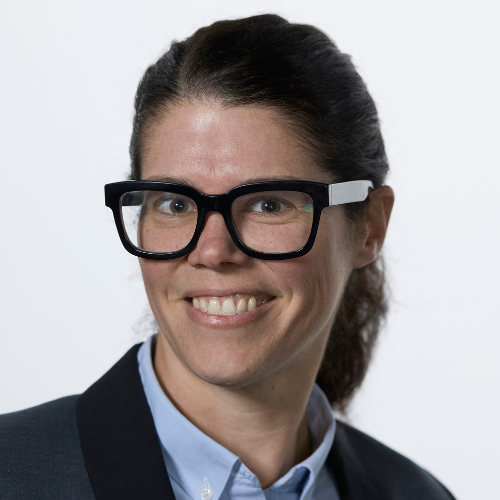
Dr Regina Jefferies
Dr Regina Jefferies is a lawyer and Laureate Postdoctoral Fellow at the Kaldor Centre for International Refugee Law, ARC Laureate Evacuations Research Hub at UNSW. Dr Jefferies specialises in international human rights law and international refugee law, with a focus on transnational legal theory, human mobility, and the application of international legal norms in transboundary and multi-jurisdictional settings.