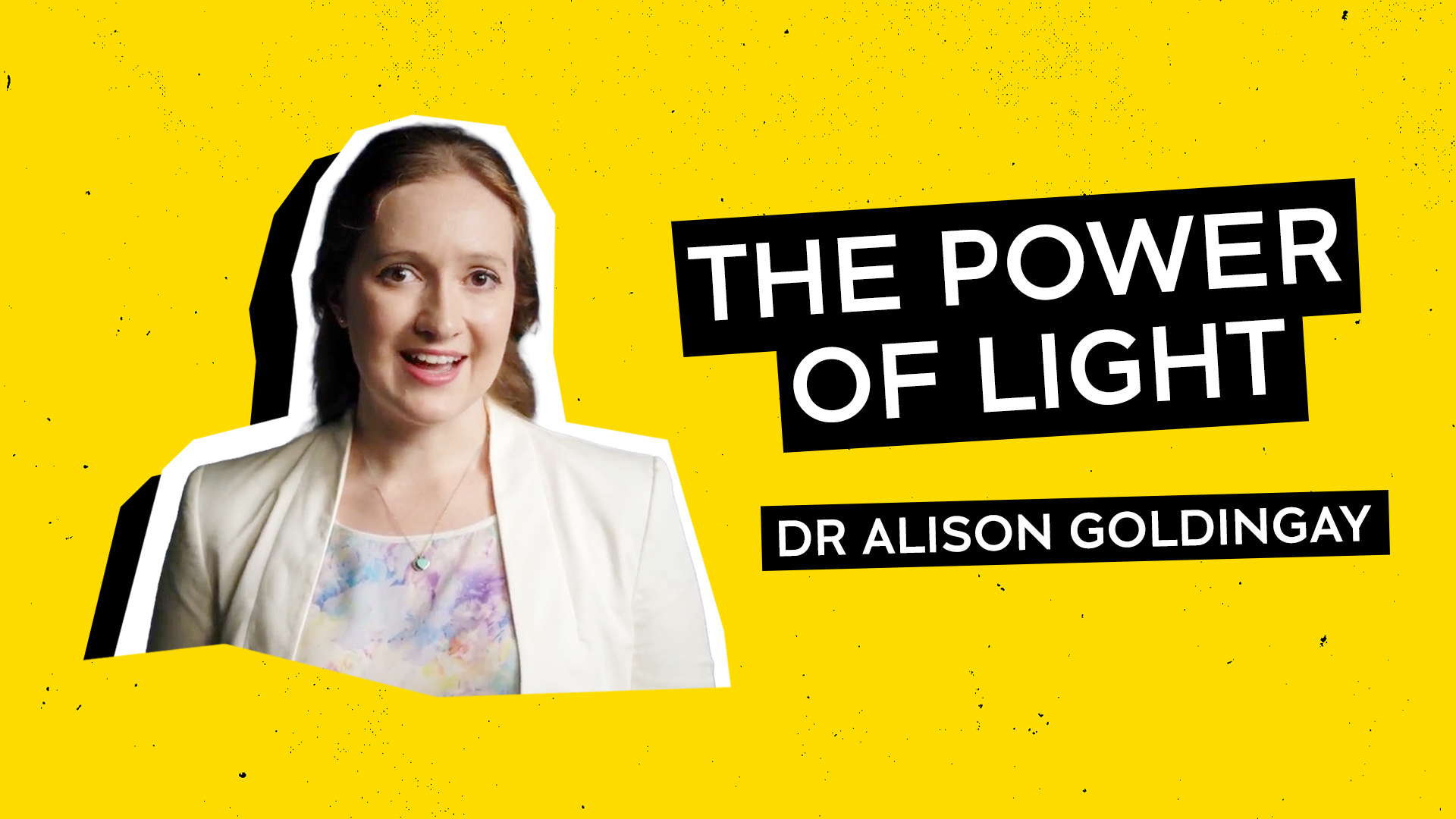
The power of light with Dr Alison Goldingay
For all of human history, light has been instrumental to our development of new technology. How would humanity have developed the concept of time if not by the light of the sun, moon and stars?
Light has unlocked many technologies over the course of human history. The more we learn about what light is and what it can do, the more applications we find to advance our lives. When we study light at the smallest scale possible, at the atomic level, we can unlock some pretty amazing, pretty weird capabilities.
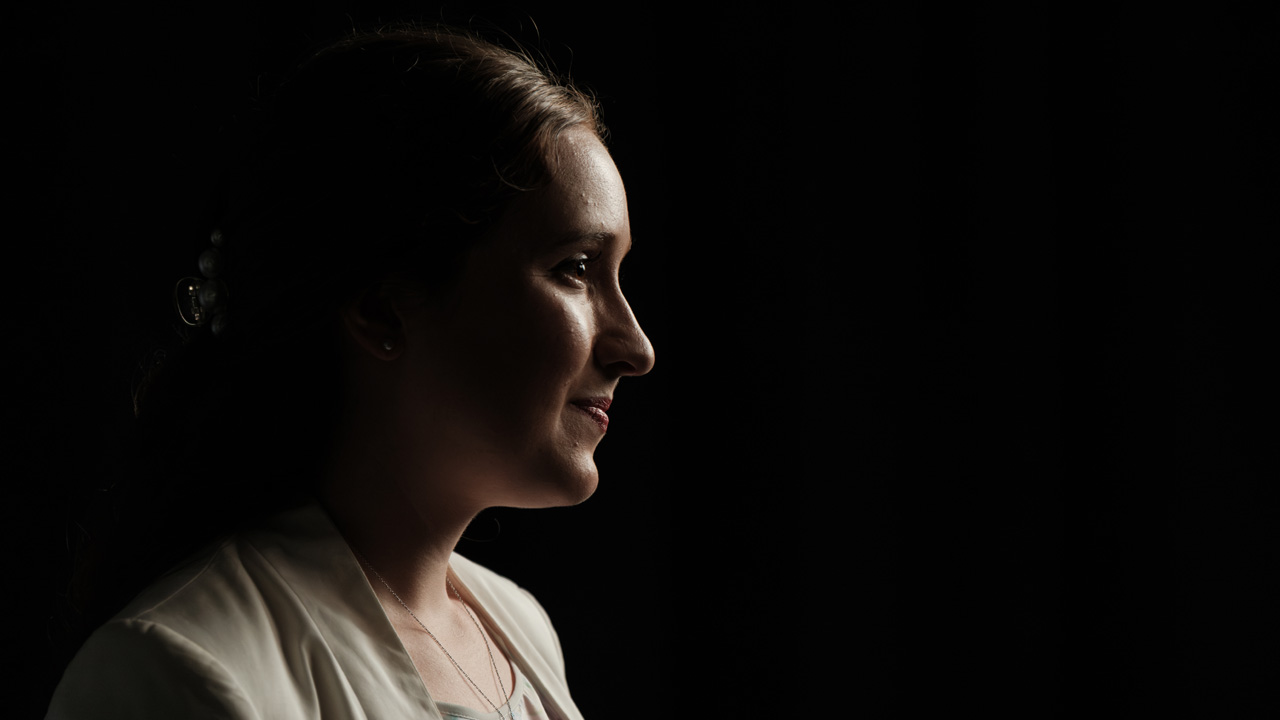
Find out from Dr Alison Goldingay, an award-winning Postdoctoral Fellow at UNSW in the School of Physics, about how the study of light is making quantum computing a reality.
Transcript
Alison Goldingay: I am very much a type A person. I like to be organised. You can see I've got these notes here, and I like to be prepared. I like to know what I'm doing and to make small progress within a scaffold of knowing kind of where I'm going. And that is really important to build that in research. It is a good thing to have that. But the reality is that a lot of the time that's not how it feels. I like to describe it as research. I like to describe it as a black curtain between you and what you want to see. And you have a needle, or maybe on a good day, you have some scissors, and you're kind of just making little holes so that you can see what's behind, and you can see where you're getting to, but you're not taking off large chunks of this curtain at a time. You're kind of just taking off pin pricks here and there and trying to make them line up so that you can actually start seeing through to the other side. That's how I think about it. And some days you think, “Well, I'm not sure if I really made any pin pricks in my black curtain today”, but if you keep applying yourself, over time, you see that things start to fall into place. That's the hope, anyway. So that's the biggest challenge, I think, is to overcome that mindset of I can't visualise where I'm going, and to be able to break down that large unknown into little unknowns that you can then tackle one by one.
Benjamin Law: G'day you're listening to One Big Idea presented by the University of New South Wales, Centre for Ideas. I'm writer and broadcaster Benjamin Law, and I can't wait to talk to seven incredible women whose research and ideas are changing the game in fields from the environment to education, quantum physics to cancer research.
Now, First Nations people on this continent have been sharing ideas and knowledge for 10s of 1000s of years. They're humanity's first astronomers, first agriculturalists, first architects, first inventors, and together, those indigenous nations constitute the oldest continuing civilization the planet has ever known. So we're really grateful to the elders of the Gadigal of the Eora nation, where we're recording this podcast, that we can continue sharing knowledge here on Aboriginal land. And if you're a listener who's Aboriginal or Torres Strait Islander, we extend that gratitude to you too.
Each episode, I'll be interviewing a different UNSW academic, learning more about the person behind the big idea, and today, I'm sitting down with an award winning post-doctoral fellow at UNSW in the School of Physics, where she works to design, make and measure qubits, the hardware component of the quantum computers of the future. She has a PhD in chemistry from the University of Sydney for her work on carbon based solar panels, and I can't wait to talk to her about how light has unlocked many technological advancements over the course of human history, and why quantum technologies are next in line. Dr Alison Goldingay, welcome to One Big Idea.
Alison Goldingay: Thanks very much. It's great to be here.
Benjamin Law: Now we have met before, and when we first met, I realised I didn't even know if I was pronouncing qubit properly. So when you meet people for the first time and you explain your work and what you do, and they're not necessarily sharing the same background as you in terms of research, how do you explain your research?
Alison Goldingay: Do you know this is going to sound like a joke, but I'm fully serious. Often I ask them, would you like the short story or the long story? Because, you know, I don't want to go too fast, too deep, too quick, but it's, it's just so exciting to talk about it. And as soon as I find someone who's keen to listen, you know, off I go, and I like to try and get them to think about things that they think they understand in a new way. And light is one of those things, because we all think we know light, but actually it's so much more powerful and interesting than we could ever imagine.
Benjamin Law: So is what you've given me, a kind of version of the short version that you give at parties.
Alison Goldingay: Yeah, that's about it. I think the shortest version is; I create and catch light.
Benjamin Law: Okay, that sounds like you're a goddess, which I'm sure you are, in many ways,
Alison Goldingay: Possibly overselling myself.
Benjamin Law: And what is, I know, the long version we've got time, right?
Alison Goldingay: Yeah, well, I found it super interesting to sit down and think about this script for the One Big Idea project. And what, what I decided to do is talk about all the ways that light has been impactful to us as a human race for so many generations and millennia. If you, if you go right back in time, it's the sunlight that allows us to have food sources, and it's sunlight, or even moonlight, that allows us to keep track of time and the stars, to navigate and explore new places, and even what we think of as advanced technology. You know, it all comes from in the old old days, from coal, which is compressed biomatter, which is plants that grew because of sunlight. And now we have renewables like solar power. Animals. So light has actually been there for a really long time, enabling so many functions of our lives.
Benjamin Law: And we don't exist without light, right?
Alison Goldingay: That's it.
Benjamin Law: I think, of all like of the major world religions, and how so many of those sacred texts start with light, like, Let there be light. We were covered in darkness, and then lights here, it feels like the giver of life, but you're so focused on it because of all of these applications of light. Is that fair to say?
Alison Goldingay: That's right, that's exactly what we're trying to do in the lab, is to work with it in a way that we can improve our lives at the end of the day, that's what all research should be about. So it's important that we have both that blue sky research, where we're curious, and it's important that we have those applications as well.
Benjamin Law: Now, when you're talking about the work that you do and the scale of the work you do, we're talking about tiny, tiny, tiny, tiny, tiny scale. And I think for a lot of us, when we're talking about the atomic level, the nano level, our brains start to melt a bit in terms of, like, even picturing what that even means. Could you explain or give us an understanding of what kind of scale we're talking about?
Alison Goldingay: Yes, of course, I have an analogy I like to use here, and I have to shout out to my colleague, Gabrielle Green, who came up with this one, actually. And the idea is, if you think about a blueberry that's actually halfway in size between the world and an atom. So if you think about how tiny that blueberry is compared to the whole world, the earth, you got to go that same distance the other way, and then you get to the size of an atom
Benjamin Law: that that has really blown my mind. It is, yeah, it's large numbers the same way, amazing.
Alison Goldingay: Well, you can appreciate them more, perhaps,
Benjamin Law: when you're talking about that scale, what I struggle to also understand then is that what your work actually looks like in the lab, in the in the Research Room. Because you can't get, you know, the world's, what are you using the world's most powerful microscope, the world's tiniest tweezers, to actually start looking at that kind of smallness,
Alison Goldingay: You know, in a sense, yes. So we do a lot of our experiments to create these samples in a clean room facility, which is a central facility here on campus that any researcher can book into. There are also some other really impressive instruments, of which we have one all to ourselves, called scanning tunnelling microscopes. And they scan across a sample. There's an electrical current which tunnels between the finger of the instrument and the sample, and in doing so, you can actually image with atomic resolution. You can see your atoms, pick them up and move them around.
Benjamin Law: Wait, atomic resolution where you can see atoms.
Alison Goldingay: It sounds like science fiction, but that's what people have managed to create, and it's really exciting. And that technology exists, and not only exists, but it's here on campus. It's in our basement, and there's like 10 of them in the building. So it's a real privilege to work in a space that has those instruments.
Benjamin Law: That is a very cool thing to have in your basement, right?
Alison Goldingay: It is.
Benjamin Law: And so, I mean, lead us through that more visually, like you step into the room, what are you actually seeing? What's the what's the scale of this equipment that you're actually using?
Alison Goldingay: A lot of our pieces of equipment that we use for measurements take up some portion of a room, so they're about the size of a couple of desks stacked together. Perhaps our samples are very, very tiny, and they're kind of the size of your fingernail, just so that you can hold them, you know, but the actual work that's going on on the sample is much smaller. So you've got this thing that's a size of a fingernail inside this piece of equipment that's the size of a room. And the reason that you need that large footprint for that equipment is because it's all about getting the sample cold, and it takes that much engineering to just get that tiny sample to be as extremely cold as we need it to be for our measurements.
Benjamin Law: How extremely cold are we talking about? Cold, as you can imagine, basically. So the furthest reaches of space that's that's how cold I'm thinking,
Alison Goldingay: Well, it's probably about 100 times colder than that.
Benjamin Law: How? How do you get something so cold?
Alison Goldingay: One way that you can do this is you can put your instrument, the inside of the instrument, into a bath of liquid helium. So helium is the same stuff that we have in our balloons that makes them rise. But if you squish it down really hard, then you'll make it into a liquid, and that liquid will be ultra, ultra cold. So for us, that's a very precious resource. And it's always funny when I go to a birthday party and I see helium in the balloons, and I think do you really need it, because we really need it, but it's also the case that we can recycle it and reuse it. So that's an important part of the engineering as well.
Benjamin Law: Can I ask a really basic question, please, when you're getting something that cold, is that dangerous?
Alison Goldingay: Well, you should not put your finger in it. So in that sense, yes, it would freeze flesh. And so when we work with these, we call them cryogenics, cold gases and liquids. We need to make sure we're, well, protecting ourselves. And the other dangerous part, if I put my safety hat on, is to think about the rapid evaporation. So if you have a liquid that is boiling at such a cold temperature in a room like this, it's just going to be boiling, boiling, boiling constantly. And what you need to think about is the fact that this gas is going to displace the oxygen. So we have oxygen monitoring systems and all kinds of things like that to make sure we're doing it safely.
Benjamin Law: When I hear all of this, I think, first of all, this is really cool, like the stuff that you're doing, really cool.
Alison Goldingay: I see what you did there.
Benjamin Law: So literally cool and also metaphorically cool at the same time. I'm also wondering, why are we doing this as well? What are those kind of applications that we're trying to do with your work in solar panels like that's quite clear in my mind what you're doing there. What are you trying to do now with looking at these atoms, getting them so cold, and monitoring how they work,
Alison Goldingay: I often fall back on two main applications. So number one, people talk about quite a lot in my space, which is quantum computing, the idea that we're going to be able to make a more powerful computer than what we currently have. These computers will be able to solve different problems, or likely to be able to solve different problems that stump existing computers. That's a research field in itself, whether or not they can outperform existing computers, but there's cases to show that they will, and that's talked about quite a lot. So what I want to focus on now is a second application, which is for our photons. If we can get them by themselves, we can actually do some really interesting security verification with them. So quantum physics tells us that we can use quantum properties of particles like photons to ensure our information is transported between two different people without it being eavesdropped. So it's actually not possible to eavesdrop that, because the information will collapse or self destruct if someone tries to eavesdrop it, and that's a property of quantum physics. So that's really exciting, and I think that's being talked about less at the moment, so that's one that I want to focus on.
Benjamin Law: So there are security applications there, because photons can carry information.
Alison Goldingay: That's it. I like to think of them as little golden snitches from Harry Potter. They're kind of flying around and carrying their little secrets.
Benjamin Law: That's really cool, because I'm casting my mind back to my very rudimentary physics classes, and photons are really, really, really small things, right? How do they carry information?
Alison Goldingay: Well, photons have different properties, and each of the properties can be used like the page of a notebook that you can read and write information on to that property. So for example, it is easy to think about the fact that light is made up of different colours, and perhaps you can send different colours of photons to mean different things in that same sense. If you have this one photon that's a particular colour, you can make it polarised in a certain direction, or it can kind of spin in a certain way, can have angular momentum. And another way that you can put information on a photon is the time of its arrival. So you can send some photons down a quick path, and some photons down a long path, and they'll get there later. And so people are thinking about all kinds of different ways to do this. So for example, the last one I described is called time multiplexing, and the first one I described is called wavelength multiplexing. And so it's one of these up and coming areas that is really exciting to think about. And it does blow your mind when you think about it too long, I will say. But someone out there is making it happen.
Benjamin Law: Your entire line of work sounds exotic and fancy. That's very cool. I want to shoot lasers into something now as well. Project into the future for us, because I love thinking about what might be around the corner. I think of this thing that we carry in our pockets that we didn't even have, like a decade and a half ago, I guess, and is just so useful. What can we expect in advances in quantum computing and quantum technology in general, 20 years from now, that might catch us off guard to begin with, but become technologies we take for granted.
Alison Goldingay: Right now, if you want to discover the cure for cancer, let's say one way to do that is to simulate it. Ask a current computer to tell you what it thinks might be best. And then you would go and you would trial and error, make what the computer thinks is good as a molecule, and then you would take that, and you would trial and error, test it on a petri dish, and then you would take it to humans, and there's this whole process. And the reason that that is so time intensive is because it's very hard to weed out what will and won't work until you try it, because the computer is doing its best. But what you really need to simulate molecules accurately is a computer that speaks the language of that molecule, which is a quantum computer. That's what people have been kind of writing about online, is that what we need is actually a quantum computer to solve the problem of the quantum chemistry, how the electrons are moving in order to help us get a particular molecule for a disease.
Benjamin Law: Your work is so interesting and obviously so involved. Can I ask you a personal question, please? What do you love about it?
Alison Goldingay: I love that I get to say I'm part of this, and I'm contributing to something that's so much bigger than myself, and I just get to be one of these people in this long, long, long line of people who've worked on this topic for the benefit of humanity. So a personal story is that my grandmother, who also lives nearby, and who I love dearly, she was one of the first computers in Australia, back when a computer was a person.
Benjamin Law: Wait, what do you mean by this? Your grandmother was an IBM computer. What is happening?
Alison Goldingay: I don't think it was IBM. It was in Adelaide. So back in the day, computers were pieces of equipment that took up a whole room and took a large number of people to operate, and it was typically women that were bringing the different code to the computer, which we would call it the computer. But in those days it was, it was the people that were operating the instrument that were called computers.
Benjamin Law: Wow, this is actually like a manual kind of thing that people are using their bodies to do in order to make the computer a room size computer work.
Alison Goldingay: Yes, they're bringing pieces of information here and there between different parts of the instrument, as I understand it. And that's such a cool story that she was involved in that. And back then, if you'd asked people, you know, what, what is this thing that takes a room? What is this going to be useful for? And people might say, “Oh, well, you can store money on it”, or, you know, I don't know what they said back then, but I don't think they would have imagined how useful it has become. I sometimes think, you know, what, if I arrive at my work and I've forgotten my computer, like, what can you do? Right? You know, everything is on the computer or on the phone. And when these pieces of equipment were being developed back then, people could only imagine how they would be useful, yeah. And so I am really excited to be in a similar position for the next generation of technology, and to think about perhaps my descendants in the future, looking back and saying, you know, well, she was there, yeah, that time. That's what really excites me.
Benjamin Law: Your grandchildren, our grandchildren's generation like just to even think about how they'll benefit from this technology that you're part of developing right now is really, really cool. Now we've spoken about what you love about this work and what you love about the research. What do you find challenging, frustrating, difficult about it?
Alison Goldingay: For me and possibly for many researchers, the biggest challenge is overcoming a mindset of uncertainty in making it into a mindset of opportunity.
Benjamin Law: What do you mean by that?
Alison Goldingay: I am very much a type A person. I like to be organised. You can see I've got these notes here, and I like to be prepared. I like to know what I'm doing and to make small progress within a scaffold of knowing kind of where I'm going, and that is really important to build that in research. It is a good thing to have that, but the reality is that a lot of the time that's not how it feels. I like to describe it as research. This is I like to describe it as a black curtain between you and what you want to see, and you have a needle, or maybe on a good day, you have some scissors, and you're kind of just making little holes so that you can see what's behind, and you can see where you're getting to. But you're not taking off large chunks of this curtain at a time. You're kind of just taking off pin pricks here and there and trying to make them line up so that you can actually start seeing through to the other side, that's how I think about it. And some days you think, “Well, I'm not sure if I really made any pinpricks in my black curtain today”, but if you keep applying yourself over time, you see that things start to fall into place. That's the hope, anyway. So that's the biggest challenge, I think, is to overcome that mindset of I can't visualise where I'm going, and to be able to break down that large unknown into little unknowns that you can then tackle one by one.
Benjamin Law: You know what I like about that analogy? I can see the light coming through.
Alison Goldingay: Yes, all about the light,
Benjamin Law: Which is beautiful, right? But I can also hear that sense of enjoy. Assurance and tenacity that you need in order to keep doing this research, that it takes time and it takes grit in order to keep going.
Alison Goldingay: And I'd love for that to be a message that spreads beyond this room as well, that often I tell people, “oh, I'm doing this work”. And they say, “Oh, you must be so smart”. And I say, “Oh, thank you, but I think it's actually the resilience and the grit that is the key skill that is needed here for this work”, because it's about showing up even when you don't know how you're going to go forward, and then finding a way to go forward one step at a time.
Benjamin Law: It's a lesson for your discipline, but a lesson for life as well.
Alison Goldingay: Yeah.
Benjamin Law: I can hear that so much of the research you do, and I guess research in general, is about the experiments that don't quite work, or it's like, “Oh, we didn't find anything interesting just then”. At the same time, what does a breakthrough look like? What does a breakthrough feel like? What constitutes a breakthrough?
Alison Goldingay: I'll tell you when I find one.
Benjamin Law: But there must be those moments you said. There are those days where it's a pin, and other days you might get a small pair of scissors. What's a day with scissors look like?
Alison Goldingay: Well, perhaps it's a day when you've made a sample, and you finally get to studying it, and you see that it gives you the result that you expected. That's quite exciting. I have to say, I've never quite experienced it going exactly to plan. There's always a surprise. But sometimes it's those surprises that are where the real interesting work can happen. If you have the mindset to notice and observe and chase that opportunity, or perhaps the time is the other concern.
So for example, there's a story that goes around. The way that the microwave was invented is a person with a chocolate bar in their pocket walked past an instrument that was designed for another purpose, but emitting microwave radiation, and the chocolate bar melted, and they thought, “Oh, well, why is that?” And that kind of curiosity is what gave us the microwave.
Benjamin Law: Most people would be so sad about the chocolate bar.
Alison Goldingay: Exactly. So, you know, spend less time being sad about the chocolate bar and spend more time thinking about what you can do with it. That's the challenge.
Benjamin Law: So you're talking about if you have a certain mindset, if you have a mindset that's conducive to this research, what I hear there is a mindset that is curious, that's capable of lateral thinking. What other kind of personality traits or mindsets do you think is really important for this type of work you've mentioned, like resilience as well?
Alison Goldingay: One thing that is definitely very important is the ability to work in a team, because modern science is done as teamwork. We have these incredible pieces of equipment, but by the time you get to learn how to use your piece of equipment, and you find you need another piece of equipment. What you really need is someone else who knows how to use that and a relationship with that person, and that is how you can answer more of these unknown questions and build together a story about what's really going on for your sample, or whatever you're looking at. So back in decades past, it might be common to find scientific articles published with just one author or two or three. Right now, you typically see journals published with 10 or you know, more authors, because we really need each other and each other's expertise to build something amazing. So teamwork skills would include good communication, good ability to have empathy for the other person and and be able to build that relationship around what each other needs. So I think that is quite undervalued and should be valued more, because that's the way of the future as well. To be able to work in a team is the way to unlock your goal.
Benjamin Law: So conversation and collaboration, I imagine that part of that conversation is having the global conversation of people who are in this work, talking about quantum physics, talking about quantum computing, doing that research. So much of that incredible work, of course, is being done at UNSW and, more broadly, Australia. But what's the global conversation like at the moment in terms of this sort of stuff?
Alison Goldingay: We're all pretty excited, I think, to see these quantum computers coming along. And there's, of course, other aspects of it too, as I mentioned before, there's quantum communications technologies. There's also quantum sensing, the ability to detect tiny changes in things like magnetic fields. All of these applications, you know, are really kind of blossoming right now. So there's a global conversation, not just about the tech and what's coming out of the labs, but how that's being made into real progress, and how we can use that to solve humanity's biggest challenges. So there's this industry network called Quantum Australia, which exists within our country to help link together the people that are developing these amazing technologies with the people who are going to benefit from them. So it's quite. Exciting to see things leaving the lab and becoming useful, and a whole industry network to facilitate that. That's the Australia scale. And of course, there are global networks doing the same.
Benjamin Law: So, Alison Golden Gate, you have blown my mind so many times during this conversation. Is there anything else that you'd like to tell me that for you, you might take this knowledge for granted, but for me, this dweeb who doesn't really know that much about physics and chemistry, where I'd be like, what is that true? Anything else to share?
Alison Goldingay: Perhaps I'll leave you with the image of a sunset, which is one of my favourite things. To be honest, I have this saying that to watch a beautiful sunset with someone you love with a cocktail if you can. You know, there's nothing better than that. And it's not just about that moment that you share with people, but it's about appreciating the world, what the world can give us, and the light that is there that is so beautiful. You know, I want to leave people with this image that there is real beauty Wherever you look, and for me, however you look, right? It's all about the how, how those photons are coming from the Sun to scatter off the particles in the atmosphere, to reach my eye, and I get to just sit there and appreciate it, and that's amazing. So that's a beautiful image to end on. I think
Benjamin Law: I think so too. Dr Alison, Golden Gate, thank you so much for illuminating the work that you do and showing us the beauty of it. Thanks for joining us at one big
Alison Goldingay: idea. It's been a pleasure. You
Benjamin Law: thanks for listening. This episode was brought to you by the Centre for ideas. For more information, visit UNSW Centre for ideas.com and don't forget to subscribe wherever you get your podcasts.
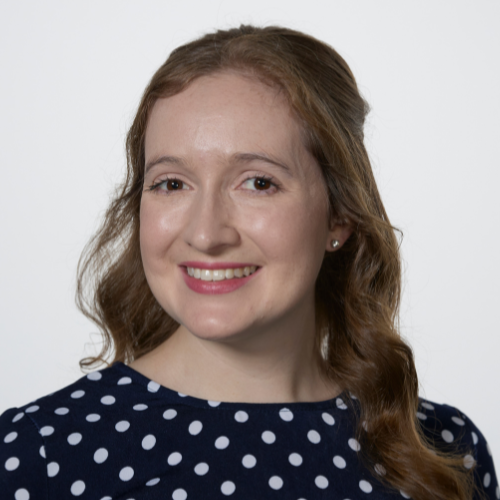
Dr Alison Goldingay
Dr Alison Goldingay is an award-winning Postdoctoral Fellow at UNSW in the School of Physics where she works to design, make and measure qubits, which are the hardware components of the quantum computers of the future. Prior to her current role at UNSW, Alison earned a PhD in Chemistry from the University of Sydney for her work on carbon-based solar panels. Alongside her work, Alison loves to engage with the public through science communication to share her passion for science.