Colum McCann: The Truth Disconnect
Facts are matters of convenience, especially right now. But there's a different form of truth, textural truth, that I think is really important.
Beneath the ocean’s surface, fibre-optic cables pulse with the entirety of our human existence – memes and messages, stock trades and state secrets. But when these fragile threads break, so too can the connections that bind us.
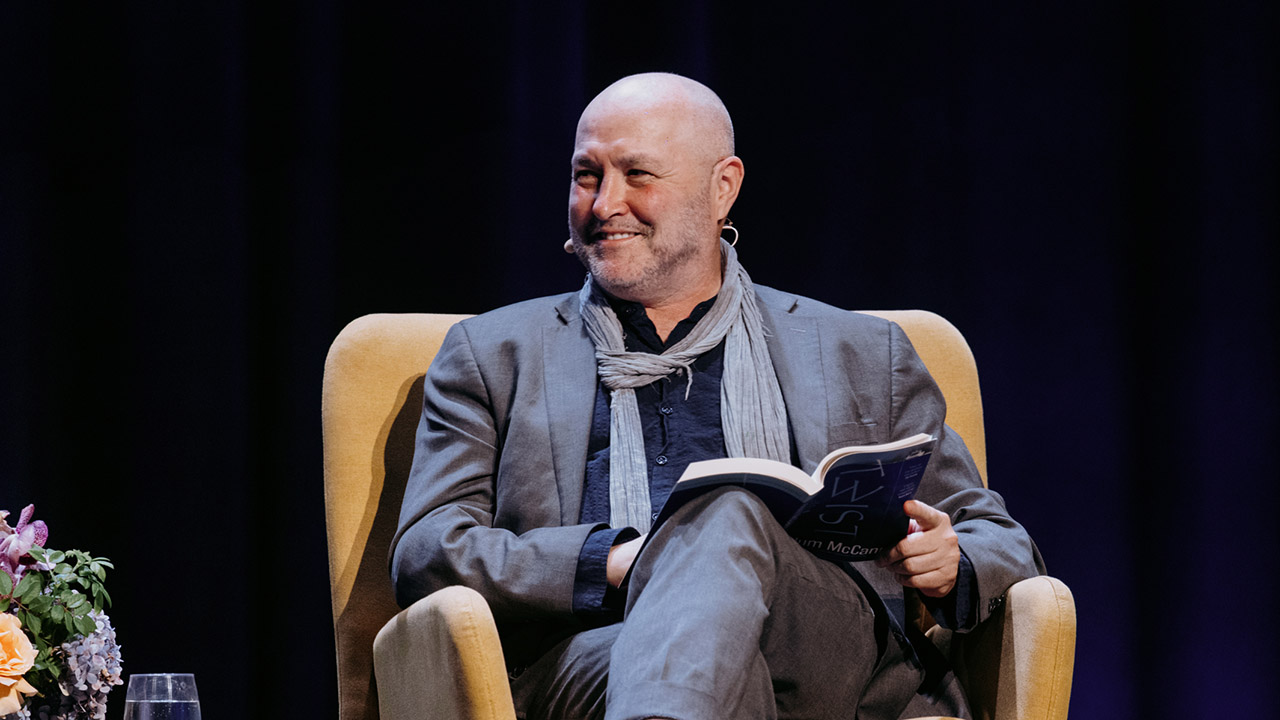
Hear award-winning author Colum McCann join The Daily Aus’ Sam Koslowski to explore truth, misinformation and human connection in a world driven by technology, and his latest book Twist.
Together they unpack the power of fiction to reflect societal truths, rupture, repair and resilience in an age of hyper-communication, asking: how do we navigate a world where information is abundant, but authenticity is elusive? And in an era of digital disarray, can we still mend the severed connections of our society?
Transcript
Sam Koslowski: Good evening everyone and welcome to tonight's event, Colum McCann: The Truth Disconnect.
Before we get going, I'd like to acknowledge the Bidjigal people who are the traditional custodians of this land. I'd also like to pay my respects to their elders past and present and extend that respect to any Aboriginal and Torres Strait Islander people here with us today.
My name is Sam Koslowski. I'm the co-founder of The Daily Aus which is Australia's largest youth news source for young Australians. I haven't slept since last Monday.
Audience Laughter
Sam Koslowski: I'm not joking. I established TDA in 2017 while I was a student here on this campus, and I saw a need for a way to service young Australians that traditional media just wasn't meeting. It's fair to say that that void is still there, but so are we. In this year's federal election, as talk of new media dominated a lot of media analysis, TDA provided the news to 4 million Australians in the 30 days before we voted.
Now, let me tell you a little bit about the guest that's joining me on stage.
Colum McCann is the internationally best-selling author of the novels Apeirogon, TransAtlantic, Let the Great World Spin, Zoli, Dancer, This Side of Brightness, and Songdogs, as well as three critically acclaimed story collections and the nonfiction books Letters to a Young Writer and American Mother, a particularly powerful story, that last one. He's widely regarded as one of the world's great novelists. I said this when I was practicing with my wife last night, and she said, you say that about everyone.
But then I showed her the bit in the New York Times interview where they said that, so it's true. But it's not just books. His writing has appeared in the New York Times, New Yorker, Esquire, Paris Review, The Atlantic, and he lives with his family in New York City.
He's the co-founder of the global non-for-profit organisation Narrative 4, which we're going to talk about as well a little bit tonight. And in his new novel Twist, we go to the depths of the ocean to explore the network of tiny fibre-optic tubes that carry the world's information from one continent to another, all at the speed of light. Now, that's all well and good and incredible to think about and a marvel of human ingenuity until they break.
Colum McCann, thank you for joining us tonight in Sydney. Thank you so much. Please welcome him, everyone.
Audience Applause
Colum McCann: It's really nice to be here. It's been 26 years. I know because I had a one and a half year old in an economy seat when I was flying over the first time, and I'll never forget that particular experience.
Audience Laughter
Sam Koslowski: I don't remember because I was four.
Colum McCann: Well, there you go.
Sam Koslowski: So, Colum, I couldn't shake this one thought as I was making my way through the novel, and it was almost a sense of embarrassment that I didn't know that there was this piece of technology that was essential to the technology that I use for, as someone who works in technology and media. I had no idea. Does that matter that I didn't know? And the first thing I thought of was the vegetarian argument. Do we need to know where our food came from? Does that make us more conscious consumers of it if we know how it gets there?
Colum McCann: It's a great question. I didn't know either, and I was embarrassed by it too until I came upon. It was during the pandemic. I thought, what's the theme of our times and what are we going to be writing about in the next few years? And I thought well, you know, it's about recovery or it's about health or it's about repair. And then I happened upon a story. I think it was in the New York Times about the Internet being down all across these countries in Africa, beginning in South Africa and working all the way up the West Coast, and that there was a boat going out to fix the Internet.
And I thought, well, that's bizarre. That's like something from a Marquez novel, because everything I do just goes up in the air and then, you know, goes into some celestial cloud and then figured out that the cloud actually lives under the sea and that 95% of the world's intercontinental information, if not more, travels in these tubes that are no bigger. Some people say they're the size of a garden hose. I'm tending towards the pipes at the back of your toilet. They're that size. And then within those tubes are the tiny fibre optic tubes, which are no bigger than the size of your eyelash.
And they carry everything that we are and or everything that we seem to be.
Sam Koslowski: And there's not many, right? There's, I think, 450 cables.
Colum McCann: 450 cables max.
And then there's about 50 ships at any one time. But operative ships, about 25 that are out and working at any one time to fix these 450 cables. Now, but I just want everyone to imagine it, because like that that TikTok that you send or that, you know, emoji or that love letter or whatever it happened to be, is actually going on the bottom of the ocean floor in places that we have not been as human beings and that we haven't really imagined as human beings.
So down in the like, turn the world upside down. You have your Mount Everest down there. You have the cliffs and all the crags and all the various things.
And our voices and so much of what we think of ourselves as being now, are actually traveling in light along the bottom of the ocean floor. I think it's kind of miraculous. And I was astounded by it, too.
Sam Koslowski: But what do you want from me in pulling my awareness throughout this novel to this feat? Because I've found myself, you know, I was sitting at work today and I sent a message to somebody a couple of desks over because that's what we do. And I sent the message and I thought to myself, shit, those pipes really are fast.
Colum McCann: Right.
Sam Koslowski: Like it just went under and up and then over and again.
Colum McCann: Yeah.
Sam Koslowski: Did you want me to become more conscious of the machinery behind the technology?
Colum McCann: Look, here's the thing about writers and writing. Like, I don't know what I wanted. And the big lie is writers actually know what they're going to do and they set out to do. They realise that afterwards, after they've struggled and like sat there and shaped and reshaped and tried to put some story together.
But at the beginning, I didn't. I had no clue. Except I thought it was vaguely beautiful and also terrifying at the same time, and having these sort of contradictory things going on at once was really interesting to me.
And, you know, I didn't really know all that much about technology. And it was an adventure for me to go out and to do. But also, I want you to know that it's physical hardware. We forget about that. And there's men and women at these landing stations that are putting these things together. But also that it's incredibly, incredibly vulnerable.
And now I know, like, you know, I'm a bit of a Luddite, right? But I can guarantee you that I could come up with a plan to take down, we'll certainly take down Australia, right?
Audience Laughter
Colum McCann: I mean, most of you could do it, actually, because there's not all that many landing stations where the cables are coming in. But to take down the world's Internet is actually possible. And the Russians are figuring it out right now. And the Chinese are figuring out right now. That sounds like I've been talking to John Le Carré.
Audience Laughter
Colum McCann: And, you know, maybe I should have been because it is happening.
Sam Koslowski: Well, I actually did some research for everyone because I can guarantee about half the room is thinking, where are my cables? Where do they pop out? So it's actually Narrabeen is where the cables pop out for most of Australia. So Narrabeen from the east and Perth from the west.
There are some smaller cables from Tamarama and Clovelly. And so just to stitch all of that together, we've got an Irishman who's flown all the way across the world to tell us how easy it is to cut cables in the very suburb where the cables are. We're going to get the feds because, yeah, I'm sensing something a bit funny.
Audience Laughter
Colum McCann: Take me. I'm arrested already.
Sam Koslowski: Do you feel more connected by the knowledge that there are these 450 cables? Bringing the seven billion of us technologically together?
Colum McCann: Yeah, I do, actually, because of that actual vulnerability. Look, I don't know what it is like in Australia, but nearly all the landing stations in the world are on beaches close to major towns in the suburbs, maybe in vaguely protected areas with maybe some wildlife protection in and around it and then some marine protection. But you could go to virtually every landing station. I've been to landing stations in New Jersey and in Long Island where I actually stood above the manhole cover. And if I'd had a crowbar in my pocket now, don't go around with a crowbar in my pocket.
Audience Laughter
Colum McCann: I'm Irish, I know. But that's a long time ago. But if I'd had a crowbar with me, I could have lifted up the manhole cover and it could have taken out, the you know, you could at least reach down to the pipes. And these are bungalows. And they're interesting because they're windowless. They're like casinos, you know, and there's always going to be a big generator outside and then maybe be a chain link fence around it, too. But that's about it. And that's all the protection that your cables are getting. So it is quite vulnerable.
Sam Koslowski: One of the most beautiful passages of the book is when you walk us through the sheer diversity of what pumps through these cables at the speed of light. And I'd love if you could read it for us, if that's OK?
Colum McCann: Sure.
Sam Koslowski: And while you're looking for it, the question I had about the section is when you do what I would describe as a list, you know, a listicle kind of piece of writing. How did you feel about the fact that even then you didn't capture everything?
Colum McCann: Well, there's no way. I mean, I wish I could have written Ulysses, you know, and because Ulysses is like a vast compendium of human experience. And I do think that Joyce would have had like incredible fun with this stuff. And part of me was like trying to. Well, I was trying to write a simple story in relation to this.
I mean, I'd come off a novel called Apeirogon, which was kind of complicated and had a thousand and one different chapters and a big structure. And I said to myself, OK, I'm going to write a simple, simple, simple story now.
Sam Koslowski: And this is your probably of your of your novels, the most simple in terms of its linear structure, its timeline.
Colum McCann: Yeah. And so it's apparently simple, I think. So for me, you know, the narrator is kind of limited in certain ways. And, you know, I'm a journalist, come from a journalist family. But he is a he's a journalist. And I hated him being a journalist.
I was like, God damn it. Couldn't he be something more interesting than a journalist? Because I guess it's obvious to send a journalist out to sea to tell the story. I wanted him to be a chaplain, you know, or an engineer or something like that. But he just wouldn't be. Because your character is sort of, anyway, this is how he characterises. Well, let him say whatever he says.
And I do feel it is him saying it, not me saying it, because this guy drinks four bottles of wine a day. I don't do that.
Audience Laughter
Sam Koslowski: Also, journalists are good.
Colum McCann: Journalists are good. I mean, I love journalists, but—
Sam Koslowski: We'll get there. We'll get there.
Colum McCann: Yeah. Journalists are particularly important right now.
Sam Koslowski: Way to piss off the moderator. Go on.
Colum McCann: Yeah, yeah, yeah. No, I'm a journalist, too. My dad's a journalist. Australian journalists now.
Audience Laughter
Colum McCann: Nothing, not even words can stop the flow of time. Things break. Nobody I talked to ever knew the precise point at which it was triggered. All of it took place so far underwater, and most of the sensors were destroyed in the flood. But it was January and the enormous slide began, an avalanche, an underwater punch to the back of the brain, rupturing the eardrums of whatever was there to hear it.
An 800 kilometre slide from the Congo River that could have destroyed anything in its path, passing through underwater gorges, beyond the jagged cliffs, over the drowned ridges, the bluffs, the crags, the caves. A huge flood then beneath the sea and a break in the cable. It was already designed for sway, large loops of it given over to the possibility, but it was stretched to the end point. And who knows what it was that the cable was carrying at the time? All the love notes, all the algorithms, all the financial dealings, the solicitations, the prescriptions, the solutions, the insinuations, the theories, the chess games, the sea charts, the histories, the contracts, the divorce papers, the computer hacks, the wild lies, the voices, the terror, the nonsense, the known, the unknown, the promises, the porn, the alphabet of flesh, the sing song of skin, the million wisps of disinformation, the flotsam of our longings, the jetsam of our truths. All of it, all of it suspended in a series of wet tubes at the bottom of the ocean floor. And who could tell what was traveling through it at the exact point of the snap? Say it was you, or say it was me, or say it was Zanele, a thought that began with a neuron in her brain, sparking other neurons, gathering, multiplying, traveling from her cerebral cortex, through her spine, through her finger, through her keyboard, through the circuit board, into electrical pulses.
0100101100110001101100.
And out again, through her building, down a manhole, beneath a street in London or in Brighton, in pulsating packets of light, to Dorset or Cornwall, all the way across the English Channel, codes of light at billions of times per second, past France, past Spain, past Portugal, past the Canaries, past Cape Verde and Ivory Coast and Ghana and Cameroon and Gabon, until it met that flood, that speck of dust, the thing that tipped it over, and the cable was already wildly stretched, encased by a massive torrent of mud and history, and then suddenly, it all just stopped. The cable snapped, and there must have been, at that moment, a tiny leak out of light into the surrounding darkness, her message to say to Conway, I love you.
Or then again, maybe not.
Audience Applause
Sam Koslowski: It's phenomenal to think that almost within every word, there is decades and decades of development and research and complexity and tough stuff that's had to be worked out for that to all come together, and it's now part of the way that we do everything.
And one thing that you say is that connectivity is a privilege. At this point, do you think it's not a right?
Colum McCann: Oh, it's a right. It's a human right. I mean, I think access to that good part of the information, the stuff that can happen is absolutely a human right, yes.
Sam Koslowski: So how do you feel about the fact that private companies, I mean, these fibre optic cables are privately owned for the most part. How do you feel about the fact that there's this inherent right that we've established, controlled by private enterprise?
Colum McCann: Well, this is a whole mishmash of nationhood and then corporate-hood, if you will, and colonialism and corporate-colonialism and everything that's going on.
So everything that's going through the tubes that we have created is owned by these major companies. And it is the major companies, Meta and Google, Orange Marine, other places like that, that own the actual cables as well. So not only is the information, but the vehicle for the information is owned by these companies.
And I think that's pretty scary. And I think it's something that we've got to know about. And I don't think if our young people don't know about that, then we're in serious trouble.
I certainly didn't know as much as I should know, but it is scary to think, you can put a cable around Africa, for instance, it'll cost you $4 billion. It'll last about 30 years. You will have made your money back in one year.
That's a lot of money. It's a lot of influence. And also, look, if they can fill the means of production or the vehicles of production, they can cut them off too.
Sam Koslowski: A common theme through all of your writing is this idea of repair. Have you just identified the problem that perhaps needs the most repair of all?
Colum McCann: I don't know. I do think that human repair has been a really interesting theme for me over the last 10 years.
And I've been looking at notions of forgiveness, looking at notions of compassion, empathy. I really wanted to set out, I'll be honest, I haven't really talked about this all that much. I wanted to set out to write a simple, good story about the elements of repair, men and women going out to sea.
And it didn't become that, not to give too much away, but that the repair became sabotaged. And then the sabotage became a form of repair in itself, in the theme of this novel. But I was surprised by how dark it was.
It's also my most, it might be my most simple of books, straightforward, chronological, et cetera, et cetera. One narrator, but it's also my darkest.
Sam Koslowski: Well, you describe yourself in other interviews as an optimist, as an inherent optimist. And I agree with you. I found the story quite dark and quite heavy. Do you think you're losing optimism?
Colum McCann: Well, I think I'm looking at optimism now.
I don't know if I'm losing it. I'm really fond, and I've talked about this before, but I'm really fond of the notion of Antonio Gramsci, the Italian social scientist, who talks about being a pessimist of the intellect. And an optimist of the will.
And in other words, the ability to hold these two things together is really important to me. And when I say to you that I'm an optimist tonight, I am very well aware that a really good optimist, like a really, really good optimist has to be a pessimist first. And you have to go to the very, very darkest, deepest part of the pessimistic instincts and say to him or her or them that you agree with them.
This is dark, but so what? And then you've got to vault away from the darkness in some sort of way. Does that sound twee or easy or sentimental or naive? In certain people's minds it does, but I don't care because I do believe that we have access to notions or methods of repair that where we can talk to one another across the different divides.
Sam Koslowski: Sounds like if you almost put a physical manifestation of what you just said, it's kind of like the bottom of the ocean.
Colum McCann: That would be a nice way to put it. I'm going to steal that one.
I think this is really important. I really want to say it to people. So after writing Apeirogon, and some of you might have read it, it's really important for me to say to you that Rami and Bassam are still the best of friends. And they call each other every single day.
And they are incredibly heartbroken. They're incredibly angry. They're very confused.
But they say to me that they would not change a word of what they have been saying for the past 20 years. In fact, in certain ways, it has focused it down and burnt it down. And one of the most, and I won't talk too much about it, because we've got other things to talk about.
But one of the most disturbing and beautiful things is that both of their grandchildren have now become involved in the peace process. So Rami's grandson is learning Arabic and Bassam's grandson, Palestinian, is learning Hebrew in order to be able to talk to the other communities. Now, you don't hear about that sort of thing in a lot of the media that we get.
But that is still their message. We don't need to hate. We don't need to love each other.
We don't even need to like each other. But we must understand each other or else we're doomed. And that's part of the optimism that I find.
Sam Koslowski: And may they be the future leaders.
Colum McCann: May they be the future leaders, yes.
Audience Applause
Colum McCann: They probably won't be. And that's part of the pessimistic part of it. But, you know, we could hope that they will be. The things that those kids are seeing right now, it's not, you know, dispatches from the West Bank and places. It's really tough.
Sam Koslowski: Why do you think you're so fascinated with the meatiest of topics? And it's not like your niche is in density. It's not in a topic area.
What is it that draws you into these unbelievably complex, multifaceted, diabolical areas?
Colum McCann: I don't know. I really don't know. I mean, I honestly don't. I do think, I honestly do think that I don't know is a really good answer right now, especially. That we all should say it more and more and more. But I don't know what it was.
Was it my dad? My dad being a journalist? I mean, I have four brothers and sisters who are not really interested in the world's, you know, bigger, complex questions. Was it because my ma came from Northern Ireland and she took me on a bus up to Northern Ireland when I was a kid and I saw conflict probably more than my brothers and sisters? I don't know. Was it because I had a teacher in school who sort of like said something to me one day that I still... I do think that I work with a lot of teachers and the most formative stuff happens in those early years.
I've been traveling a lot recently and on American planes, they say to you, if you're active military or if you have a military card, you know, please come up on board and get on the plane first.
Right. And I'm cool with that. I'm not going to argue. That's fine. You know, some of these people do incredible things, but I can't wait till the day that you get your teacher's card or your union card and you walk up there and you can get on the plane.
Why not? Because these teachers are at the front line of experience and doing some really, really tough things. So my respect for these people who are at the front line is enormous.
Sam Koslowski: You just mentioned your father and it's actually something that we have in common.
We're both sons of journalists. We're both journalists ourselves. And I loved reading about your father in preparing for our chat tonight.
I found an article that you wrote in the Granta magazine about him taking you into the newsroom of the Evening Press when you were nine years old. And I have to say, for me, it was an unbelievably powerful piece of writing because I had never read a description of what are some of my most formative memories, which is when my dad took me into Fairfax when I was about eight or nine years old. And what you write about, the smell of newspaper and the hustle and bustle.
I mean, there's no wonder that both of us are now in words ourselves. There was one section you write, ‘the news of the day to a boy nine years old was how very big the world suddenly was and how very different men could be and how people seem to have their own little corner and every corner was a world.’ Do you still see the world that way?
Colum McCann: Yes, absolutely.
I mean, I wish I could go back to that newsroom because what was really fantastic about it was that my dad was there and the print was coming off the big rolls. He was reading it backwards and upside down, but there was all these printers who were running around and there was all these messenger boys and there were vans going off and there was a big complex operation to get these words out into the world. And later, I went into the newspaper more and more and I'd go and I'd hang with the journalists.
And there was a lot of drinking going on also in those days.
Sam Koslowski: That hasn't changed.
Colum McCann: That hasn't changed? Well, in Irish papers, it's changed a little bit. Just very quickly, one of my favourite journalists was Con Houlihan, who was a great Irish sports journalist. Anyway, he had a great phrase when I sat beside him when I was like 17 down the pub.
He was talking about another journalist who'd been slagging everyone off and he was on his way off to Hollywood and everything like that. And Con Houlihan, who was noticeably taciturn, knobbly in his pint, and he says, ‘there he is, Sheridan, forgotten but not gone.’
Audience Laughter.
Colum McCann: Talk about being able to put someone down.
Sam Koslowski: Yeah, I do notice actually that journalists have a way of picking up little phrases like that and carrying them through. You know, my dad's favourite one is, you know, I say, ‘well, if he'd just kicked this goal, then we would have won. And if I'd just done this,’ and he says, ‘if your grandmother had four wheels, she'd be a bus.’
And he's just said that once a month for my whole life.
Colum McCann Laughs
Sam Koslowski: So they have a funny way of—
Colum McCann: How'd your grandmother feel about it?
Audience Laughter
Sam Koslowski: She's a lovely lady.
But it is something magical about that experience of being in a newsroom. And I would love for you to come and see how TDA's newsroom operates, because a lot of that hustle and bustle is actually still there, despite the fact that we don't print stuff upside down and in fact, we don't have a printer in the office at all. Give me a sense of your current observations on news media, the ones that we charge with transmitting truth through these tiny cables at the bottom of the ocean. Give me a sense of how you're seeing that world at the moment.
Colum McCann: Well, I think this is like, I mean, the most important thing that we can think about and talk about is like, you know, what's true now and how do we find out what is true? And I've been thinking a little bit about this. I think I've been writing about it for about the past 20 years. I've been doing a lot of fusion between fiction and nonfiction and what's texturally true.
And, you know, because facts can be mercenary things, right? You can give a fact to anyone, they could ship it off to whatever orphanage they wanted to go to or can do whatever work that they wanted to do. So facts are matters of convenience, especially right now. But there's a different form of truth textural truth that I think is really important.
So it's not factual anymore, that the real facts of contemporary experience are the ineffable things, the things that are impossible to put a fact around. So whether you're talking about violence or compassion or sacrifice or love or pity or all of those things that are really hard to put a fact around, you know, it's hard to put a fact around the idea of love. Yes, you can say, well, it's made of four letters and, you know, whatever else, you know.
But can you really, you know, put an absolute fact around it? So it's hard to pin down. And that's part of what we're trying to do both as journalists and as artists is to try to achieve a description of those ineffable things that are actually true and honest at the same time.
Sam Koslowski: Do you worry that that sort of perspective could be taken too liberally by, say, somebody like, hypothetically, Kellyanne Conway or somebody from the current White House administration who have introduced this term of alternate facts?
Colum McCann: Yeah, of course. I mean, yeah, and it happens all the time. But then I think and sometimes it's unfortunate because sometimes you do have to wait for time to parse these things out. But if you look at people like Rami and Bassam, they will be on the right side of history.
People will look back and say, what they were talking about was actually true. The tragedy of it all is that sometimes you have to wait for the truth to resolve itself. And so you're in this like big jukebox or, you know, crazy machine where things are zinging around and it's hard to put your finger on what's absolutely true.
But I suppose that's what poetry tries to do.
And that's what really good journalism tries to do. And really good teaching tries to do. And let's not forget that there are always many different facets, there are at least always two good truths.
And a lot of scientists have talked about this a lot. Often at the end of one idea is an equal idea that's opposable, but also equally true. And a very simple level, like in relation to what we're talking tonight, you can say technology is bad.
Look at everything that's doing to us. But technology is also good. So how do you hold these opposable ideas and talk about them?
I looked at your site and I'm not trying to flatter you, but I looked at what you're trying to do with Aus and I thought, well, this is really good. This is somebody who's trying to parse all this stuff. But who's to say what's ethical and what's not ethical? I think you just have to again, you have to feel it.
Sam Koslowski: Yeah. And what I've found through publishing with The Daily Aus is that people actually aren't used to that sort of journalism anymore. And a good piece for us is when we get called, violently left wing and violently right wing on the same piece of content.
Audience Laughter
Colum McCann: Right, right, right. Yes.
Sam Koslowski: And if the only thing that everyone can agree on is how much they hate The Daily Aus, then it's going to be a happy world.
Colum McCann: Well, that's really interesting, though, because we have these channels that are going down that are left and right and they get deeper and deeper and deeper. But the floodplain in between is where everything good happens. But the problem is, as they get deeper and deeper and deeper, the water goes down further and there's less ability for it to jump out into the floodplain. So I do feel that that part of our necessity is to call for good floodplain stuff.
And, you know, you've got to acknowledge that there are some between the red and the blue, there's always going to be purple.
Sam Koslowski: Yeah.
Colum McCann: You know, and that's where really good stuff comes in. It's all, you know, is it messy? Yeah, it's really messy. I want to actually write a book called ‘In Praise of Messiness.’
Audience Laughter
Colum McCann: You should see my office. But I really do.
Sam Koslowski: And you've talked about that metaphor as well with the cables in that you can have, you know, totally opposite views traveling together at the speed of light in these cables. It reminded me of a very, very important piece of, I'd call it poetry, from Jon Stewart at the Rally to Restore Sanity in Washington in probably 2008, something around there, where he says that we should just think a little bit more about society as a freeway, where, you know, there's two lanes and then there's one of those boom gates where one has to go and then the other.
One has to go and then the other. You've got a Republican voter and a Democrat, but it's one and the other. And at a certain level, when we can remember the fact that we actually can function with some sort of, you know, sanity and civility and manners and normality, whether it be in pipes or on highways, that that's kind of comforting.
Colum McCann: Yeah. So I and you mentioned this at the start at the kick-off, but I have this really cool organization called Narrative 4.
Sam Koslowski: I wanted to ask you next about that.
Colum McCann: Which is like, you know, it's a global nonprofit where we bring young people together, not necessarily always from different backgrounds, but we bring young people together to tell stories to one another.
Sam Koslowski: So give me an example of that in practice.
Colum McCann: So in practice, you know, we can bring kids from, say, Limerick with kids from Birmingham or kids from East Belfast and West Belfast. We're big in Ireland, but say in the States, and this will blow your mind, we bring kids from the South Bronx, which is the poorest congressional, much to New York's shame, the poorest congressional district in the United States, together with kids from Eastern Kentucky. Right. These kids are black and or immigrant. These kids are white and or Cherokee. These kids are urban. These kids are rural. These kids are blue. Politically, these kids are red.
And you bring them together in a room, say, this size and the size of the stage. And they're completely terrified of one another. I've seen grown boys, men who are old enough to be sent off to war, crying in a corner because they couldn't face these people from their own country until the moment that they tell stories, personal stories to one another, not didactic stories, but personal stories about what they you know, things that are important to them.
And so then what happens is that girl who wears the hijab in the South Bronx meets that boy who drives the pickup truck in Kentucky. And he realises that she's wearing AirPods beneath her hijab. And she's listening to Beyonce. And guess what? He was just listening to Beyonce's country album last week, you know, and then she realises that he's the first white boy that she's ever met, who's so poor that he has to shoot rabbits in order to, you know, put food on the table. And suddenly everything becomes sort of beautifully messy.
Sam Koslowski: That is your next novel.
Colum McCann: Yeah. That’s it.
Sam Koslowski: I got it.
Colum McCann: All right.
Sam Koslowski: Thanks.
Colum McCann: You write it.
Sam Koslowski: It's going to be called ‘The Floodplains.’
Colum McCann: The Floodplains. Actually, that's not a bad title.
Sam Koslowski: Well, there's no money in journalism, so I might have to jump ship.
Colum McCann: Is there no money in journalism, really.
Sam Koslowski: It's pretty tough out there.
Colum McCann: Yeah.
Sam Koslowski: I mean, we've got, you know, 80% of Australia's media is owned by two companies.
Colum McCann: Right.
Sam Koslowski: So, you know, we've got two major supermarkets and the idea of starting a supermarket competitor is ridiculous. And yet here we are. We've done it in news. So it's pretty tough.
Colum McCann: And are they trying to buy you up or they're trying to imitate you or what they're trying to do?
Sam Koslowski: They go through cycles where they try and buy us. And then when we say no, then they copy us. So does anyone work for News Corp? Great.
Audience Laughter
Sam Koslowski: So News Corp, you know, they had a little sniff and then we said, no, thank you. And then they said, OK, well, we're going to start one. It's also going to be called The Oz.
Colum McCann: Oh!
Sam Koslowski: Yeah. Red Hot. And then they spent 32 million dollars and shut it down after eight months because it was controlled by old people.
Colum McCann: Right. Right. Right. Right. What's it? I'm sorry, but what is an old person?
Sam Koslowski: I've just become old. I just turned 30.
Colum McCann: Oh, shit. Listen, I just had my 60th birthday party. I don't think I'm old at all. Like, you know, I will just say this.
Sam Koslowski: Is there any form of truth?
Colum McCann: There is many forms of truth. But John Berger said this amazing thing.
John Berger, a great English writer, novelist and art critic and lived in the south of France. Anyway, he was a great Marxist scholar as well. But he said, if ‘I'd known as a child what the life of an adult would have been, I never would have believed it. I never could have believed it would be so unfinished.’
And I love that because I do think that life is constantly unfinished, you know, even when you get older. So there you go, young man.
Sam Koslowski: Thanks, dad. We've got two questions that I want to bring you. Colum, First Nations people here in Australia say that we've got two ears and one mouth for a reason.
Do we need to listen more?
Sam Koslowski: Yeah, that's a beautiful question. Yeah, I mean, listening is the absolute soul of storytelling. And the proper way for us to learn how to repair is to learn how to listen.
That's why the Narrative 4 thing works beautifully, because you tell my story, I tell yours. And we go back into, you know, a group and I tell your story back in the first person. But yes, having two ears and one mouth is a beautiful notion.
And the power of listening. I will tell you something because I think it's important. And we lost him just a week and a half ago.
I had a chance to meet Pope Francis last August with Rami and Bassam. So he wanted to meet Rami and Bassam. And we went into the papal residence and we went up to his sort of apartment area.
So, you know, formal and everything. But we sat down with him and an interpreter and one other person for over an hour. And I've never in my life ever, ever, ever seen anybody listen as powerfully as Pope Francis did.
And he listened to Rami and he listened to Bassam. And you could see the words entering him. And then when he when he wanted to say something to have them continue and say something in English, something very small, he said, oh, yes, yes, yes.
But then when he wanted to actually say something to them, he spoke in Spanish, his original language. And the interpreter did it. But I've never seen anybody anywhere listen as powerfully and as beautifully as Pope Francis.
So that's, you know, it's an Aboriginal saying. It's like absolute proper ancient wisdom.
Sam Koslowski: A bit of a change of speed to this next question, but I think it's really interesting.
Let's say the cable was cut to Australia tomorrow. What do you think that next day or week would look like?
Colum McCann: So if all the cables were cut. And so, as you know, there are submarines that have been spotted in and around Australia.
They've been spotted in Ireland and they've been spotted in other places. And a British admiral told me he said that the next war, at the very least, will begin underwater. The cables will be cut and then it will be a process of disinformation.
Now, if the cables were cut to Australia, of course, you'd have some satellite. But satellite is five times slower and five times more expensive. And you would see the power concentrated amongst the very, very, very powerful.
And you would see society begin to fray. But you also might see certain wounds that would be open that would begin to teach us some things. There's a poet who said that the light comes out of the wound is some of the one of the most interesting things about the wound itself.
I think we'd be we'd be in big trouble. Hospitals would be in trouble. Universities be in trouble.
You know, supermarkets and we in general would be in trouble because it would take it takes a couple of months to fix the if it's a deep underwater break. If it's sabotage, you probably take a couple of weeks to try and fix it. And I think it would be catastrophic for a lot of people.
But in the end, there might be something that we could get out of it.
Sam Koslowski: A final question from me Colum.
Colum McCann: Can we not just talk all night because this is a lot of crack.
Audience Laughter
Sam Koslowski: This is nice, isn't it? Yeah, we just sit here.
Colum McCann: Listen we'll all just go out and we'll have a pint together.
Sam Koslowski: Be lovely. Just two journalists, son and dad. Yeah go on.
Colum McCann: Actually, can I just tell you what a very funny thing that happened to me like in the park when I was your age, actually back when I was your age, son, I was crossing road and the cyclist was coming at me and I said, what the hell are you doing? And he says, he just glided past me and be careful, pops. And it was the best insult I'd ever been given. I had no comeback for it whatsoever.
Sam Koslowski: It's fine. One of one of our journalists just said to me this week, well, Sam, you wouldn't understand. You're not in the target audience anymore. He's sacked now. Last question from me.
It's fair to say that we are at a point of fragility in the world. Reading the novel, I was constantly reminded of the fragility of the physical infrastructure. And as you just explained in the kind of week after scenario, what our world would look like should they malfunction.
Colum McCann: Right.
Sam Koslowski: With all of that fragility. What can you leave us with to feel optimistic about our hopes of repair?
Colum McCann: OK, well, first of all, I think this has always happened. Right.
It happened, say, for our fathers like back in the nuclear age when we thought everything was going to go awry and the world was ending then. And then for our grandmothers back in the 1940s or whatever, and the world was falling apart and morality had gone and nothing held.
And even before that, the First World War, and I'm sure before that and before that and before that for time immemorial. What I do think is different now. Is that we're living in the exponential age so that the shattering is actually quicker.
And so when we lean down to pick up the shattered pieces, the shattered pieces themselves shatter on us. And that's what's really causing this massive anxiety that's all around us. Right?
And there is this epidemic of loneliness and isolation. And but I do still believe that we can reach out and, you know, engage with one another. I still believe in the art of stories and storytelling.
You can still you can take away a lot of things from people. You can take away their houses, you can take away their countries, you can take away their identity. But in the end, you can't take away their story.
And I do believe if we can somehow get to a point where we can see the healing properties, the medicine that's involved in that that sort of proper engagement with one another across the aisles in particular, then I do think we have a chance.
Sam Koslowski: You said before that one of the experiences of being an author is that you're not quite sure how it's going to land with the audience. You're not quite sure what meant by certain phrases and parts of your novel. I can safely say that it has bettered my world.
Colum McCann: And that's very wonderful thing to say.
Sam Koslowski: So, I thank you for your novel. And please, thank the Colum for his time.
Centre for Ideas: Stay with us—before we wrap up The Truth Disconnect with Colum McCann, UNSW’s Avegail Matutina shares a short but powerful take on misinformation and social media addiction.
Avegail Matutina: Good evening, everyone. I'm Avegail Matutina.
I'm a UNSW graduate and a social media officer for the UNSW central channels. I began as a student content creator during my second year as a student, and I've been lucky enough to be with the team ever since. And in that time, I've produced over 300 videos, helped grow our TikTok and Instagram accounts to over 100,000 followers and helped contribute to making UNSW the most engaged social media platform by university in Australia.
But beyond uni, I've also created content for organizations like Black Dog Institute and the Uluru Statement, creating informative social media content during the 2023 referendum campaign. And now today, I also work with Teach Us Consent as a social media officer in supporting Australia's national plan to end sexual violence. So long story short, I am your social media expert for today.
Now, let's get into this.
Avegail holds up a smartphone
Avegail Matutina: Now we all have one of these right now in our pockets, bags, purses, where it's waiting for this talk to end, to steal away our attention, scroll by scroll. On average, the typical Australian picks up their phone 58 times a day or spends four to five hours per day on their screens.
Now, for my generation and younger, those are rookie numbers. We spend an average of seven hours per day or a minimum of 10 hours per week. 95% of us have a social media account and more than a third of us report that we use it constantly.
From the things we eat, what we buy and wear, the way we talk and how we socialise, our addiction to social media shapes our relationship with the world around us and even our sense of self. Our self-development is increasingly dictated by online influence as we adhere to online trends, aesthetics and online groups as a means to build identity. They call us the buy everything or nothing generation as we buy our way into belonging and social acceptance through trendy products and experiences, all depicted online.
So while my generation is the most connected on social media, that also makes us the most disconnected with what is real. Now, you might just say, just put down the damn phone. Well, you can, but it's just not that simple anymore.
Does anyone remember the days when we actually saw posts from people we actually followed, but it now seems that personal posts are hidden in a stream of endless content from accounts we have no real life connection to? Well, that is because of one update in 2016, which meant that platform giants like Instagram and Facebook moved from chronological feeds into algorithmically driven feeds, using our data from our viewing habits to curate personalised for you pages. Now, while this offered a tailored experience, it also allowed platforms to monetise users' attention to sustain a user base and profit, making it less social and harder to put down the phone. It also allowed the algorithm to limit visibility to the side of the story that was the most attention grabbing.
So very quickly, it became about not the most valid truth, the most accurate truth, not even the most reliable truth, but it became about the truth that got the most views and likes. And now with TikTok announcing that it is the most popular search engine, surpassing the search volume of Google, social media is becoming the main source of information, especially for young people, 40 per cent to be exact. And now the danger of this is that the distortion of truth via social media is far more pervasive and insidious as it has users like you and me who we trust spreading unchecked information, whether truthful or not.
The distortion of truth via social media is very real and is shaping our world and our lives. But what we cannot forget is that social media also amplifies. It amplifies perspectives, attitudes, and niche topics we would have never even come across.
It amplifies stories across the world and tragedies which normally would have gone unseen. Social media allows us to receive information unscripted and unfiltered by biased mainstream media outlets. Social media lets us receive information like never before, and it's all accessible through here.
So where does that leave us? Well, social media, it's here to stay, and its future seems more so to be uncertain and going in the wrong direction with meta turning off its fact checkers and the intrusion of AI generated images becoming greater and greater, which I won't even go into. But this uncertainty, this unknown of social media, it challenges us. It incentivises you and me to go search for the truth.
It tells us to be more vigilant with the content we consume and to be more critical with what is out there. And to maybe not rely on a 30 second TikTok as our means of truth. Thank you.
Centre for Ideas: Thanks for listening. For more information, visit unswcentreforideas.com. And don't forget to subscribe wherever you get your podcasts.
-
1/5
-
2/5
-
3/5
-
4/5
-
5/5
Colum McCann
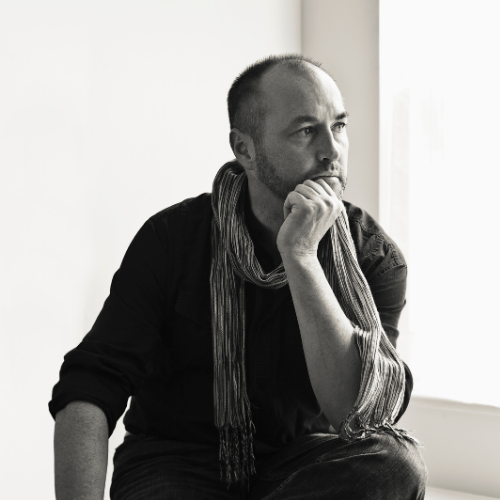
Colum McCann is the author of seven novels, three collections of stories and two works of non-fiction. Born and raised in Dublin, Ireland, he has been the recipient of many international honours. In 2017 he was elected to the American Academy of Arts. His work has been published in over 40 languages. He is the President and co-founder of the non-profit global story exchange organisation, Narrative 4. His 2009 novel Let the Great World Spin has sold a million copies in the United States alone, and was voted on The New York Times Readers List, ‘100 Best Books of the 21st Century’. Apeirogon, published in 2020, became an immediate New York Times bestseller and won several major international awards. His first major non-fiction book, American Mother, was published in February 2024, and was a bestseller in Ireland, Italy and France.
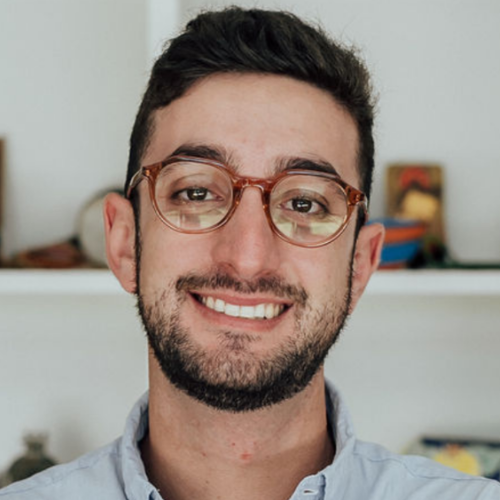
Sam Koslowski
Sam Koslowski is the co-founder of The Daily Aus, Australia’s leading social-first news organisation for young Australians. He holds a Bachelor of Laws/Bachelor of Communications (Journalism) from UNSW Sydney and worked as both a lawyer and journalist prior to co-founding TDA. Sam has been named in the Forbes 30 Under 30 list on two occasions, and co-authored a book on understanding the news with Penguin Random House. Sam is an Advisory Board Member at the Australian Human Rights Institute, and a member of the UNSW Media Degree Advisory Board.