
Psychedelia
I'd been in therapy for 30 years, but I felt like as I was getting older, I wanted to be more progressed, I wanted to be less angry, and I started to worry that some of those coping mechanisms weren't working.
Since early 2023, MDMA has been authorised for use in Australia to treat post-traumatic stress disorder.
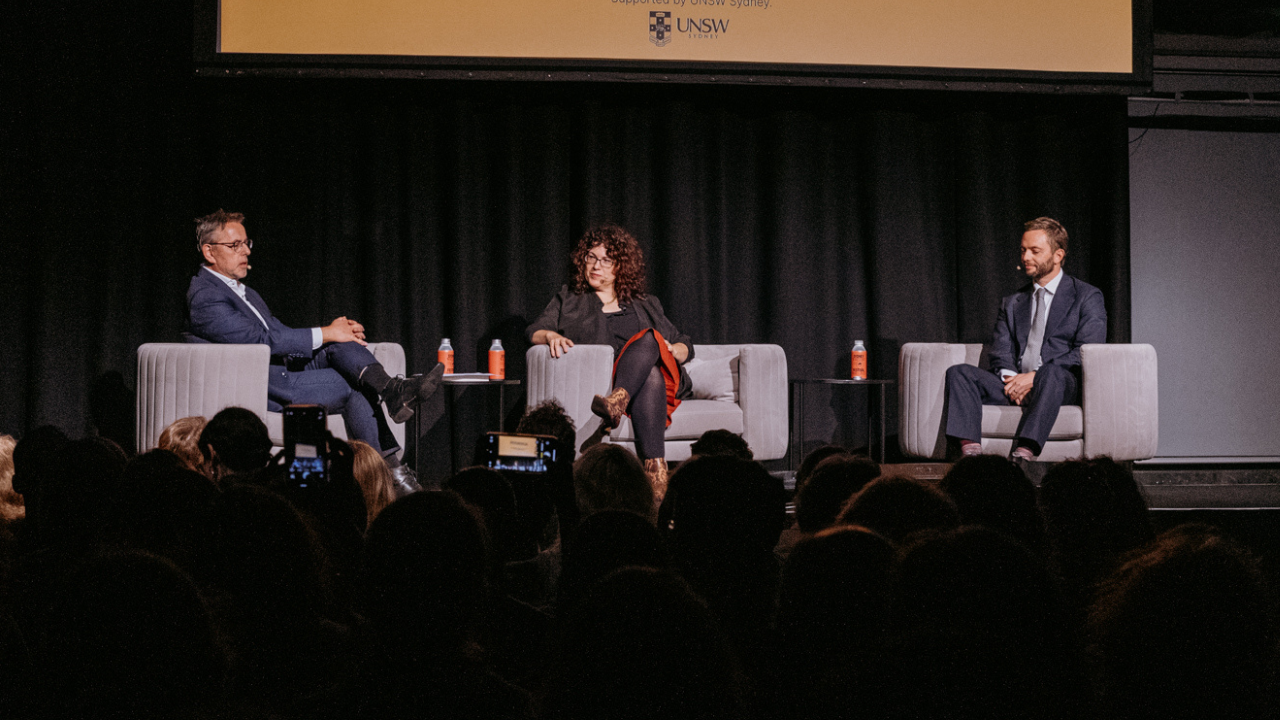
Still, it remains a controversial treatment publicly and among experts. Adam Bayes from the Black Dog Institute and researcher Rebecca Huntley, whose book Sassafras: A memoir of love, loss and MDMA Therapy recounts her experience of using MDMA to treat trauma, discuss the personal and medical cases for (and against) psychedelics.
Learn more about this contentious treatment and hear Adam and Rebecca’s perspectives, in conversation with Norman Swan.
This event was presented by the Sydney Writers' Festival and supported by UNSW Sydney.
Please be aware that this podcast discusses domestic abuse and trauma which may be distressing for some people. Resources and support can be found here.
Transcript
UNSW Centre for ideas: UNSW Centre for Ideas.
Norman Swan: Well, welcome trippers to this session called psychedelia. I take it. You all had your chocolates walking in. We haven't, so we're probably the straightest people in the room. This has enormous interest, this area.
I'd like to acknowledge the traditional owners of the land on which we meet, the Gadigal people of the Eora nation. I'd also like to pay respects to past elders, present elders, and possibly most important of all emerging elders. I'd also like to pay my respects to any Aboriginal Torres Strait Islander people here today.
Our guests are Dr Rebecca Huntley, who's a social researcher and author of this great book, really well written and very touching book, but an important book called Sassafras, and we'll come back to why it's called that in a moment, and Dr Adam Bayes, who's a research psychiatrist at the University of New South Wales and the Black Dog Institute with a special interest in treatment of resistant depression and the use of psychedelics, particularly psilocybin.
You'll hear more about that later, and also Elon Musk's favourite drug ketamine. And having somebody in his powerful position off his face is really something to consider. So thank you very much to you both.
Rebecca, in the book, you kind of get to a point where you realise I need to do something. And it was on the Camino trail.
Rebecca Huntley: Yeah, it was so I had been a hiker for a very long time, I think, as a way, amongst other things, to kind of manage this internal kind of churn.
Norman Swan: So this isn't a walk around Centennial Park, but you know…
Rebecca Huntley: It wasn’t but I do have to say I didn't rough it on the Camino. I'm very much kind of walk all day and glamp with Pinot Grigio in the evening.
Audience Laughter
Rebecca Huntley: So I don't want to make myself out to be tougher than I actually am. That being said, it was a lot of uphill, down dale. And normally, a walk like that, I'd feel quite kind of relaxed afterwards, but I was pretty, I was really, really churned up about a lot of stuff. So I started to, after that walk, worry that some of the things that had been…
Norman Swan: Before you go on. So you thought it was gonna be therapeutic?
Rebecca Huntley: Oh, absolutely. I thought it'd be fun- therapy, therapy with tapas. I thought it'd be all fun, but it wasn't.
Audience Laughter
Norman Swan: And why did you think you needed therapy? I mean, you were having therapy anyway, but which we'll come back to later. But what was the issue? Because you talk a lot about anger in the book.
Rebecca Huntley: Yeah, the issue was kind of constant rage, constant rage, like so many people, I think, with complex childhood trauma, who they're kind of struggling with that in many ways, you think there must be something terribly wrong with me if I'm this angry all the time and kind of barely keeping a lid on it.
Norman Swan: How does the anger express itself?
Rebecca Huntley: Often to a lot of inanimate objects were thrown against the wall. I mean, I'm lucky. I don't tend to direct that anger towards people. But occasionally that has happened in the past.
Norman Swan: Nobody's got in the way of you, in the wall.
Rebecca Huntley: Couple of ex boyfriends got it in my early 20s, I've got to say, but yeah, just constant anger like and so a lot of just churning and raging. And I would say that I developed some pretty reasonable coping mechanisms, and walking was one of them. Time in nature. I'd been in therapy for 30 years, but I felt like as I was getting older, I wanted to be more progressed, I wanted to be less angry, and I started to worry that some of those coping mechanisms weren't working.
Norman Swan: And it was on the Camino trail that crystallised.
Rebecca Huntley: I thought at the end of it, I thought, if I've walked across Spain and I'm still I haven't got the normal kind of sense of release that I normally would, then I started to get worried.
Norman Swan: Had you worked out where the anger came from?
Rebecca Huntley: I knew intellectually that I that it was to do with my childhood, but I thought that years of therapy and time should have made that anger less intense.
So what I thought was, why is it getting worse rather than better? And I just thought, I've put so much money and time into this, like so much, 30 years of work, 30 years of reading, I should be kind of more progressed.
So I started to question whether some of those techniques were working as well.
I knew I was pretty angry at my parents, but I also and other people, but mainly my parents, but one of them was dead. There's no point in really being angry with the dead person.
Norman Swan:This was your father,
Rebecca Huntley: Yeah, my dad, and the other one I who I don't my mother, who I don't really talk to, I don't talk to at all. I wanted to get to a position more of acceptance and compassion with her, but anger was in the way.
Norman Swan: And at that point, you were still talking to her. You were still in contact with her?
Rebecca Huntley: No in the Camino, I hadn't been in contact with her with 18 months. That's the longest time I'd be and I'm still not in contact with her. There’d been times previously where we weren't in contact, but this was the longest period of time.
Norman Swan: So to put it in context, you, your parents were from Adelaide. Your grandmother and grandfather were Italian,
Rebecca Huntley: Yes.
Norman Swan: And you kind of grew up with that sort of semi-Italian background. You had a nonna and nonno, but your father was opposite, an Anglican, very opposite
Rebecca Huntley: Yeah, absolutely.
Norman Swan: And an academic. He was a legal academic. So it sounds like a nice environment, but it wasn't.
Rebecca Huntley: Oh, look, it was a nice middle class environment from the outside. And this is not an uncommon thing from the outside, it would have seen affluent and the perfect family. You know, my mother was a high school teacher. My father was a very well esteemed academic. We lived in a lovely house once the doors closed, though it was very different behind the scenes.
Norman Swan: What's your earliest memory of a traumatic event with your family?
Rebecca Huntley: One of my earliest memories is running away at five, and I don't know what it was, but like to run away as a five- or six-year-old like pack a little bag and think I'm out of here. I think about it's just a real something has to be so bad for a five-year-old to think about running away.
Norman Swan: And you kind of assumed that most kids had a bag ready to run.
Rebecca Huntley: I in the book I talk about with my eldest daughter every six months when she was a kid, we'd always go through her room and we'd, you know, see what clothes we needed to be mended and what I'd always go under her bed and everything to get all the Lego and sandwiches that were half eaten.
And I remember, at about that age, at about five or six, I said to her, like, where's your running away bag with the money, and where's that?
And she's like, she looked at me, and I was like, you know, with the teddy bear and the books, and the money, where's the running away bag?
And I'm like, Oh, she's never running away bag. I was like, It's not normal to have a running away bag.
My earliest, really traumatic memory, which I forgot for a long time, but kind of re remembered when my father left, was I had a problem with eating as a child, so we'd eat a lot, and later on in life, would had bulimia and anorexia, for a while. I was pigging out at a Christmas event, and my father got very annoyed with me. I think my weight was shameful for him, because he was also very fragile. And then I kind of made a comment out of the room that I really hated him sometimes because he humiliated me in front of guests and everything by saying you shouldn't be eating any more food. And then he took me home, and he kind of shoved chocolate cake down my throat until I threw up. So that was probably my, one of my earliest memories.
Norman Swan: And your mother was kind of recessive in the background, almost in a nearby…
Rebecca Huntley: Yeah. I mean, I don't, and I look, and I don't want to be one of those people who kind of so analyses my parents. However, my mother came from a very violent background, and I kind of think she froze. She was in a freeze state. She was and she would just stand there and watch it happen.
She was pretty good at intervening when there was always a moment where I thought my father would lose control, so she'd find a way to get in and pull him away. And that was the cycle. And that cycle of kind of of tension, building tension building a violent episode that my mother would intervene, that was on a kind of, I would say, like a six to eight week cycle in our house. And there was a ritual where, afterwards, after everything had happened, I would have, you know, and I'd be, I'd often be washed down, or have a shower or whatever. And my mum would say, “You've got to understand, you're the parent. He's the child. Now I need you to go in and to apologise”.
And so that was and as I got older, I would sit there in the chair in their room for hours refusing to apologise. But I would apologise eventually. I shouldn't have left the towel…
Norman Swan: In a sense that you're apologising for something he did. Rather than…
Rebecca Huntley: I was apologising for leaving the wet towel on the ground, which was the reason why he threw me across the room. “I'll never wear that leave that wet towel on the ground ever again. I'm sorry. I shouldn't have done that”. I am a neat freak. As a result. I can't, I can't leave a wet tail on the ground, now.
Norman Swan: There's something I actually meant to ask you before we came on stage, but I'll actually ask you here, because you've written about it. You've written your story here. I've often wondered when you've written it there, and we're talking here in front of few 100 people. Yeah, am I re traumatising you by talking about this?
Rebecca Huntley: It's a good point. No, no. Weirdly, my biggest concern is for you, because I actually can't see you. My biggest concern is always that I'm making people feel like, “Oh, this is a bit much, and I want to walk away” so often feel a bit more anxious for other people. No, I don't think so. I don't think so. I don't feel that way. I don't think I would have written the book if I felt that I wasn't ready to tell the story, and I didn't think it was a socially useful story. No, but thank you for asking, No.
Norman Swan: So you've got this big, long word, methylene dioxy methamphetamine.
Rebecca Huntley: I know it's a bit mouthful.
Norman Swan: Isn't it easier to say ecstasy or MDMA? What? Kind of got you to thinking that's what I need, or just talk us through that.
Rebecca Huntley: Yeah, it was, it was, I stumbled into it, but I was lucky to stumble into it, to be treated by somebody who knew what they were doing.
So what happened at the end of the Camino trail, as I was was with some friends in Madrid, and kind of telling them how I was feeling, and one of them was a psychologist, and she said, I want you to go off and read about trauma. She suggested some books. And it really, I know it sounds weird, but it wasn't really until that, till she said that, and I thought, that's weird, I haven't had a traumatic childhood. I had a nice middle-class childhood. It can't possibly be trauma
Norman Swan: You hadn't translated into trauma.
Rebecca Huntley: I would never if somebody said you had a traumatic childhood, I would not have believed them. I would have dismissed it, but she was insistent. And so I went to read a whole lot of books. And within that context, some of the people who were writing about it were also saying that. So the Body Keeps the Score is a good example, but I read a lot of other things.
They talked about some very some clinical trials and some useful stuff that was happening, or some promising, we would say, but not yet entirely proven stuff around psychedelics, and that was intellectually interesting to me, but not practically interesting. I was just getting my head around the thinking about it and talking to my psychiatrist about it.
And then it was Christmas one year, and I was having lunch with a friend, and she asked me the question. She said to me, “how are you?” And I said, instead of kind of rattling off all the things that I was doing and pretending everything is okay, I said to her, “I've decided to never see my mother again”. And I thought she was going to say so I was really honest with her about how I was going. And I thought she was going to say, “That's a terrible thing”, and, you know, she was, but instead, she looked at me and she went, “how wonderful. I wish I could see my mother again as well”.
And then she told me, then she told me about the experience that she had had with MDMA. And we're very similar. We're not. I was surprised, because we're not. We're very similar kinds of people. So I was surprised that she was taking something, she was doing something that was so I kind of out of the box, and she suggested I should try it. And then I thought, well, what the hell? So I did.
Norman Swan: But it's not just trying it, because it's not going to a party and swallowing an e.
Rebecca Huntley: 100% is not that, yeah, very important.
Norman Swan: So it's quite structured,
Rebecca Huntley: Very, if it's being done well, very.
Norman Swan: So describe that structure, because you found this woman, Julia.
Rebecca Huntley: Yes.
Norman Swan: Was she recommended to you? How did that work?
Rebecca Huntley: She did, She'd worked with her. And so that was the reason why I thought it was useful to work with somebody who knew what they were doing.
Norman Swan: Was she a psychologist or just a lay person who'd got into it.
Rebecca Huntley: She's a lay person who's done it this work for a while.
Norman Swan: So, and at this point, MDMA is still illegal.
Rebecca Huntley: It is, it is. Then I'd hadn't, and you may not believe this, but I'd never had ecstasy before. I'd never had any interest in having ecstasy before. So I didn't know anything. I didn't have any reference point. No, I had to kind of join a secure server to email her, or kind of like, even contact her. She made me fill out a big form pages long about my history and a whole range of things and my everything to do with my life, very quite detailed, before she agreed to have a conversation with me.
And she said, “this is how this works. Is that we'll do a session, but we need to do some preparation before the session”. She asked if I was on any antidepressants. She wanted to know if I was seeing a psychiatrist. She wanted to know if I was in any other health issues, whether I was in safe accommodation, all of those things. So she was kind of testing to see...
Norman Swan: She didn't want to you to drop her your other therapist.
Rebecca Huntley: No, no, no. In fact, that was for her important that I had. Because the thing that was very important is that I had this integration afterwards, which would be some with her and some with my therapist.
And she said, we're going to try it once. But normally what would happen is there would be the maps protocol, which she has been trained in, is three sessions spaced out over a period of time, so that she can have these integration sessions and also physically recover. Because, as you know, your body's been flooded with all of these happy drugs. They've got to come from somewhere, and so you've got to build them up after a while, after they’ve all…
Norman Swan: How did Martha Stewart get involved in your first session?
Rebecca Huntley: Well, I mean, I'm Italian and an over caterer, so when she said that we were going to do the first session, it was going to be eight hours in my house, and I'd never met her before, I just said, “Oh my God, what are you going to eat? Like, what can I-” and she's like, “I'll be fine”. I said, “What about the food?” And she said, “You're not going to want to eat”. And I'm like, not about me. What do you want to eat? And she said, “It's fine. Let's just bring a sandwich”. I said, “no, no”.
And in the days before, the thing that I was most worried about is like, will there be enough food for her while I'm on the drugs and as hyper vigilance, obviously, and people pleasing all everywhere. And then I thought, in these normal occasions, I would look up what Martha Stewart says one is supposed to do, but she's not written a book about psychedelics and how to cater, but I'm sure she'd be quite good at it.
Norman Swan: So you take the. The pills, and you have, there are two doors involved, and she plays music, and you lie back, and yeah, she records what you're saying, and then, if it's anything at all, yeah, we haven't got time to go through everything. But what would be the, what would be the single thing you remember most out of that one, that first session?
Rebecca Huntley: The most important thing, and it connects with what has been my long running challenge with this anger is that after about an, I don't know when the drug was really strong, I looked into some would say, I looked into my body, and there was this, like endless grey whirling pit, almost like a, yeah, it was kind of like, kind of churning pit, of like grey sand, and it was bottomless, like you couldn't look through it. And I felt like the anger I had was like floorboards that I'd pulled up, and underneath it was just an immense pit of sadness for my parents and sadness for my family.
So underneath - the anger that I thought I was dealing with was a veneer for this deep sadness.
Norman Swan: Could you explain that sadness?
Rebecca Huntley: I'm, I've I genuinely feel, I genuinely feel sorry for my parents because to behave the way they did to their children and to each other. They must have been. I know that they were very unhappy people, and we are unhappy family, and I feel a lot of sadness about that. And then now you read therapy and you realise that anger is always connected with grief and sadness like they're always connected.
But for me, it was hugely important to know that anger was not my problem. Anger was just the - was covering up the sadness. And in some ways, sadness is easier to handle.
Norman Swan: So you got context,
Rebecca Huntley: Huge context. But what was, I think, significant is that that felt like it was inside me, in my body. It wasn't like something that I was looking at externally.
Norman Swan: So was it, did you feel better at the end of it?
Rebecca Huntley: So much better. So I cried just so much in this eight hours, but not kind of angry, sobbing, like I was crying. I thought, at one stage, because you're out of the drug I thought that I might have been sweating or wet myself or something. I was on the couch just thinking what has happened. But it was just like tears, tears, tears. And I'm never been much of a crier as a like before all of this, and now I'm I cry a bit more freely. So it was just this enormous release of sadness.
Norman Swan: And the integration afterwards was about explaining that,
Rebecca Huntley: Analysing it, understanding it, talking about it. And what was very interesting, I think, when it's done well, is, and, you know, one of the other problems that I was having is, before the Camino is I was turning up to therapy regularly and thinking, I'm wasting her time and my time, like, where we're having a good session, she was excellent, but I didn't feel I was progressing. And then as soon as the first session happened, I finally felt like I had so much more to talk to her about. And so it almost like it…
Norman Swan: Which is what they talk about with psychedelics, it kind of lifts the lid
Rebecca Huntley: Absolutely. And so instead of going, I don't want to do this anymore, I'm just going to take more of this. It was like, now I'm in a position to actually even do more of this stuff and to actually get more out of it.
Norman Swan: But the anger came back a bit.
Rebecca Huntley: Anger always like, it's not, this is the thing you're not. It's not a couple of drugs and it's one and done, but it's, it's, it's much better. And the real evidence of it is my children…
Norman Swan: You haven’t broken any mobile phones for a while.
Rebecca Huntley: No, it's my children have noticed. It's interesting. They have all in different ways, said that they've noticed that I just get less angry at inanimate objects than I used to before.
Norman Swan: And you had three sessions. You went up to Byron Bay for the second one, and she went, literally, went overseas, and you had the third one online.
Rebecca Huntley: Yeah how COVID. The third one was on Zoom.
Audience Laughter
Rebecca Huntley: Yeah, it was on Zoom. I got to be my pyjamas in my bed, which is really good.
Norman Swan: So what was the benefit of the second and third session? Just consolidation or different things happening.
Rebecca Huntley: Oh, very different things. Very different things. So the first session was so extra. I mean, the first session was extraordinary, and I felt such a release afterwards, and got really in touch with that sadness.
But I also had some almost like you, having these visions of and re-remembering in your body some things that have happened in the past, and I had some moments of pure moments with my mother, where she I was clear that she had that at least at that moment, she deeply loved me, and that was hugely important. I'd forgotten about those moments, particularly when I was sick, she could be very attentive. And to remind myself for what it feels to be loved is really important.
The second session was a lot to do with some of the loss I'd experienced. I'd had a still birth and a number of miscarriages and some real challenges getting pregnant the second time with the twins
Norman Swan: But your father didn't appear in these.
Rebecca Huntley: He didn't I kept thinking he was going to turn up like Kevin Bacon is in all of these movies in the 80s. You know what I mean, where you kind of watching movies like somebody is going to come in at any time, or Brian Dennehy, but he wasn't in it.
And I think maybe I'd spent a lot of my 20s being angry at my father.
Norman Swan: Had he died by this point?
Rebecca Huntley: Yeah, he had. And I spent a lot of my 20s and 30s being angry at my father, and it just became less and less as time went on. And also at the end of his life, he was very unwell. I don't know it's quite hard to be angry at somebody who's dying of Parkinson's, and I'd let go a lot of the anger with my father.
Norman Swan: And the third session on Zoom.
Rebecca Huntley: The third session on Zoom, something happened, like lots of things happened in that session, but the thing that was most remarkable about that session…
Norman Swan: Before you go on, were you a bit scared about doing the session while she's in Spain and you're here?
Rebecca Huntley: Well, what was interesting about that is she said, We can do it. We can wait till we come back, but I won't. I will only do it if you have somebody downstairs who is, I'm in contact with. So I was upstairs, and then I had two friends, one of whom has actually done psychedelics, done psilocybin for depression.
So they did the four hours either side, and she was in contact with them on Signal just to make sure that everything was fine. By then, I'd done it twice. I trusted her. I catered well for them as well, because I was very worried…
Audience Laughter
Rebecca Huntley: So they there was anyway. I knew you wouldn't ever do that for the first or second, but by the third I was pretty…
Norman Swan: And what happened in the third session?
Rebecca Huntley: So you mentioned that my grandparents were from Italy, so my family all came to this country before the First World War,
Norman Swan: And they were cane farmers.
Rebecca Huntley: They were cane fathers, Northern Queensland. In the Second World War. And some people would know this, we interned a lot of Italians, all men in my family, were gathered up one day from the farm and put in paddy waggons and taken to the South Australian desert. And were gone for years.
And in the middle of that, and I'd written a book about it, and I haven't looked at that book for a very long time, in the middle of that third session, I was my grandmother standing on the farm, watching her father being taken away, and feeling this enormous sense of being alone in Australia and being an enemy alien, and the uncertainty of that, of that you're you could be building a life, and then one day you could be taken away, you know, all the men could be taken away.
And for me, that was an extreme. It was a missing piece of the puzzle because of that deep sense of insecurity, anxiety that comes with migration and racism. There's a lot of racism against Italians.
My grandfather was interned for a long period of time, and came out a very angry man.
Norman Swan: Because they thought he was a spy. They found a camera.
Rebecca Huntley: They thought they were going to be a fifth column. Little did they know that Italians that came here before the First World War knew nothing about Mussolini. They just - anyway.
But my grandfather came out of internment very angry, and basically beat the shit out of my mother her whole life, unless she was sick. And she was sick a lot. And so that was very difficult for my mother, and then, as a result, she found it very difficult to be a parent.
So it's kind of interesting that it kind of came back to that. And really that's intergenerational trauma for you, but for me, I was my grandmother. I was my grandmother in that moment, standing on the… in the dirt in this cane farm in northern Queensland, watching the police go through the, you know, go through all this stuff, load her, her, all the men into a paddy waggon, and didn't see him for two years. So…
Norman Swan: And this, these are hallucinations. Essentially.
Rebecca Huntley: They are they. They are hallucinations that are informed by so there are either you're either remembering things that you kind of forgot, or remembering something in a different way.
So they do feel like, almost like a weird Fellini film in your head of your own experiences, and strung together over those three sessions with all the integration, it was a very, very clear story about, you know, why I am the way I am, why my parents were and and the main thing coming out of that was acceptance, compassion and something beyond anger, which is a mixture of love and grief, which allows you to get better.
Norman Swan: You talked about integration. How do you feel that you've integrated that now into your life? I mean, that's, in other words, you're there's a kind of behavioural it translates into a behavioural change or emotional?
Rebecca Huntley: Slowly, really slowly, but effectively. So for some people in the room know me, some people, unfortunately work for me in the room, I started to do things like being able to not work on a Sunday and be able to sit on the couch.
Norman Swan: And so you were just like your dad.
Rebecca Huntley: Exactly like him.
Norman Swan: Because when you explained that,
Rebecca Huntley: Yeah, total workaholic,
Norman Swan: Although sometimes he was actually having an affair rather than working.
Rebecca Huntley: Yeah yeah yeah.
Norman Swan: I’m not going to ask that questions, won’t go there.
Rebecca Huntley: Total workaholic. Clean-aholic, workaholic, and now I can go to do things like not work on a Sunday.
We've never been out or go. I'm just going to let that go, and maybe I'll look at it on Monday morning. I'm not yet ready to let a wet towel lie on the ground, but I'm working.
Norman Swan: That's a normal behaviour.
Rebecca Huntley: I'm working up to it.
Norman Swan: Yeah, so Adam talk to me about what's known about MDMA and how it works.
Adam Bayes: Sure, I just wanted to say that's just incredible to hear you talk talk about this and and the effects that the MDMA had, yeah, just so moving. Yeah. I mean, look, we we have limited time. But I guess in MDMA, it's not a new drug. It's been around, I think, since 1912 so it's quite an old drug, really.
Norman Swan: And like life of drugs invented for another reason, exactly, exactly,
Adam Bayes: And then it became sort of used therapeutically in the 70s and 80s, in the US, and as part of, say, part of marriage counselling, you know, to facilitate a couple that might not be doing so well, and they'd be given some MDMA and because it has this sort of makes you feel good.
Norman Swan: And veterans would go off to Mexico to deal with their PTSD having an MDMA session.
Adam Bayes: So there was some news. Then it kind of spread into the clubbing scene and this kind of thing. And then it was, and it was made, you know, Class A drug in the US, and then it was banned globally. And what I mean, what is it? It's, it, basically, it's, I know, this is called Psychedelia.
It's a sort of quasi psychedelic, if you like. It's, it's actually an amphetamine, but it's, different to say methamphetamine, and essentially, it floods your brain with serotonin, amongst other chemicals like noradrenaline and dopamine. Basically, it floods the brain with serotonin, which is a feel-good neurotransmitter, and then it has this effect on the amygdala, which is the sort of fear centre of the brain to really quieten that down.
Norman Swan: So this is where you when this is quite related to PTSD, is it processes memories into the brain, and if you've got emotion attached to it, those memories get more strongly laid down?
Adam Bayes: Yes
Norman Swan: and that's thought to be the process for PTSD,
Adam Bayes: exactly
Norman Swan: intrusive memories.
Adam Bayes: So there's fear associated with some memories that may have occurred and and that could be something like a veteran who, you know, witnesses their buddy getting blown up, or it could be more, you know, a series of different traumas, like childhood, sexual abuse, physical abuse, emotional abuse, which is more cumulative over time.
So basically, it quietens down the fear centre in the brain and allows patients to revisit some of these memories.
It doesn't change the memory, but they can revisit it without being so fearful and avoiding essentially, they've been avoiding these memories.
Norman Swan: So it's almost a phobia, where,
Adam Bayes: In a way,
Norman Swan: You keep that down. I don't want to go near a start of this memory. And…
Adam Bayes: So it comes out in other ways, you know, maybe with anger or whatever, because
Norman Swan: So in a sense, is it like exposure therapy? Where you would just slowly acclimatise to seeing a spider? In this way, you slowly acclimatise to addressing your fears.
Adam Bayes: Yeah, I think when combined with some some psychotherapy, it can do that, yeah. So it sort of allows for, it lays the groundwork for a therapist to help someone revisit some of these memories.
The other thing, that interesting chemical it causes to release, is oxytocin. So we know that oxytocin is this hormone. It's very important for mother-baby bonding, and oxytocin is released so it sort of can build that bond with the therapist as well as so people tend to sort of open up a bit more when they're under the effects of MDMA.
It's also called an empathogen, which means that people feel more empathy. And an entactogen, which means that they become touchy feely.
So if you go to, you know, the Mardi Gras, or if you go to a nightclub and people are on MDMA, that's what you see, right? People are, they're chatting, they're, you know, they're more tactile. So we can see those effects.
But I guess what I'm sort of interested in is harnessing those effects in a therapeutic, medical context, in combination with therapy. So it's quite different to say, a recreational use that doesn't have all that therapy wrapped around it.
Norman Swan: And I mean, that's the important message, isn't it Rebecca? Here is that we're and we'll come to psilocybin in a moment, but you're wrapping around with therapy so that when the memories come out, there's somebody there to help you lose fear, interpret make sense, move on. Or…
Rebecca Huntley: Exactly, yeah. Exactly,
Norman Swan: And the risk is, well, I mean, where do you know where Julia got these drugs?
Rebecca Huntley: No
Norman Swan: But she was sure it was pure MDMA. If I buy a party drug, anything could be in it.
Adam Bayes: Yeah, look, and that is the danger. I mean, I did read about someone that thought they were getting MDMA and ended up getting methamphetamine or ice.
Rebecca Huntley: Oh, wow,
Adam Bayes: Yeah, so that was and so they had a sort of horrible experience.
Norman Swan: So what are the there's this thing called the default mode in your brain, which kind of inhibits your brain, keeps things in check. Yeah, and they say that psychedelics, what psychedelics do is remove that default mode and allows creative ideas and other things to come to the to the surface. And unless you get that experience, you're not actually going to get a therapeutic effect. And we'll come to psilocybin I keep on saying in a minute, but some people say there's a risk in that is that.
Some people have they say, if you're artistic and creative, your default mode is actually much lighter, because that allows your creative their ideas bubble to the surface, and they're not as inhibited in creativity. Some people say that, then that if you're depressive, yeah, it's a safer drug than if you are creative, because you're more likely to get a psychotic episode. Is there any truth to that?
Adam Bayes: Look, there is some truth to it. I mean, I think for people that say, have you know, they have psychosis or schizophrenia, for example, adding in a substance like psilocybin, which is going to disrupt that, they have probably limited Default Mode Network, maybe a limited sense of self, say, if you add that in, then yes, there's the risk of tipping someone over into psychosis. So in all the studies that we do, if there's a personal or family history of psychosis or bipolar disorder, then those patients don't get in the trial for that reason.
Norman Swan: So psilocybin is a full-on psychedelic.
Adam Bayes: Yeah, it's a classical psychedelic, yeah? Like, is similar to LSD,
Norman Swan: Yeah, and you're using it in what's called treatment resistant depression.
Adam Bayes: Yes, yep.
Norman Swan: So what is treatment resistant depression?
Adam Bayes: So essentially, it's depression that has failed to respond to standard therapies. So usually, you know, we can classify it as a minimum of two antidepressants, but there's a full range of treatment resistant depression. So it can range from that more low end right up to patients that are needing, you know, many drugs or ECT, electroconvulsive therapy. And so we're looking at that population that, yeah, aren't responding to standard treatments to see if psilocybin assisted therapy can be beneficial.
Norman Swan: And so that and just describe the process, because it's quite similar to the MDMA.
Adam Bayes: It's very similar, actually. So it's essentially, and I think this whole field of psychedelic assisted therapies, you know, it really goes back to the 70s, where this model was kind of developed, which is interesting the 60s and 70s, which was to have some preparation, essentially in a trial, we would screen out patients, right, if there was a risk of psychosis and whatnot, and then we do some preparation sessions where we make patients feel comfortable. We know that psychedelics act as amplifiers. So really, preparing the mind is so important, because what's what's inside is going to be amplified, and also the setting as well, so that the setting needs to be comfortable patient,
Norman Swan: Timothy Leary would say the set and setting
Adam Bayes: Exactly. So we still, we still use those principles. Then there's the actual dosing sessions themselves, and mostly that is just keeping the patient sort of safe, really, and I mean that both physically and mentally safe.
What's interesting is the model, we usually use two therapists rather than just one therapist. So the standard model is there's two therapists in the room for the one patient.
Norman Swan: Why?
Adam Bayes: So again, that goes back to there's a few reasons. One, it's pretty intense. Basically, you've got to be in the room, like at the trial at St Vincent's, we’re there all day, and we can't really leave the room. So if there's two others…
Norman Swan: So you’re not describing mass therapy here, this is expensive at the moment
Adam Bayes: yeah, at the moment, it's very single patient. Also for boundary violations. And unfortunately, we know in psychiatry and psychology there's a history of therapists being inappropriate with their patients, unfortunately. So if you've got two therapists in the room, it's going to reduce the chances of that, and particularly because not only is the patient potentially vulnerable, but they're even more vulnerable because they're under the effects of, you know, whatever psychedelic it might be.
Norman Swan: And my understanding is that you're not, you don't, despite all the chat about micro dosing,
Adam Bayes: yeah
Norman Swan: You don't really get an effect unless you have a true psychedelic experience. You got an out of body kind of, I think
Adam Bayes: the jury's out on that. I think the jury's out on that. I mean, the trial at St Vincent's we're doing, we're using large doses, so macro doses. I'm also part of a trial at Macquarie University with Vince Polito, and we're looking at a, it's a randomised, controlled trial of micro dose psilocybin versus placebo in mild to moderate depression, because there's, at the moment, there's actually no, there's no trial evidence for micro dosing. A lot of people are doing it, but there's actually no evidence for it. So we're trying to see, does it actually do anything for depression? But yeah, so it's basically either going for looking at micro dosing or the the macro dosing.
Norman Swan: And you've also working with Elon Musk's favourite drug.
Adam Bayes: He's not my patient, though
Norman Swan: He's nobody's patient. America is his patient, unfortunately.
Audience Laughter
Norman Swan: And when I talk to psychiatrists about ketamine, they say they talk in two modes. One is, they've never seen anything so amazing. Somebody with deep depression?
Adam Bayes: Yeah,
Norman Swan: A couple of hours later, they've been trying for years to get them and they're better, yes, but they've also seen a drug that's not. They've never seen a drug that terrifies them so much because that evening, they could be suicidal. How much are we learning about how to use ketamine?
Adam Bayes: Yeah, I'm glad you brought up ketamine. Look, it is a I think both of those things are correct. I think it's a really incredible drug. It's been a real game changer. Because really, there hadn't been any major developments in psychiatry, you know, in terms of drug development for years. I mean, there was sort of tweaking any standard antidepressants. But ketamine works in a completely different way. It can be rapid onset, which is just incredible to see someone they've been depressed, they're depressed, and, you know, the next day, or even that afternoon, they can say, I don't feel depression anymore. And these can be patients that have had ECT, or failed ECT, so really unwell,
Norman Swan: But it's not set and forget.
Adam Bayes: It's not set and forget. It's a tricky medication. I think it takes a lot of skill to use. And Colleen Lou and I really, we run these training courses educating psychiatrists about how to use it. Because some people think, “oh, you know, it's pretty straightforward. How can it be that hard?”, but it's really you can get someone well within 24 hours, but then they can actually crash out of that and be quite suicidal and back to square 1, 48 hours later. So requires a lot of finesse, a lot of experience and and really screening patients so you're treating the right cohort of patients.
Norman Swan: So I just wanted to have some, as you would expect, in this room, some really intelligent questions.
Rebecca, were you scared to do the first session? Were you scared?
Rebecca Huntley: I wish I had been more scared. I was a little bit blase in that I… if you told me that I was going to have this experience, I might have been more scared. I'd done some I'd researched some of the clinical trials. I was looking at some of the academic articles as well as I kind of Googled what happens when you take MDMA, because I'd never had it before, and I remember thinking, that sounds like perimenopause to me, with a bit of without, wanting to eat any food. So it's like, I don't think that's the problem. My biggest concern that I was..
Norman Swan: You thought you were having a menopausal sweat when you woke up.
Rebecca Huntley: I think my biggest concern was that I was going to embarrass myself with this person that I didn't know very well, but she was very, very professional throughout the whole process. So no, I wasn't. But knowing what, knowing what I've been through, and thinking about all three of them, where I do get anxious is when people have come to me at book signings and said, “Oh, we've got some ecstasy, and we're gonna, we're all gonna go to the into the forest and deal with our trauma”. And I'm like, please don't do that. That's not what the that is the anxious. That's the anxiety I have.
Norman Swan: Another question, which I think you've kind of answered, but the extent to which the memories are real. They're not really real, but they're they're almost poetic and metaphorical,
Rebecca Huntley: Exactly. I mean, some of the some of the memories were real in both the first and the second sessions. One of the memories that kept coming back to me, which is a very clear one, was when I'd had my twins, and they gave me the first one, the second one had to go, Sadie, had to go into NICU. But I remember that before I did the set, before I did MDMA, I remember that moment of one of pure happiness and relief, but the MDMA made me remember that one of absence of terror.
They remembered it very differently in the MDMA, which was basically, I'd had such trouble getting pregnant again. I had a miscarriage, two miscarriages, and a really bad still birth. And it was, it was almost like my body was saying, you remember this is a happy moment, but what you've forgotten is the four years where you were so unhappy and. And it's all in there. So it was almost like the MDMA made me remember that memory differently through the body.
Norman Swan: Was there, was there a come down afterwards?
Rebecca Huntley: The first session, I woke up. So when you were talking about ketamine and saying that sometimes somebody can be immediately better, but then can crash after the first session, I woke up without any of the the churning was gone. It was like this complete stillness in my body. And I remember thinking, this is the first time I've ever felt this so churning,
Norman Swan: Meaning anxiety?
Rebecca Huntley: Just this constant anger, you know, the anger and that, like this thing inside me, like constantly, and for the first time, I didn't have it, and I woke up, and I thought, maybe this is what it's like to be addicted to a drug. If somebody could give me this I'd felt like I woke up in a different body.
After a couple of days, some of that stuff came back, but I'll never forget that feeling of what it was like to wake up and whatever it was, a lot of, some of that grief, sadness had been released. Very, very, very low after the second session, like, really, very low. And this is why integration is so important. If I hadn't had support friends and after the third one, a sense of a real sense of clarity about what it all meant.
Norman Swan: What would it take is another question, to get psychedelics into the mainstream?
Adam Bayes: Look, in my view, it is through research, clinical studies, if we're talking about medical
Norman Swan: use. I mean, it's never going to be mainstream with us, two therapists, 8 hours hours.
Adam Bayes: No, okay. I mean, look, I think at the moment, that's the model. I mean, I think there's a possibility, and I could imagine it would be interesting to test whether some of that could be done, like group integration, for example. And we know, you know, group psychotherapy can work well. So whether there's the potential to have aspects of it done in a group way, that that might be one way, but I think we need more trials in different disorders.
I mean, we've spoken about trauma, PTSD and treatment resistant depression. Of course, there's great interest with anxiety disorders, eating disorders, substance use disorders, actually, and alcohol abuse. So there's a huge amount. It's quite an exciting time, really. But I do think we need to be guided by the science so that, you know, there aren't sort of adverse events that could occur, and then, you know, things could go backwards. I think that would be a real shame.
Norman Swan: There’s a question there about, how do you proceed quickly to a psychedelics?
Adam Bayes: Yeah,I don't think we should cut corners, but I understand people with lived experience. There's a huge need for, you know, not all the treatments are working. So I think we, you know, there needs to be investment in research. And, you know, Australia, we have a real opportunity here to contribute to, you know, what's happening globally.
Rebecca Huntley: I do have a question the two people who sit, do they both have to be psychiatrists at the moment?
Adam Bayes: No, they don't.
Rebecca Huntley: So it could be a trained nurse or
Adam Bayes: In fact, neither of them have to be. It depends on the depends on if it's in a research context or not. But in the research context, not necessarily, there could be psychologists, social worker in the room, but with oversight from a psychiatrist.
Norman Swan: Yeah, but some treating and psychotherapy,
Adam Bayes: Yeah, I do yeah. And then it still has to be sort of overseen by a by a psychiatrist.
Norman Swan: One of the key moments in your book is the decision to stop seeing your mother. You talk about it as not having contact with her. So for some people in this room, it's entirely understandable. For some people in this room who are mothers.
Rebecca Huntley: Yeah
Norman Swan: It's heart wrenching.
Rebecca Huntley: Yeah
Norman Swan: For you as a mother with your children, just reflect on that for a moment, because it's a very challenging thought.
Rebecca Huntley: It's a huge it's a challenging thought. But one of the other things I would say about that is that - And I won't spoil the book if you want to read it - I got to a point of just such desperation and hurt with my mother that I said to her, well, she wouldn't talk to me, she wouldn't pick up the phone. And I emailed her, and I said, “If you think I'm such a terrible person, maybe we shouldn't see each other anymore,” and I just never heard from her again. So, I mean, I did say perhaps we shouldn't see each other anymore, and she accepted that. So I actually think it is very difficult for what I'm trying to say, Norman, is it wasn't just my decision.
I think if one, if my, one of my children, said to me, “I don't think we should see each other anymore”. I'd be like, I really want to understand why, and I'm going to do whatever I can so that we can continue to see each other. And what could I do?
Norman Swan: And that's not what happened to you.
Rebecca Huntley: No. And I think the other thing, it's hard to recognise, and I think this is one of the many reasons why I think. It's wonderful that we are in a society where you get to choose to be parents or not, in many ways. My mother didn't grow up like that. She grew up as a working class Italian girl in the 40s, and there was one thing she was required to be, a wife and a mother. I don't think anybody ever asked her whether that was something she wanted to be. I don't think she ever had the freedom to choose. There's a big difference between somebody who says, “I'm desperate to be a parent and I really want to be a parent, and it's one of the most important things to me”, and I'm glad I grow up in a society largely, where that's an option.
Norman Swan: Ladies and gentlemen, can you please thank Rebecca and Adam.
UNSW Centre for Ideas: Thanks for listening. This event was presented by the Sydney Writers Festival and supported by UNSW Sydney. For more information, visit UNSW Centre for ideas.com and don't forget to subscribe wherever you get your podcasts.
-
1/4
-
2/4
-
3/4
-
4/4

Adam Bayes
Dr Adam Bayes is a clinical academic psychiatrist with a special interest in mood disorders (depressive and bipolar conditions) including their diagnosis, classification and treatment – with the latter focusing on interventional psychiatry (e.g. rapidly acting antidepressants) and novel neurostimulation (transcranial magnetic stimulation; TMS). Adam works at the interface of research and clinical application, and has an interest in developing models of care most recently establishing the BDI Ketamine Treatment Program which arose out of a clinical trial. In addition to spending half of his time managing patients as a psychiatrist, he is actively engaged in teaching and mentoring medical students, psychiatry registrars, higher degree researchers as well as contributing to treatment guidelines and conducting workshops for psychiatrists and GPs. Adam currently works at UNSW Sydney.
Norman Swan
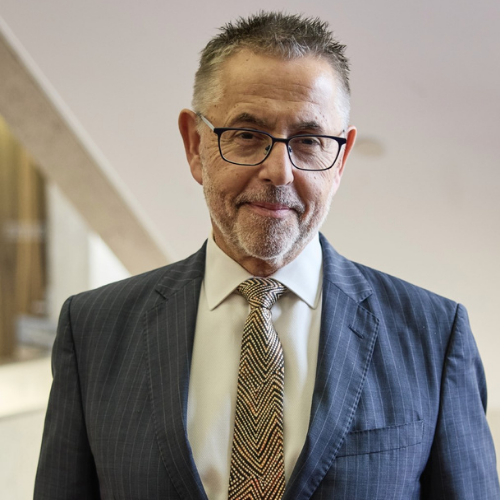
Dr Norman Swan is a physician and journalist who co-hosts the ABC's Health Report and What's That Rash. He also reports for 7.30 and has won multiple awards including the most prestigious in Australian journalism – the Gold Walkley. He has three best selling books: So You Think You Know What's Good For You, So You Want To Live Younger Longer and, the latest, So You Want to Know What's Good For Your Kids, which covers the critical years between birth and age ten. In 2023, Norman was awarded an Order of Australia in the 2023 Australia Day Honours.