
Pankaj Mishra: Global Conflicts, Competing Narratives
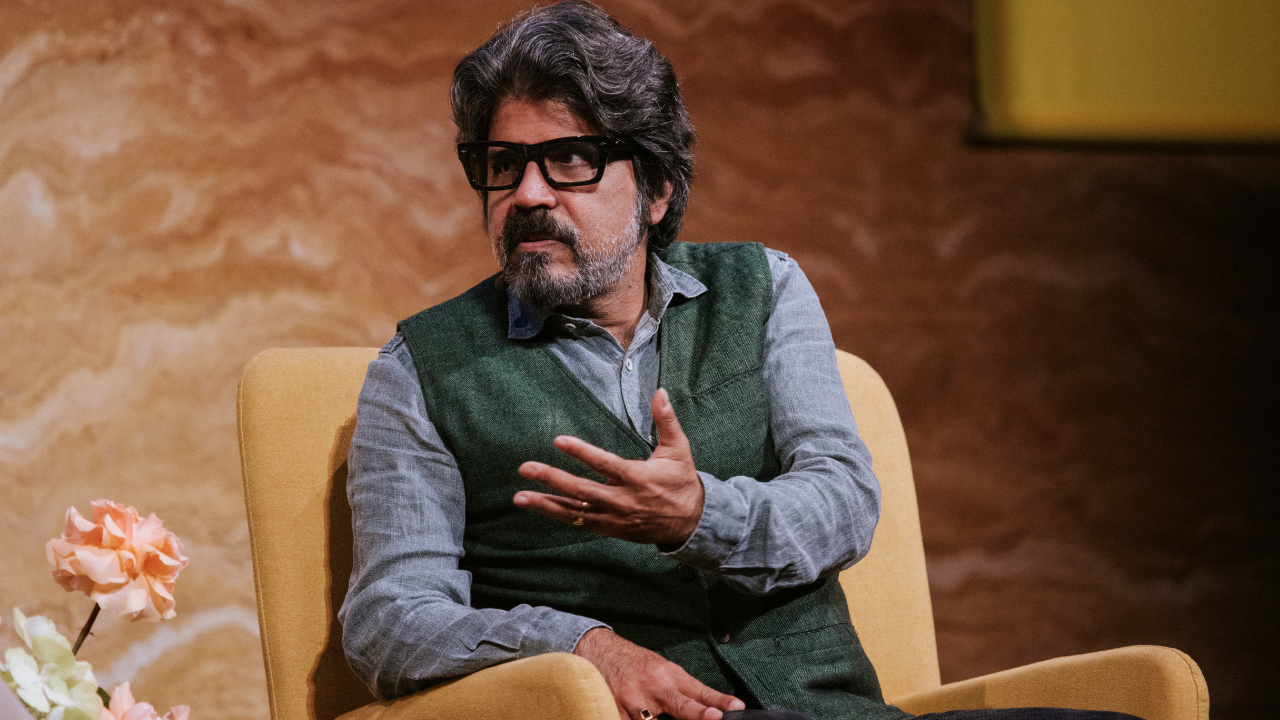
People who offer me some hope are young people... people who are still students, people who are still able to see that there is something terribly wrong about war, about violence. That kind of fresh vision, which is a kind of spontaneous ethical recognition, is what gives me hope today.
Pankaj Mishra | Simon Longstaff
In a timely and thought-provoking discussion, essayist and author of the recently released The World After Gaza, Pankaj Mishra, reflects on the ongoing war in Gaza, examining how competing narratives of colonialism, national identity and justice collide with tragic consequences for all.
In a conversation with philosopher and Executive Director of The Ethics Centre Simon Longstaff, Mishra delves into the historical, political and ethical forces shaping our world, the waning influence of the Global North and the role of journalism in actively constructing and distorting reality.
Transcript
Simon Longstaff: Well, good evening everybody. My name is Simon Longstaff. I'm here in a number of different roles. I suppose the first one to mention is that I'm an Adjunct Professor here at the University of New South Wales. I'm also the Executive Director of the Ethics Centre. And some of you may have come across me in my other role as one of the co-founders of the Festival of Dangerous Ideas, all of which makes me delighted to be here joining with Pankaj in this really interesting gathering today.
Before we go on, I'd like to acknowledge the Bidjigal people, part of the Eora Nation. They have been stewards for the things seen and unseen from the land, the sea and the air, for many millennia, holding it in trust for all of us who come to this country. If you drink of its waters, eat the food, walk across this land, it's here for you and to keep you safe. The Elders, past and present, who I acknowledge have been holding that in trust for all of us today and will do so into the future. I'd also like to acknowledge any Aboriginal or Torres Strait Islander people who happen to be here with us today.
Now, there are some accounts of this world that take account of its tragedy, its triumphs, its conflicts and their resolution, which present a really simple picture, which is a world of black and white, and where certain groups are all good, and certain groups are all bad, and that is not this book. That's not what's happening in this book as we talk about it.
As I went through it, I was struck by the generosity and even handedness of Pankaj Mishra's addressing a series of fundamental issues to do not with any particular group, any particular conflict, any particular place or time, but instead to do with the human condition, and a perilous set of circumstances that can engulf any of us.
This book doesn't have its heroes and its villains according to the colour of one's skin or one's culture or religion or place or time. It confronts all of us with some really fundamental questions, which we're going to dig in as we go through. And I'll frame the particular question which Pankaj is posing to us from his own book in a moment. Before I do that, I should tell you a bit about him.
So, Pankaj is a writer and an essayist. He's actually quite prolific. He's been involved in contributing to public debates now going back over decades. He has written two novels, I think it is, as well as these other works in non-fiction. Some of them have become really controversial. Some of them, like this book, I think it's really easy to misunderstand, to misread and even to misrepresent. And I think there are some people who probably have a vested interest in doing that with a book like this given the topic it deals with. But he's had his moments of controversy with all sorts of people over the time.
I won't go through all of the works that he's published, because the one that we're here to focus on today is The World After Gaza. So, before we do anything else, can you join me in welcoming Pankaj Mishra.
Audience Applause
Simon Longstaff: He writes beautiful prose. So, if you enjoy lovely prose, you should read this. Not just for the ideas, it's actually really well written. But there's a particular point, as you can probably see here, I've got lots of thumb marks and dog ears. There's so many points where I stopped. I thought, wow, what do I think about this?
But here is what I think is the nub of the question. And I'm going to use his own words. “Is it possible to rescue visions of justice and solidarity from zero-sum contests for recognition and identity, and the strange quests for guiltlessness? In the face of Gaza, we ought to do more than register anger, grief, disgust or guilt. Neither veneration of the victims nor loathing of the perpetrators will help us see a way out of a global impasse.” Here it is. “Is it possible to imagine moral and political action in the present that is liberated from Manichean historical narratives?” That's the nub of it.
Pankaj, you take us through the book in a way which touches on so many different conflicts in history and you see the possibility of good and bad, whichever side you look at. No one comes out the hero, the undoubted villain in this. But you do focus in the beginning of the book on telling what is an incredibly sympathetic, I felt, story about the plight particularly of the Jewish people throughout history. I was struck by a young bloke growing up in India with a picture of Moshe Dayan on your bedroom wall and then other things. What was it about that experience that struck you as a young Indian boy growing up that was so significant?
Pankaj Mishra: First of all, thank you Simon for a very generous account of my book and a very fair one too, I should say, because this subject invites controversy, it invites a very kind of polarised perception and accusations of prejudice, of bias, of even just the worst accusation you can level at anyone which is, of antisemitism.
And I think if you read the book, you will recognise very, very early on, in it, that my relationship which I describe with this particular episode of modern history, which is the suffering inflicted on the European Jewish population in the first half of the 20th century and then even afterwards, after the creation of the state of Israel, that relationship that I describe is a very complicated relationship and something, I dare say, has not been written about.
Because here I was growing up in India in a family of upper caste Brahmin Hindu nationalists, and they all felt, and this is something I imbibed from them, they all felt a great affinity for the state of Israel, because they thought Israel had done or succeeded in doing something that Indians had conspicuously failed to do, which is to create a very strong nation-state, inculcate a very strong sense of nationality in its citizens, and that we needed to learn these lessons from Israel.
At that point, I was not actually aware of this history that had led to the creation of the state of Israel. We were extremely poorly informed about European history in general. Of the Holocaust, I don't recall knowing anything about it at that age and mind you, I'm eight or nine years old at this point, and a picture of Moshe Dayan, the Israeli general, appears in the Indian newspaper. He made a secret visit to India in ‘77 or ‘78, and then the news of the secret visit leaked and so there was a picture of him in the newspaper, and I cut it out and put it on my wall. A very charismatic figure obviously. There was a little cult of him back then in the 1970s, I now realise in many other countries too.
Then, of course, I went to college, came into contact with Palestinian students. There were many Palestinian students in India in the 1980s, people who had come from places like Jordan, Syria. They were obviously people from Palestine who had been displaced, who had been dispossessed, and were now living as refugees in these neighbouring Arab countries, some of them from Iraq as well. They started to tell me a different kind of story altogether than the one I had known about their dispossession, about the creation of the state of Israel which involved ethnic cleansing and dispossession, and this permanent statelessness that all of them were now condemned to.
So, I think I kind of date my interest in this subject to my earliest years and then of course through reading, through personal encounters, I came to, I started to learn more about it. I developed an interest in European history, so obviously the two world wars, the two civil wars as I prefer to call them of Europe, in which Australia also participated. And then of course the Holocaust.
Those episodes seemed to me to in a way encapsulate the modern experience, or the experience of the modern world, more resonantly than anything. So, I became obsessed with that subject at some stage. I think in my mid-20s or so I read as much as I could about German history and books about the Holocaust, and the books about the Holocaust, if you remember, had really started to kind of arrive in very large numbers, in large quantities from the mid-90s onwards, which roughly coincided with my own interest in the subject.
And then of course I went to Israel and the occupied territories, and that was a different experience altogether. And that experience really was quite a traumatic one, because I still harboured a great deal of sympathy, and I still do, for the state of Israel, a state that was really formed out of a pressing moral necessity.
You had almost the entire population of European Jews destroyed in those five, six years and then of course there were survivors, there were refugees, which most countries did not want to accept, even the people who had won the second world war.
Simon Longstaff: Well, they turned them away, yeah.
Pankaj Mishra: Were turning them away, we're raising the barriers even higher. And it's an extraordinarily shoddy episode and it's, you know, when you actually read specialised scholarship about it, you're shocked, you're really shocked by the levels of anti-Semitism that existed at the highest levels of the US government, the British government, the Australian government, the Canadian government. You know, this is an extraordinary statistic in the book about how the city of Shanghai alone accepted more Jewish refugees than all the, you know, commonwealth countries combined.
So that was, you know, in a way, if you know that history, which I did, it's impossible not to think of the state of Israel as, you know, perhaps based on a deeper moral need than just about any modern nation-state.
But when I went there in 2008, I realised to my great shock that Israel had become yet another nation-state like my own, which was now invested in an idea of majoritarianism, in an idea of ethnic religious supremacism, and its leaders were increasingly corrupt and, most importantly and egregiously, it was occupying, it was an occupation of Palestinian land, and was governing a Palestinian population in the most oppressive ways imaginable.
And this came as a particular shock to me because of all that I knew about the background to the formation of the state of Israel. And so I wasn't, you know, like those people who show up there, and knowing very little about the history and then come away shocked and outraged by what they see and become sort of doctrinaire anti-Zionist.
I think mine was probably, well certainly it was a deeper shock, but also a melancholy realisation that Israel shares this fate, with my own nation-state, and with other nation-states in Asia and Africa, which also emerged out of a great moral necessity, maybe not as extreme or urgent as that of Israel, but nevertheless, you know, we fought our battles against European imperialists. We could claim, a very high virtue for ourselves because we were engaged in these battles against a cruel, racist, inept and corrupt imperialism. And some of our best people, some of the best, you know, leaders, activists, thinkers, artists, were involved in these struggles against the British Empire.
And so all that gave us a great sense of pride, but then over the decades that pride dissipated, and we also became, by we I mean, you know, people who belong to the ruling class, in places like India, we also became corrupt. Sometimes even more corrupt and violent than the people we had displaced, the Europeans.
Simon Longstaff: So thank you for introducing that latter part too, because I think that goes to the point that there's a thread I'd like to come back to a little bit later about this almost like an endless wheel turning, in which a group, any group, may have been under the thumb of another. They shake off the oppressor, and then the cycle, they become the thing that they opposed in some senses.
You don't, I think, say that that was an inevitable or unipolar direction in the story. You tell, for example, when you talk about the particular account, and I think it's worth just dwelling on this, because you say the moral necessity around the state creation of the state of Israel is so compelling and perhaps unique, that the forces that could have led to it becoming something else are equally having to be of the same match size and potency.
You start to look, though, at the people in Israel when this started to happen, where people started, because you talk about these narratives now being captured. Somebody begins, or some groups start to say, I will take this narrative of what occurred, through the first part of this, not just the 20th century, go back a thousand years, and we will make that now serviceable to a political objective. And others say, no, we don't want to go down that way.
Can you talk a bit about the different voices? One for, let's harness the narrative of the Shoah for a political end, which gives us a nationalism. And another said, no, don't, we shouldn't touch it. That's not what that was about.
Pankaj Mishra: You know, I think the people who lived through the Shoah, and the people I actually write about in the book, really struggled with that experience in that they tried to draw meaning out of it. They tried to see whether there was some broader lesson to be drawn from it. And they failed. They failed, because no matter how hard they tried, they realised that this was such a monstrous act of evil, of political evil, that it was not something that could be reduced to murderous prejudice, or murderous anti-Semitism. It was something that really existed in our social and political arrangement. It was something latent in it.
And of course, you know, people who not literally survivors, but who escaped the Holocaust, people like Hannah Arendt, when they looked at the Holocaust in a larger historical perspective, they traced it back. They started to trace it back to practices of European colonialists and imperialists in different parts of Asia and Africa. They started to see, to notice a certain kind of systematic violence in the making of the modern world, of which the Holocaust they saw, they identified as a kind of monstrous culmination.
Likewise, I think people like Primo Levi, who survived the Holocaust and then wrote about it for three decades afterwards, they did not possess this longer historical perspective, but they were still trying to grapple with it. The last thing that was on their minds was the story of the Holocaust becoming a kind of self-legitimising narrative for demagogues, which is what it became in the state of Israel.
Simon Longstaff: When did that happen?
Pankaj Mishra: That's, I mean, I think that's an interesting story. You know, we tend to think, I used to think that the Israeli narrative of the Holocaust, which is that, you know, this terrible thing happened to the Jewish population, and now we will never let this happen again. And our entire state is really constructed around this idea of, you know, giving us permanent, eternal security.
That narrative really started to develop very late in Israeli history. So, around the mid-60s or so, after the trial of Adolf Eichmann. When politicians realised that the Israeli population was too diverse, you know, most of the population consisted of people from Arab countries. These were not Europeans. They had no memory. They had no experience of the Holocaust. But it was important to bind them into a new national narrative. All nations need a story about themselves, a story in which people can find themselves, can locate themselves.
So, people were told, look, the Holocaust happened. It could happen again. The people around you, the Arabs around you, these countries, these are potential Nazis. That was a rhetoric that started to entrench itself in political life, used over and over again. And that if we don't do this, if we don't do that, we are going to be overwhelmed and there'll be another Holocaust. And so, at some stage, post-67, the Holocaust became a justification for Israeli expansionism.
Simon Longstaff: So, you think it was a conscious political strategy to do this?
Pankaj Mishra: It was a very deliberate cultivation of a certain memory of the Holocaust. You see, I think individual memories are spontaneous. They arise out of, you know, a certain experience, certain trauma, and then they work themselves through an individual's life.
Those memories are passed on sometimes to their children or grandchildren. Collective memory is always something constructed very deliberately.
Simon Longstaff: Now, Primo Levi, you mentioned him. He's almost, in a sense, a kind of a hero in this. He's always come through time and time again. Can you tell us a bit about, a little bit more about who he was, and then what he was saying in response to this? Because I know he had a pretty tough time, I think, when he, for example, went to the United States and found this narrative being the dominant one that was being propagated, I think not just amongst the Jewish community there, but more generally.
So where had he come from? And you mentioned some of his experience. What does he say about this when he encounters it?
Pankaj Mishra: You know, Primo Levi, Italian Jew who was really, in a way, completely unprepared for this climate of anti-Semitism that arrived in Italy. And remember, Italy didn't have a kind of very strong local tradition of anti-Semitism. It was something almost sort of imported by Mussolini and all kinds of repressive laws were passed against the Jewish population of Italy.
And then, you know, suddenly at some stage, Primo Levi, along with many other Italian Jews, was deported to Auschwitz, which he survived. And he tells that story in those two amazing, amazing books of his, you know, release from Auschwitz, then his extraordinary journey through Russia, really a very tangential route that he took to get back to Italy. And he wrote about this experience. Nobody wanted to listen to those stories. That's also quite extraordinary fact about the Holocaust narrative, is that people really didn't pay much attention in the 50s and 60s. So Primo Levi's book was turned down by a major Italian publisher. It was published by a small press. It was really discovered several years later. And then he came into circulation. But even in America, he was not really known until the 1980s.
So, he worked, you know, he was trained as a chemist. He worked in Turin for a long time and, you know, kept reflecting on this experience, kept going back to it in his writings. Towards the end of his life, he went to America in the mid-1980s. By that stage, he had started to come into contact with people who had, in a way, been responsible for creating and entrenching and institutionalising a memory of the Shoah, such as Elie Wiesel, probably the most famous survivor of the Holocaust in the United States, probably, I would dare say, the world.
And when Primo Levi met him, he was very disconcerted to see a kind of culture of celebrity that had grown around Elie Wiesel, because he had started to think about the Shoah in a very different way altogether. I mean, obviously, Primo Levi was deeply attached to the State of Israel. He felt a great sort of emotional identification with it, even though he was never a Zionist, but he could see why Israel was necessary. But he had also become a critic of Israel once he realised that the country was increasingly run by demagogues and people that, you know, who were expansionists, who were also incredibly bellicose and interested in expanding Israeli territory and trampling on Palestinian rights. And he was very exercised about that.
And then when in America, he encountered this new sort of culture of Holocaust memory consumption, he became even more disturbed by this. And he was attacked. He was actually attacked by an American critic, a young American critic, and basically told that he's not Jewish enough to really be talking about these things. It was an extraordinarily presumptuous thing to say about someone like him. And he, you know, he wrote to someone shortly before he killed himself how this attack, among other things, extinguished his will to live.
So, an extraordinary figure in, you know, I've emphasised the autobiographical elements in the narrative that I've just offered to you. But I think what's most striking is the way he refined his thoughts, refined his experience, his reflections on this experience of surviving the Holocaust, on the meaning of the Holocaust. And towards the end of his life, a remarkable book that he published called The Drowned and the Saved, where he moved away from, you know, simple ideas of guilt and innocence and started to speak about complicity, the ways in which victims, many victims, had become complicit in these monstrous acts of violence.
Simon Longstaff: And he's talking about, in that case, I think, about some of the people in the camps like Auschwitz, where he doesn't condemn them. He sees them struggling for survival, but having to make that choice, but becoming part of the very thing which is killing the others who are held within there. And he doesn't condemn, does he? He tries to understand but points out for what it is that this can happen. I can understand why he might be here.
I get a sense, and this is presumptuous of me to claim a sense about you, but that you are fundamentally what might be called a humanist, or your concern is for humanity in general. And that you see particularly this idea about the fundamental intrinsic dignity of people, rights towards self-determination, respect and other things as applying to everybody, irrespective of what group or identity they belong to. Is that fair?
Pankaj Mishra: I would like to claim that, yes. I mean, I think I'm sure I fall into, you know, the identity trap occasionally.
Simon Longstaff: Well, the reason I ask about it, that idea is very much claimed by, whether justifiably or otherwise, by the European Enlightenment, which takes an older idea and secularises it. But that larger historical story that some of the people you were talking about reflecting on, is actually that that European Enlightenment sows the seeds, particularly in the West, for the very kind of things which lead to imperialism, colonisation and things. And in fact, it gives it the tools to do these things on a global scale.
So what do you, do you think there's a particular character in that form of thought, rather than the peoples who come from certain countries, in other words, a civilisational direction, that is part of what you see unfolding to the point in the 20th century where it becomes so terribly expressed?
Pankaj Mishra: I think, you know, the way in which people construct identities based on, you know, what they see as, you know, national origins or racial origins or civilisational origins increasingly, and essentially assigning themselves, you know, a superior status or superior existence. And obviously, when you do that, you're automatically assuming, automatically assigning an inferior status to other peoples.
That is a tendency, I think, particularly pronounced in the modern world in the last 200 years, not something, you know, actually arrested by the Enlightenment. In fact, the Enlightenment, by basically insisting that reason is what makes us, you know, in a way human, made it seem like those who lacked reason, and there was clearly a hierarchy of people who have reason or people who don't, that people who lack reason are somehow inferior, or at least reason as they define it.
So, there was a kind of built-in hierarchy there which allowed imperialism to also claim certain Enlightenment ideas for itself. It could claim that it was there to civilise the natives, no matter that the natives didn't need to be civilised.
I think, you know, all of us have been, I think probably simpler to say, have been floundering for ways in which to reconstruct ideals of freedom and dignity after the decline of traditional religion, after the breakup of, you know, smaller closed-knit traditional societies set adrift in the modern world, in a much more anonymous, impersonal society. We are constantly looking for some kind of affiliation, some kind of identity, and I think, you know, our modern social political arrangements, which place so much emphasis on clear-cut identity, fixed positions, a certain kind of competitiveness, all of that, I think, makes for intense polarisation, intense conflict. And that, I feel, is also in many ways in the foreground of this particular conflict that I'm writing about in this book.
Simon Longstaff: You and I were chatting briefly beforehand about Frantz Fanon. I'm not sure whether to call him French or Caribbean, a man who spoke and wrote the French language. Fanon is often adopted by people who want to legitimise the use of violence, to overthrow a colonial administration or others.
Do you think that that's a fair representation of his view? And even if it's not quite his view, what do you think of the argument that there's this kind of scale of power or privilege or whatever that authorises the use of violence if you're oppressed in an unrestrained way, in order to secure your own independence?
Pankaj Mishra: You know, I think Fanon has been invoked as someone who sanctions violence, for instance. That is the kind of violence that makes the colonial native finally realise his humanity. And that kind of violence directed against the coloniser. I think that's the sort of probably the simplest part of Fanon in many ways. I think he's also really talking about how identities shift. They actually change all the time. There is no such fixed category as the colonised and the coloniser. History is too dynamic for those identities to remain static. And at some point, the colonised can overthrow the coloniser and then become the oppressor himself. And this is a situation he very clearly outlines.
That is, of course, not the message that most people who read Fanon or invoke him, want to hear or want to absorb. But I think there's a very strong critique in him, in his work, of a certain facile kind of anti-colonialism, which again makes very large, extravagant claims on moral virtue. At the same time, that anti-colonialism is also prone to become deeply corrupt.
And something he was writing in the 1960s was then proven, in decade after decade, one ruling class after another in Asia and Africa, revealing itself to be profoundly corrupt and oppressive to its minorities in particular, even to people within their own majority community.
So, I think that sort of circular movement, where the possession of power, particularly the possession of collective power, creates a scope for corruption, scope for moral decay. That is what, in a way, Fanon was interested in, Hannah Arendt was interested in, Primo Levi is interested in.
Simon Longstaff: You’re interested in.
Pankaj Mishra: I'm very interested in it. And I think, you know, the way in which we use historical narratives to justify our position, justify our violence, the Holocaust narrative is another instance of that.
Today, when the Indian Prime Minister speaks of anti-colonialism and upholds it as a great sort of sacred cause that is still alive, and Vladimir Putin speaks of anti-colonialism, ironically, because he knows it has a great emotional potency, that he can deploy for his own purposes, one can very clearly see that these are self-serving demagogues, who are exploiting a particular historical experience.
Simon Longstaff: So, we have a vicious cycle going here. We've got people united by a common experience of having been oppressed, ruled over by imperial power, then the turns and they become that thing. I want to know whether you think this wheel can ever stop turning.
And the recent part I want to know is, it's to do with the title of the book. It's The World after Gaza. This clearly implies that there's a world before, and there's a world that's coming after it. And I can't tell, honestly can't tell having read this, whether or not you think that we will be able to achieve what you refer to explicitly as the ethical constraint that is needed, or whether or not you think we are inevitably doomed for this cycle to continue. I think I know your answer, but it's not entirely clear whether I should be an optimist or a pessimist as to what comes next.
Pankaj Mishra: Well, I think if you look at the world after Gaza, we are in it right now. We are living it right now. There is, frankly speaking, very little cause for optimism. If you look at the United States right now, you look at the first four and a half weeks of the Trump administration, the chaos that it has already unleashed, the kind of ugly, nasty, vicious sentiments that he has encouraged.
I don't know if any of you saw this video that he put out yesterday of…
Simon Longstaff: Trump World.
Pankaj Mishra: Of Trump World in Gaza, one of the most hideous things ever put out by a political leader. But I think it's impossible to really be optimistic at this point. But I do think that what this is also showing is the bankruptcy of certain ideas that came into existence in the 19th century.
This idea of imperialism, of racial hierarchy, this is something this man is deeply invested in, of racial supremacy, sanctioning South Africa, because he thinks white South Africans are being victimised. And of course, the people around him, again, full of this kind of racialist resentment.
I think it's very hard to imagine us breaking out of the kind of fixed identities this sort of rhetoric, this sort of policy fixes us all in.
Simon Longstaff: Have you seen anything that could stand as a counter narrative to that of the demagogue who seeks to prey on these factors? I mean, the one who wants to capture a narrative, milk it for everything that it's got, in order to whip people into some kind of confected hole. And you talked a little bit about bringing diverse people together. So, we find a common enemy, the common narrative, away we go. And we end up becoming the thing we seek to oppose. Is there anything you've heard or seen that stands as a potential powerful counter narrative to that?
Pankaj Mishra: You know, Simon, now that you asked me this, I'm thinking, actually, there are two people I would think of. One person and then another set of people.
One person who's extremely old. He's actually in the hospital right now. And he doesn't, in one sense, doesn't really belong to the modern world. He belongs to a much older tradition. And that's Pope Francis, who perhaps is the moral leader of the world today in the positions he's taken, in his insistence on equality, in his insistence on social justice, on freedom.
And I think the second sort of group of people who offer me some hope are young people, who are not sufficiently entrenched within a corrupted modern world, to have lost or to have compromised their moral sense, to have had their consciences shackled by ambition or by desire for career advancement or social promotion, of the kind most of us, in a way, are determined by.
And people who are still students, people who are, you know, in a way, still able to see that there is something terribly wrong about war, about violence. That kind of fresh vision, which is in a kind of spontaneous ethical recognition, is what gives me hope today. You know, I think those of us who are very much part of the professional world, and this is what I keep saying, like, we have to examine the political, social and economic systems that, in a way, make us so morally feeble, and sort of, you know, make us complicit in monstrous acts of violence and dispossession.
And the two people I can think of, who are not part of this, sort of, compromised world, it's a very old man who's 88 this year and in hospital, and then people who are still the late teens or early 20s.
Simon Longstaff: Okay I think we're going to move to see what questions might have been coming through while we've been chatting. First one, how do you navigate telling the truth in this post-truth world, especially in current day India?
Pankaj Mishra: You know, it's always a risk. It's, you know, but a risk always worth taking if you're a writer, and you feel your commitment is to at least complexity, if not truth, because truth is, again, you know, I'm not claiming that I have some special privileged access to truth, but I think I do have a commitment to complexity and to examining, you know, statements, ideas, situations, events with, you know, broader awareness of all the many forces working on people, on events, and that is, you know, something you have to keep doing.
I think, you know, no matter how much disinformation there is being unleashed by social media, or the old legacy media. I think the idea of the writer or a thinker with, you know, an individual conscience still trying to report truthfully on the world. I think, you know, it's important to really keep that idea alive and important to keep alive the idea of the dignity of truth.
Simon Longstaff: This is kind of going really to the core about competing narratives. So much discussion, particularly on Israel-Palestine, is about the opposition of two sides. Even descriptions of what's going on are based on different narratives. How do we move beyond that?
Pankaj Mishra: Well, I think, you know, this is what I've, in a way, tried to sort of argue in the book, that we have to move beyond these historical narratives, because in the absence of an ethical worldview, in the absence of a strong sense of right or wrong, we look to these historical narratives, and those narratives are primarily of victimhood.
So, claim to virtue is being made, you know, through the experience of victimhood, and sometimes that victimhood is not directly experienced. It was experienced by one's grandparent or great grandparent, and yet one makes claim on that experience, and then, you know, also makes a claim on a certain kind of historical innocence.
And that, I think, that kind of affiliation with a historical narrative makes for a political impasse, I think, where we refuse to recognise the dignity of the other, the sort of profound, you know, rights and responsibilities that, in a way, bind all of us in any given, you know, society or in any given setting, to completely always insist on one's own particular historical narrative, and to say that this is what entitles you to do certain, you know, violent acts, or acts of dispossession.
That, I feel like, that is a kind of, you know, spiral, really.
Simon Longstaff: But are you asking, do you think, maybe, for what some would consider to be an almost superhuman effort to rise above the immediacy? I'm thinking of people who are involved in conflicts like the ones that are taking place in the Middle East. If you're sitting there looking at the moment of bodies coming back from hostages. Or if you're in Gaza and seeing, you know, the bodies of people have been bombed in, and broken, and all the rest.
In other words, if you are the family of the people on either side of that conflict having to do… how do you bring yourself out of that? That moment on either side to see something of the larger kind that you're describing.
I mean, I mean, this is… I know we can say we understand, but is it possible, really, to expect more, that people come beyond that, the bonds of community and identity that give them at least something to cling to?
Pankaj Mishra: Simon, you know, it's not just the people who are directly affected by this violence on both sides, who are beholden to historical narrative. In fact, it's much easier to understand their situation. They cannot but be provoked into adhering to a particular, you know, historical narrative.
But they are not the only actors in this. That's really important to understand this, that the rest of us are actors too. The rest of us who are living very far away from that conflict and yet exercise a kind of pressure, a kind of influence through our actions, through our affiliations here.
I mean, it's, you know, one knows that the situation in Palestine is not something that's determined by only the Israelis or the Palestinians. There are various other constituencies in Europe, in America, in other parts of Asia and Africa that are also working on that. I think it's incumbent upon them to have a larger understanding of this, you know, if not the people themselves who are so in a way, you know, profoundly emotionally involved with that situation that they don't have the luxury of detachment, but the rest of us do. So why is it that the rest of us are so trapped in these particular historical narratives when we can actually try to break out of them?
Simon Longstaff: Yesterday, Australia's 39 universities adopted the IHRA definition of antisemitism. The question, and I don't have what that definition is before me, but how do we, maybe the general question is, how do we safeguard academic freedom in the current climate of censorship?
So, it's a pretty pertinent question here for a uni, I guess.
Pankaj Mishra: I think, you know, to continue to speak out and to insist on, again, you know, the sort of really inviolable idea of human freedom and dignity, I think these kinds of strictures, these kinds of restrictions, history is full of them. You know, I think if you look at the history of authoritarian societies, much, much more repressive measures, much, much more repressive, you know, restrictions were placed, and yet people broke free of them. People spoke up.
Whether it's in the Soviet Union or, you know, in China today, there are people still speaking up for, again, you know, ideas that have been with us from the very beginning of human history. And those are, you know, simply things that one has to keep insisting on upholding, no matter what the authorities say, you know, it's incumbent upon all of us to push back against those.
Simon Longstaff: I'm rolling a few questions of this together. It goes to do with the before and after Gaza issue. And it's to do in part with whether or not this is a unique moment in terms of the nature of the violence that's unfolding there and has been unfolding since October 7th.
But it's also linked to a question about the weight of moral necessity that you spoke of bringing into existence the state of Israel. That is, has that unfolding pattern of violence, as it's escalated to the point where it is now, in any way invalidated that flame of moral necessity? Is it made worse even by the moral necessity that gave rise to the creation of the state in the first place?
Pankaj Mishra: You know, I think you'll find that almost every nation state is founded on acts of violence. And often those states continue to be extremely violent. But that doesn't actually undermine the legitimacy of states. You know, I think it will be, we'll all be living in a very kind of utopian world where a nation state, you know, simply has to kind of dismantle itself because it has somehow undermined the moral case for it.
We are not living in that world. States exist. They will continue to exist. We have to learn to live with them. We have to learn, you know, to find ways that can actually reduce violence. Violence is not going to go away. That is very much built into, you know, the sort of modern systems, especially of the nation state. We have to find a way, find a way of reducing it, making it manageable.
And certainly, I mean, I think, you know, after all that has happened over the last 15 months, the state of Israel is not going away. It's there. I think, you know, the Palestinians are there. They have to learn to live together. They have to find a way forward.
And I think, you know, this sort of notion of ethnic cleansing Gaza, or the West Bank, or thinking that Israel can be wiped off the map, these are dangerous fantasies. You know, I think one has to recognise that no matter how much violence has been unleashed, but these are, you know, populations, very large populations. And there is no way to, you know, imagine a situation where those populations simply disappear, or the state disappears. We just have to live with what is there right now.
Simon Longstaff: This is a question about reparations in a sense, but it's expressed in slightly broader terms about the notion of repairing things that have been broken. And so, the question goes: can we repair what colonial countries did to other countries to avoid repeating violence or oppression, but ensuring some type of reparation to those affected?
That's partly about reparation as a general view is to look at back in history, an endless cycle we've talked about, but also this really interesting notion about repairing damage after it's been done. Should we be hopeful that that can be done? And are there good cases we should look to?
Pankaj Mishra: You know, it's a very, it's a very, really extremely complex subject. And again, you know, differs from context to context. Obviously, the situation here with the Indigenous peoples, the situation of African Americans, or the reparations Germany paid to Israel after 1945, these are all very, you know, different contexts.
It's impossible to generalise about them. But yes, I think one could say that yes, absolutely, there is a way to repair, not exactly repair, but to actually acknowledge some of the damage that was inflicted on many of these countries. I mean, right now, Namibia is involved in a process of negotiation with Germany for reparations for the genocide committed by Germany there in the early 20th century.
And again, you know, I think it's, you know, the argument is that if you've paid reparations to the state of Israel, why not to us? But again, you know, you have to examine very closely, like who is asking for this? And who is it actually going to benefit within these countries that are asking for reparations today? Is it just yet another class of people who are going to, you know, benefit, and the rest of the population just watches this money or, you know, reparations disappear?
So again, I mean, I don't think there's any kind of clear, broad answer to this question.
Simon Longstaff: Do you think that people who aren't, you know, I think you and I both live quite privileged lives. Certainly, I do anyway.
Do you think that there are people who might listen to this from outside of that circle who would say, what are you two on about? You know, you're talking about this universal respect for dignity. You're talking about this endless cycle that everybody runs the risk. You don't know what it's like.
You know, it might be a Dalit somewhere in India. It could be an Indigenous person here in Australia. It could be someone on either side of the Gaza Strip.
What would you want to say to them as to how you understand their predicament, and why what you're arguing in your book is of relevance to them, even if they cannot see it at present?
Pankaj Mishra: I think, you know, just a very simple lesson that the temptations of power are such that the weakest person in possession of that kind of power or even, you know, slight possession of that kind of power can be easily corrupted by it. And that is a very simple lesson, I think, for all of us. I mean, you know, even the, you know, you mentioned Dalits who are, you know, the most sort of depressed population, traditionally the most depressed population in India. But in cases where some Dalits have enjoyed a certain degree of political power, and they've also, in a way, started to resemble their oppressors.
So, I think, you know, one has to be constantly wary of that temptation, no matter where one is placed, you know, in any kind of social order. Of course, as people in positions of power and influence, one has to have sympathy for the victim in any situation. But at the same time, one has to be extremely aware that that victim can also very quickly turn into an oppressor.
And if we continuously insist on that victim being the sole claimant to virtue and being morally superior, no matter what that person does, and this is where, you know, we've ended up with the state of Israel, it's a sort of German insistence on particular, that Israel has a right to virtue in perpetuity, because of what the Jewish population of Europe suffered during the Holocaust. Now, it's caught in a total trap, because, you know, Israel has a far-right government, its leaders speak openly of ethnic cleansing, of eradicating Gaza, of killing all Palestinians.
Are you going to continue supporting this? Because you think they have a, you know, unbroken, eternal claim to virtue? Or do you recognise that victims of yesterday can turn into oppressors of today?
Simon Longstaff: Well, we're out of time. It's gone pretty quickly for me. One of my contemporary intellectual heroes is a fellow called Michael Ignatieff. He's a Canadian thinker, failed politician. There's so many interesting things about him. He has a wonderful quotation, though, that I've not lost sight of in many years, which is the difference. It was written in dealing with the military, so it's a question of a preceptive ethics. But “the difference between a warrior and a barbarian lies in ethical restraint.” I think you have made an invocation far wider in its application than just to those who are in the profession of arms.
But for all of us to think about the ethical restraint or constraint that we might apply, whatever our circumstances, so that we not become the thing that is otherwise at risk of destroying us. It's a fascinating account, a generous account. It's a chilling account, too, of the human condition in many ways.
But our time having elapsed, would you please join with me in thanking Pankaj Mishra.
Audience Applause
UNSW CFI: Thanks for listening. For more information, visit unswcentreforideas.com. And don't forget to subscribe wherever you get your podcasts.
-
1/4
-
2/4
-
3/4
-
4/4
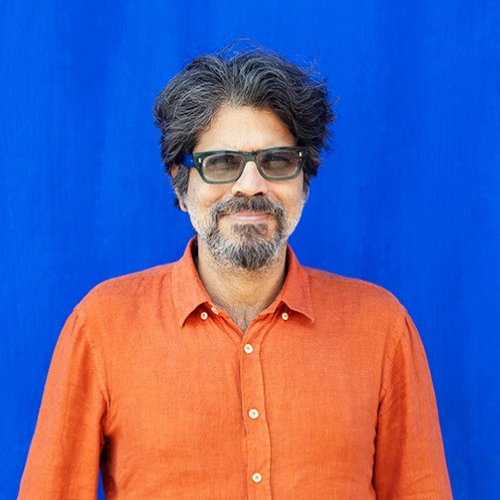
Pankaj Mishra
Pankaj Mishra is an essayist and novelist, a frequent contributor to the New York Review of Books, London Review of Books and The New Yorker, and the author of two books of history, From the Ruins of Empire and Age of Anger: A History of the Present. His most recent book is Run and Hide: A Novel. His new book The World After Gaza is published in February 2025.
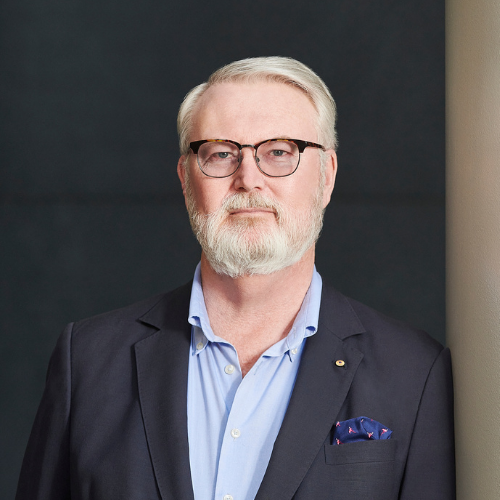
Simon Longstaff
Simon Longstaff began his working life on Groote Eylandt in the Northern Territory of Australia. He is proud of his kinship ties to the Anindilyakwa people. After a period studying law in Sydney and teaching in Tasmania, he pursued postgraduate studies as a Member of Magdalene College, Cambridge. Simon has been Executive Director of The Ethics Centre for 30 years. In 2013, he was made an officer of the Order of Australia (AO) for “distinguished service to the community through the promotion of ethical standards in governance and business, to improving corporate responsibility, and to philosophy”. Simon is an Adjunct Professor of the Australian Graduate School of Management at UNSW, a Fellow of CPA Australia, the Royal Society of NSW and the Australian Risk Policy Institute.