
Luke McNamara on Hate Speech and the Law
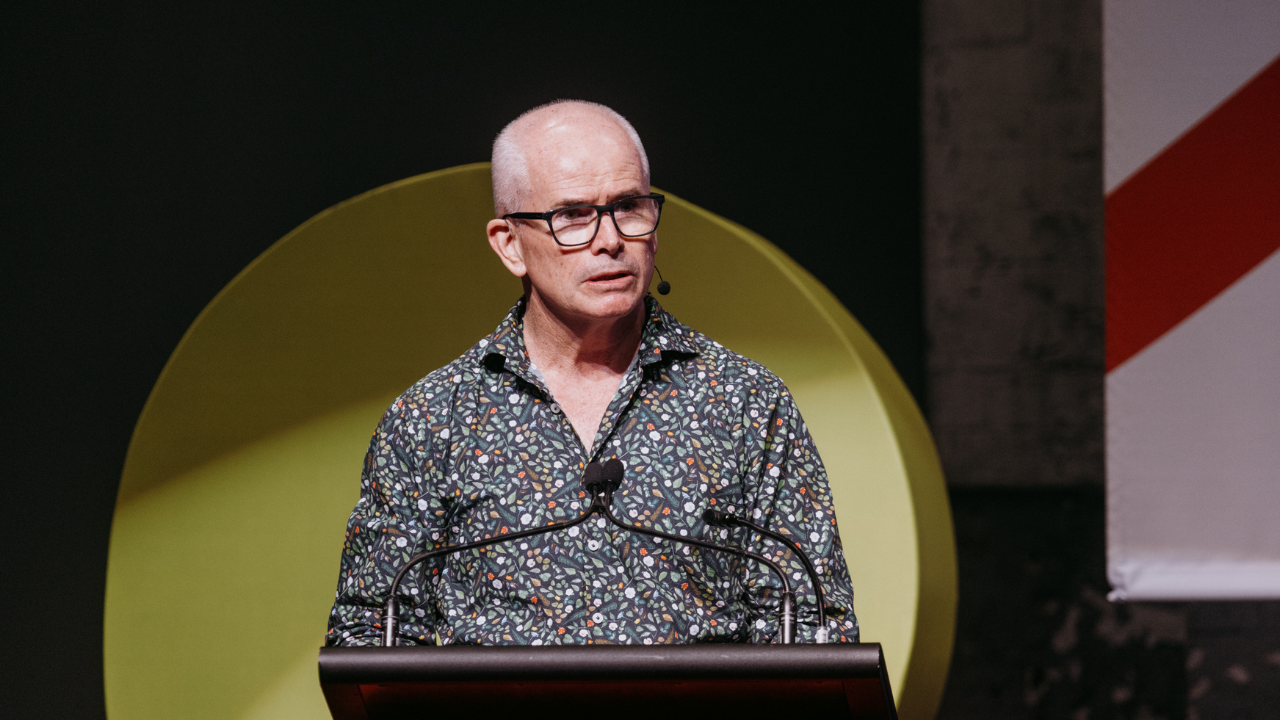
One of the reasons the phrase ‘hate speech’ came into existence was to challenge the idea that hatred directed at a group defined by race or another inherent identity characteristic should be tolerated.
As state and federal governments move to criminalise forms of hate speech, it's time to look at what evidence shows about the effect that laws can have on hate speech and its victims, with legal expert Luke McNamara.
This event was presented by the Sydney Writers' Festival and supported by UNSW Sydney.
Transcript
UNSW Centre for Ideas: UNSW Centre for ideas.
Luke McNamara: Good afternoon. I'd like to start with two stories that I hope will set the scene for my topic today. In 1982 a high school teacher, Jim Keegstra, in a small town in Alberta, Canada, taught his students that the Holocaust perpetrated by the Nazis was a hoax. In his lessons, he told students that Jews were treacherous, sadistic, money-loving, power, hungry and inherently evil. In short, he communicated anti-semitic statements to his students.
Keegstra was convicted of the crime of unlawfully promoting hatred against an identifiable group, in this case Jews, an offence that had been added to the Canadian criminal code in 1970. He appealed his conviction all the way through the courts, but in 1990 the Supreme Court of Canada rejected his appeal and confirmed his conviction. His punishment was a one year suspended sentence, one year of probation and 200 hours of community service work.
In 1993 a year after the landmark Mabo Native Title decision, a local councillor, Jim Eldridge in a small town in New South Wales, Australia, stood up at an event that had been organised to mark the United Nations International Year for the world's indigenous people. He interrupted proceedings and made a speech that described local Aboriginal people as half caste radicals who have made a claim upon the city of Wagga Wagga.
He claimed to have a right to speak on behalf of the white people of Wagga Wagga against these radical half castes at a council meeting two weeks later, the same man said, “My people came down the river and established this city when nobody, other than savages had been here before.”
The New South Wales. Equal Opportunity tribunal, as it was then called, found that Eldridge is conduct was unlawful because he had engaged in a public act that incited hatred towards, serious contempt for or severe ridicule of a group of persons on the ground of race, in this case, Aboriginal people. Such behaviour had been made unlawful in New South Wales in 1989 via an amendment to the Antidiscrimination Act from 1977.
The tribunal ordered that Eldridge print an apology in two local newspapers and pay $3,000 to the lead complainant in the proceedings, Marion Atkinson, who had requested that the money be donated to an Aboriginal cultural awareness centre for the people of Wagga Wagga.
Now we would now call these hate speech cases, although the term was not in common usage at the time. In Canada, the criminal laws that were applied to sanction Keegstra were known as hate propaganda laws. In New South Wales, the civil laws that were applied to sanction Eldridge were known as racial vilification laws.
These two examples illustrate, I think, the essential meaning of what we now call hate speech. Words or symbols or conduct that expresses or incites hatred or other ill feeling towards people on the basis of some aspect of their identity. Note that there is a difference between hate speech and a hate crime, which refers to unambiguously criminal behaviour such as assault or arson, which is made more serious because the perpetrator was motivated by hatred towards an aspect of the victim's identity.
When it comes to hate speech, the technologies of communication have changed much over the years. For example, old fashioned wall and telegraph poll posters were used widely by right wing organisations in Australia in the 1980s. Today, social media posts are a preferred method, but the essence of hate speech is the same. As political theorist Bhikhu Parekh has put it, “hate speech stigmatises the target group by ascribing to it qualities widely regarded as highly undesirable”.
As a young lecturer at the University of Wollongong in the early 1990s recently returned from postgraduate study in Canada, where I first heard about the Jim Keegstra case, I decided I needed to better understand this new tool in the legal toolbox for fighting racism. My studies to that point, particularly about the experiences of First Nations peoples in the criminal justice systems of Australia and Canada, had taught me how law and legal systems can inflict racism. I was keen to learn more about a new model for alleviating the burden of at least some forms of racism. And so, a student of hate speech laws, I became.
The decision of the New South Wales tribunal in the Jim Eldridge case was the first Australian hate speech decision I ever read. I mention this personal origin story, because I want to emphasise that my knowledge of hate speech is a product of research and scholarship, of academic inquiry, not lived experience. I am an Australian, born white, straight, cisgender man who does not live with a disability, who, though raised a Catholic, is now an atheist. Even during my Catholic childhood, religious sectarianism in Australia was largely a thing of the past.
Now, I've no doubt, been hated from time to time over the course of my life, maybe by a student angry about a mark that I awarded on a university assignment, or a boss hostile to the work I've done as a union delegate, but I have never been on the receiving end of words said about me, or groups to which I belong that disparage my identity, that express hatred towards me, or my people for who I am.
Many, many people are not so lucky.
They have experienced being hated for their appearance, their aboriginality, their ethnicity, their accent, their country of origin, their religion, their socio-economic status, their sexuality, their gender identity, their disability. So I have never given myself the luxury of approaching the topic of hate speech laws in an abstract or ivory tower way. Now, with apologies to the authors of the many books and articles on this topic of hate speech, I did a library catalogue search at UNSW recently, and I found 50,000 entries popped up. So with apologies to those learned authors, I'm not mainly interested in philosophical or constitutional debates about the theoretical legitimacy of hate speech laws.
I'm interested in what hate speech laws do and what they don't do. Before I tell you five things about hate speech laws that I've learned over 30 years. I want to make a couple of topic related shout outs.
First, a lot of what I have learned about hate speech I've learned through the gift of collaboration, from a long list of collaborators. I want to single out the wonderful Professor Kath Gelber, who is an internationally regarded politics and public policy scholar at the University of Queensland, with whom I spent several years researching the impact of hate speech laws.
Second, I learned even more, and keep learning more from people who know what it is like to be on the receiving end of hate speech, and who have been actively involved in trying to enforce hate speech laws, not for their own personal benefit, but to protect their communities and ours because of their commitments to anti racism, anti-bias and equality.
The first thing I've learned. The harms done by hate speech are real. I was a bit dismissive earlier of the many books that have been written on the topic of hate speech and hate speech laws, but I want to make a special exception for what I've learned, what we can learn about the harms of hate speech from the work produced by a group of African American and Hispanic legal scholars in the United States who were the pioneers of critical race theory. Now much mischaracterized, much maligned, especially in the US lately, critical race theory has played a really important role in voicing the real harms done to minority individuals and communities by hate speech left unchecked by law. Up against the enormous weight of US First Amendment free speech, constitutional doctrine and political ideology that was deeply hostile to the very idea of hate speech laws. Books like Words that Wound: Critical race theory, assaultive speech and the First Amendment by Charles Lawrence, Kimberle Crenshaw, Mary Matsuda and Richard Delgado and The Alchemy of Race and Rights, Diary of a Law Professor by Patricia Williams. These books were instrumental in giving voice to those encumbered by the effects of racist hate speech in their daily lives. It was Williams who coined the evocative phrase, ‘spirit murder’ to describe the experience of being fundamentally disregarded and to describe the existential harm of hate speech.
When Cath Gelber and I conducted a study that involved interviews with Australians from culturally and linguistically diverse communities, we learn that people experience what academics tend to refer to as constitutive harm, what Williams described as spirit murder and consequential harms that is, harms that are done in the performance of the speech act itself, and harms that might occur as a result of it.
The point is that hate speech is not only a problem because it might result in future discrimination or violence, but because it can cause harm now to the people who are subjected to it,
Our research confirmed what people already knew. Hate speech incidents occur in a range of environments, at school, at university, at work, during sporting activities, in service environments, supermarkets, banks, on the street, in the workplace, at culture and political events on public transport, via stickers and posters and graffiti in media reporting and commentary and of course, on the internet and social media.
In our interview work, one participant said, “I think for me, every day, I get vilified”. Another described the effect of being subjected to hate speech as, “crushing emotionally and spiritually”. Other words we heard in interviews used to describe the impact of hate speech include, “hurt, upset, anger, distress, fear, intimidation, exclusion”.
Now, while it is important to be sensitive to all of these effects, it is also true that not all forms of objectionable or upsetting speech are hate speech for legal and regulatory purposes. For example, criticisms of the actions and inactions of the Catholic Church may hurt some Catholics, but they do not inherently constitute anti Catholic hate speech. Criticisms of the actions and inactions of the State of Israel may distress some members of the Jewish community, but they do not inherently constitute anti semitic hate speech.
In my view, we show disrespect to victims of religious and racial vilification, and we risk undermining the legitimacy and the authority of hate speech laws, if we collapse the categories of upsetting and uncomfortable speech on the one hand and hate speech on the other, or if we too readily allow the lines to be blurred. We can respect lived experience and subjective perspectives on these things. But it doesn't necessarily follow that state laws and sanctions should fall in behind.
Lesson number two, a democratic society can have laws that sanction hate speech and still be committed to freedom of expression.
Now most countries around the world get this, and we shouldn't let the outlier example set by the United States and its first amendment derail sensible debate about what types of hate speech laws we should have, and about an evidence-based assessment of pros and cons of hate speech laws. One of the reasons the phrase ‘hate speech’ came into existence was to challenge the idea that hatred directed at a group defined by race or another inherent identity characteristic should be tolerated and beyond laws reach, because all speech should be free.
It is abundantly clear that all speech has never been free. In addition to social conventions, informal rules about what we should and shouldn't say, and the social power disparities that mean that not everyone enjoys the same access to the classic liberal marketplace of ideas, there are lots of laws that sanction speech, including defamation laws public order offensive language laws, laws on misleading advertising and laws on deceptive statements that perpetrate fraud.
Now, some of these laws have their controversies, but in my view, there is nothing controversial about the idea that hate speech is sufficiently serious that there should be laws about it. The more important question is, what sorts of laws? A question I will return to soon.
When the bill for Australia's first racial hate speech law was introduced in the New South Wales Parliament a little over 36 years ago, the then Attorney General, Mr. John Dowd, said “legislation against racial vilification must involve a balancing of the right to free speech and the right to a dignified and peaceful existence free from racist harassment and vilification”.
It was true then, and it remains true today.
The third thing I've learned. Hate speech laws don't make racism or other forms of prejudice magically go away, but they generally do more good than bad. As I said, racist hate speech laws now have a 36 year long history in New South Wales, 30 years at the federal level, in the form of section 18 C of the Racial Discrimination Act, which was added to that act in 1995 now over that time, hate speech laws have been expanded to offer protection to a range of other groups targeted by hate speech. The brand new and improved statutory regime introduced in Victoria just last month is illustrative.
When the new legislation comes fully into operation, it will make unlawful hate speech based on race, religion, disability, sex, sexual orientation and gender identity. These are referred to in the legislation as protected attributes. But if you look around the country, there are still gaps. For example, Muslims are not protected by section 18 C at the federal level, by the Racial Discrimination Act and the protections of the New South Wales Antidiscrimination Act were only extended to Muslims in 2023 when religion was added as a ground of unlawful vilification.
Now, hate speech hasn't disappeared as a result of hate speech laws, but there is evidence that over time, the more blatant forms of hate speech have reduced. What about the other side of the equation? Has free speech been diminished over the last three decades? Well, that's a big question and a tricky one, and it's probably beyond me to answer it fully today.
What I will say is that to the extent that the right to freedom of expression has been diminished over time, it is not because of hate speech laws. Media concentration and restrictions on the right to protest, to name just two examples, things like this are likely to have played a much bigger role in the erosion of the right to freedom of expression. Overall hate speech laws leave plenty of room for robust public discourse on all manner of topics, immigration, refugee policy, the rights of Aboriginal and Torres Strait Islander people, same sex marriage, global conflicts. There's a long list.
Number four, not all hate speech laws are the same, and each legal regime should be assessed on its merits. Now, understandably, the criminalisation of hate speech is usually regarded as the most serious and controversial form of hate speech law and fair enough, criminal punishment is the most serious sanction that the state can impose. The social stigma of conviction is high.
It is to Australia's credit that our lawmakers have mostly resisted the urge to criminalise hate speech. I say mostly because there are exceptions. 35 years ago, Western Australia steered its own unique path, relying exclusively on criminal laws rather than civil laws to address racist hate speech. Now, the risk of over criminalisation there has been managed by sensible policing and prosecutorial decisions about what sorts of conduct fall within the bounds of the criminal offences.
Until recently, most states and territories in Australia have adopted a different approach, one that focuses on creating a civil wrong of hate speech with the criminal law reserved only for hate speech that threatens or urges or advocates violence. Violence being precisely the sort of conduct with which the criminal law is traditionally concerned. Even when the Australian Parliament introduced a raft of new hate speech offences earlier this year, it respected this boundary, choosing only to expand the reach of existing criminal offences on violent hate speech. There is a catch, however, in relying on civil wrongs, defined in anti-discrimination statutes as the main vehicle for addressing hate speech.
Unlike criminal offences that are investigated and enforced by the state's police officers and prosecutors, civil hate speech laws require a person or organisation from the affected group to come forward and do the heavy lifting of formally complaining to a human rights body like the Australian Human Rights Commission or anti-discrimination New South Wales, and then, if conciliation fails, commencing litigation in a tribunal or court. Now, not every community has a Marian Atkinson or Wagga Wagga Aboriginal action group without whom Jim Eldridge would never have been found by a tribunal to have engaged in unlawful racial vilification. And it can take a very long time to pursue a civil complaint. For example, the late Jeremy Jones worked hard to ensure that anti-semitic Holocaust deniers like Frederick Tobin and Olga Scully were sanctioned under Section 18C of the federal Racial Discrimination Act. He told me once that civil hate speech laws are hard to use, and he recognised that he'd had the advantage of organisational resources and expertise that many communities targeted by hate speech just don't have.
You have to be patient and dogged. It took almost 10 years for Keysar Trad to achieve and defend a tribunal ruling that Alan Jones had engaged in unlawful racial vilification under the NSW Antidiscrimination Act, when during Sydney radio broadcasts in 2005 he referred to Lebanese Muslims as mongrels and vermin who hate our country and our heritage and simply rape, pillage and plunder a nation that has taken them in.
I think our system of civil hate speech laws is an imperfect one, but it's valuable nonetheless. Many of the people from targeted communities that we interviewed said that although they could never imagine lodging a hate speech complaint or pursuing litigation, they saw hate speech laws as a precious symbol. They said that simply knowing there is something there to protect you made them feel less vulnerable.
Hate speech laws were seen by those we interviewed as the government setting a standard, making a statement about what is not right in public behaviour, acting as a deterrent and allowing us all to be treated with respect.
In recent times, however, we are seeing some signs that the balance that has held for over 30 years is starting to shift. That is the balance in favour of civil laws over criminal laws. In February this year, the New South Wales Parliament created a brand new racist hate speech criminal offence. It is now an offence to do a public act that intentionally incites hatred towards another person or a group of persons on the ground of race. There are some other legal requirements, but that's the gist of it. There is no need to prove that the hate speech encouraged or threatened violence. For the first time in the three decade history of New South Wales, racial hate speech laws, it is a crime to incite hatred. Now that's a big deal. To be honest, I'm not sure what to make of it, because Much will depend on how the new law is operationalised over the years to come.
I trust that the New South Wales Police and the New South Wales Director of Public Prosecutions will exercise the same sort of careful judgement and restraint that has prevented the overuse of Western Australia's criminal hate speech laws all these years. And this restraint will be important in the current climate. As you will be aware, there has been a lot of attention this year on anti-semitism, which, of course, is a form of racism.
At the same time that there is genuine and well-founded concern about unambiguously anti-semitic crimes, including property damage, arson and the display of Nazi symbols, there is an ongoing debate which is very prominent in the university world, of which I'm a part, about what the definition of anti-semitism is and whether it extends to some forms of criticism of the State of Israel or the actions of the IDF.
With a brand new crime of inciting racial hatred on the statute books in New South Wales and in Victoria as of last month, the stakes are now especially high. The maximum penalty for the new crime is two years imprisonment. Now it is not for me to tell members of the Jewish community or their allies that they are right or wrong when they suggest that statements made or slogans chanted at a Palestinian solidarity rally are anti-semitic. I respect their lived experience position.
However, with further respect, I do get a say. We all get a say on whether the law created by our elected politicians has drawn the line in the right place, and whether the most appropriate regulatory approach has been adopted. As a general rule, good laws are not made in a hurry. It took Victoria some five years to gather evidence and consult widely on its recent overhaul of hate speech laws, which does include a new inciting hatred crime, the new New South Wales offence, was announced, drafted and enacted in great haste, partly in response, if you recall, to the caravan of explosives plot, which turned out to be something quite different to original reports. The bill that created the new crime was introduced to Parliament on the 18th of February and passed by both houses three days later.
Lesson number five, the last one, periodic spikes in hate speech directed at a particular group are not Australia's biggest racism problem.
I do not underestimate the impact on members of Australia's Jewish communities of the increase in anti-semitic incidents since October 2023 nor do I underestimate the impact on members of Australia's Muslim communities on the increase in Islamophobic incidents over the same period. As an evidence based researcher, I value the work done by the Executive Council of Australian juries anti-Jewish incidents reports and the reports of the Islamophobia register Australia.
But while history tells us that particular groups will come in for an outsized and unfair share of hate speech at different times, we also know that over time, the peaks reduce. Now this is not a reason to be complacent, but it does invite some perspective. It is important not to make the mistake of treating public racist hate speech as synonymous with racism or other forms of identity prejudice.
Hate speech is one form or manifestation, the tip of an iceberg for some communities in Australia, there are many other forms of insidious, systematic and destructive racism, and the same is true of other sorts of prejudice, including that experienced by our transgender siblings.
Other forms of racism and prejudice, they may be less visible and so less amenable to legal redress, but they are real. In terms of perspective, even more importantly, Aboriginal and Torres Strait Islander peoples and communities have been on the receiving end of hate speech and other forms of racism for almost 240 years.
Recently, Professor Lindon Coombes and the Jumbunna Institute for Indigenous Education and Research at UTS released a report called If You Don't Think Racism Exists, Come Take A Walk With Us, drawing on information provided to the Call it Out register.
The report confirms that racism in multiple forms, including hate speech, is a common experience for Aboriginal and Torres Strait Islander people. One woman who reported to the register said that she had enough experiences of racism to fill a book. Another entry recorded the following shortly after the unsuccessful Voice to Parliament referendum in October 2023 that I'll quote. “My 12 year old nephew was involved in a group chat with his school friends last night. They made comments including, you're a monkey. No wonder why everyone voted no. At least I have a voice. Proud to be the one who stole your land. Why are you talking? I thought everyone voted no for you not to have a voice”.
When I reviewed the call it out report in preparation for today and read this entry in particular, I recognise three things that I'll close with. First not nearly enough has changed. In 1993 a Wagga Wagga city councillor stood up and spewed nasty racism at an event that was intended to be a celebration of the survival and unique rights of indigenous peoples around the world. 30 years later, a 12-year-old First Nations child was mocked and racially abused on a day that we should have been celebrating a referendum win and a small step in the direction of coming to terms with Australia's colonial past.
Second. My other reflection was that in these moments, hate speech laws seem small in the face of an enormous task, including an unfinished national project on recognition of self-determination and the proliferation and intensification of hate through technology. My final reflection, however, which is more positive, was that I thought about the legacy of organisations and collective efforts like the Wagga Wagga, Aboriginal action group who took on Jim Eldridge back in the 1990s their legacy is large, and the call of that register is a proud and strong 21st century incarnation. It defiantly resists the marginalisation and silencing that the hate speakers seek to produce.
So I plan to keep walking in the direction of calling out and confronting racism and hate speech and making the case for balanced hate speech laws as I go.
Thanks for listening.
Audience Applause
UNSW Centre for Ideas: Thanks for listening. This event was presented by the Sydney Writers Festival and supported by UNSW Sydney. For more information, visit UNSW Centre for ideas.com and don't forget to subscribe wherever you get your podcasts.
-
1/4
-
2/4
-
3/4
-
4/4

Luke McNamara
Luke McNamara is a Professor in the Faculty of Law & Justice at UNSW Sydney. His research focuses on the deployment of criminalisation as a public policy tool. Current projects include studies of sexual offence trials and the history of criminal law-making directed at safety from violence. He is the author of the books Regulating Racism: Racial Vilification Laws in Australia (2002), and Human Rights Controversies: The Impact of Legal Form (2007); and a co-author of Criminal Laws: Materials and Commentary on Criminal Law and Process of New South Wales (7th ed, 2020).