
Kaliane Bradley: The Ministry of Time
I also like to imagine that basically every book that's published is part of a chain of books that are stretching back to the beginning of the printing press, and that's actually quite joyous to imagine myself in conversation with so many different books.
The Ministry of Time landed on multiple bestseller lists thanks to its highly original, genre-defying story, which combines elements of time travel, romance and spy thriller.
Described by Booker Prize winner Eleanor Catton as “outrageously brilliant”, Kaliane Bradley’s debut challenges the boundaries of literary and genre fiction as the past meets the future when a disaffected civil servant accepts a job at a mysterious new government ministry specialising in ‘historical expats’.
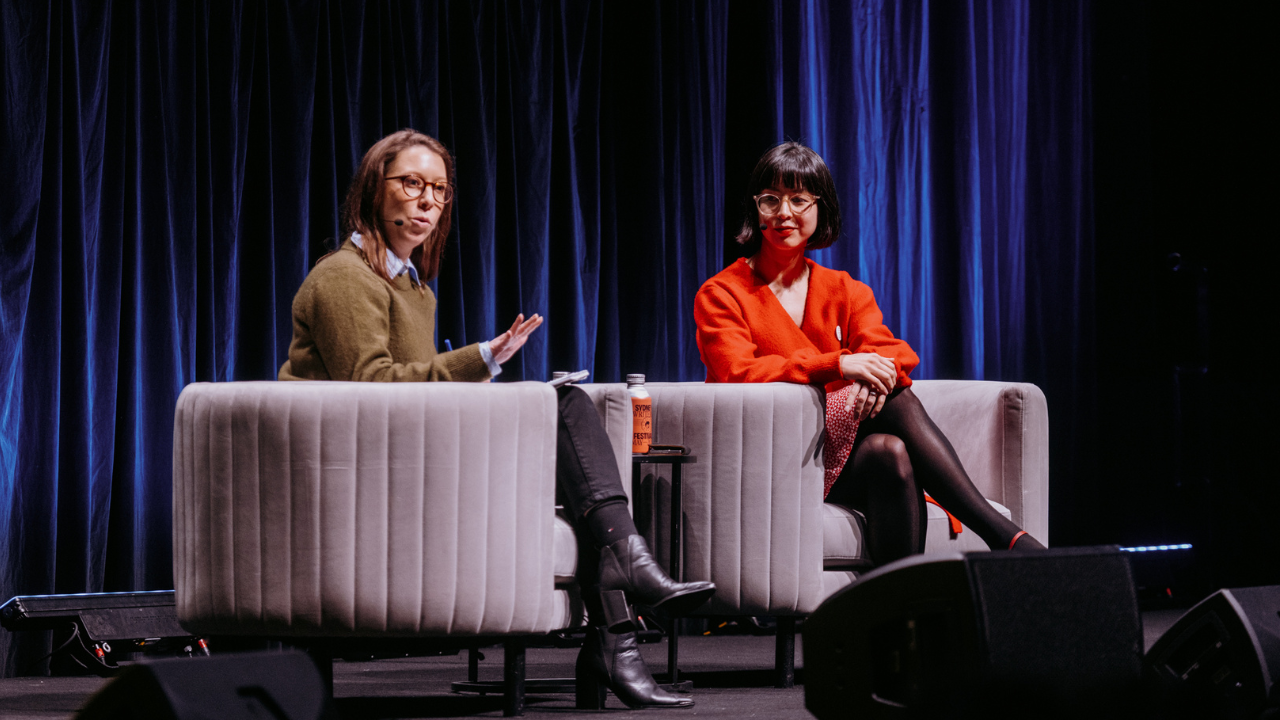
Join Kaliane and host, Spectrum editor Melanie Kembrey, to unpack the triumph of Kaliane’s debut novel and what it means to change the world by defying history. With an introduction from Fiona Morrison.
This event was co-presented by the Sydney Writers' Festival and UNSW Sydney.
Transcript
UNSW Centre for Ideas: UNSW Centre for Ideas.
Fiona Morrison: Hello everyone. Welcome to the Sydney Writers Festival, 2025. It's terrific to have an opportunity to welcome such a vibrant and excited crowd to this session, a conversation between Kaliane Bradley and Melanie Kembrey about the book that has barnstormed its way into Australia and the world The Ministry of Time.
My name's Fiona Morrison, and I'm an associate professor in English at UNSW, the co-presenter of this session, and I work in the faculty of Arts, Design and Architecture, where I teach courses with titles like Global Literatures Now and Writing the World Literature After Empire. I wanted to acknowledge a couple of things. First, that Kaliane appears tonight with the support of Rosie Williams and John grill and with the support of Dymocks, for whom I used to work more years ago than I care to remember, as part of my welcome and introduction, acknowledging the wonderful UNSW Centre for ideas as well, I'd like to acknowledge that we're meeting today on the unceded lands of the Gadigal people.
I'd like to thank them for their unceasing custodianship of country and pay my respects to Gadigal elders past and present, as well as any Aboriginal and Torres Strait Islander people present tonight.
Questions of belonging and displacement seem to me to be central to this dynamic new work from Kaliane Bradley, and in rather rich and fascinating ways, I was struck by two things as I turned my pages very rapidly through my first reading like the rest of us, I wanted to find out what happened.
The first was the centrality of the matter and the dimension of displacement in time and space. And the second was the feeling of, well, I can only think of the phrase daring-do. this bravery, this permission. That informs Bradley's work with genre is such a capacious, inventive and fun approach to form in this work. For a work with such a lot to think about, it is strikingly free and fluent in style and speculation, but sure in voice.
Australians have embraced this work and the crowd tonight here indicates some of this literary enthusiasm. I'm sure Melanie will have some words of introduction about Kaliane, but I'd like to say that I had first seen her name in connection with some rather distinctive and energetic short fiction, followed by what seems like the overnight sensation, the success of this first novel. A Cambodian British writer based in London, Kaliane’s background is saturated in writing and reading, from her UCL undergrad work in English literature to her sustained work as an editor.
Melanie Kembrey is, as many of you will know, the current editor of spectrum, the Arts and Culture section of the Sydney Morning Herald. Involved with reviewing, editing and a range of public facing events for a number of years, many of us will know her for an indefatigable championing of books, book culture and reading in Sydney and more broadly in Australia. We are so grateful to her for this essential work, and may it last a long time. And on this note, would you join me in welcoming to the Sydney Writers Festival stage Kaliane Bradley and Melanie Kembrey.
Audience Applause
Melanie Kembrey: Thank you so much, Fiona, for those very kind words. And welcome to the Sydney Writers Festival. I am so excited to go time travelling with Kaliane Bradley as we delve into The Ministry of Time, which is at once such a beguiling, funny, Pacey, sexy, risky book. Please join me once more in welcoming Kaliane Bradley to the stage.
Kaliane Bradley: Thank you. Thank you so much. It's very exciting to be here. Thank you for laying on some British weather for me. I feel immensely welcomed.
Melanie Kembrey: just to make you feel not displaced at all. Now The Ministry of Time, I know it started during lockdown. You were watching a supernatural horror show, and then you kind of were drawn to the character of Lieutenant gore. What was it? Was it the mutton chops?
Kaliane Bradley: It's or, you know, a man with a good pair of mutton chops is a man you can hang on to. That's what I always say, yes. So I was watching. A TV series called The Terror. I don't know if any of you are familiar with the terror, which is, as you say, it's based on a book called The Terror by Dan Simmons, and it is a possible explanation for what happened to Sir John Franklin's lost Arctic expedition. So in 1845 the Admiralty sent two ships, 129 men, to the Arctic to find the Northwest Passage. They all vanished.
Both ships vanished, and I was watching this during lockdown when my brain was made of cream cheese, and I was very, very intensely invested, almost from the word go in this beautiful story, this incredibly human story about how you keep your humanity and your sense of community at the ends of the world when you're almost certainly going to die. No spoilers for history.
I was really enjoying it. But there are, I think, 66 named characters. Most of them are men with mutton chops. White men with mutton chops wearing big coats, quite difficult to tell apart. So I just, I thought, you know, I might just check that what I've just seen is what I think I've seen. I checked Wikipedia page for just an episode summary, I ran across this name, Graham Gore. Lieutenant Gore is not actually a very major character in the TV series or in history, but he had an interesting name. I was not doing anything. I was on my sofa. I couldn't go outside, so I thought, “Okay, I'll go and have a look at his Wikipedia page. Why not?” And there's this photo. Thank you for the single Woo.
Audience Laughter
Never seen the photo. That's the that's the quiet woo of someone who has indeed seen Graham Gore in profile, a very dashing photograph, and this biography, which had been put together mostly by people who had read other people writing about Gore, a very calm, very competent, very likeable man. Again, this was during lockdown. The people in charge were not calm or competent or likeable. I thought, “God, I bet this guy would be great to have around”.
Melanie Kembrey: And then, you know, you joined a whole online community of polar expedition fan people. Is that? Right? Exactly. That's a real slide.
Kaliane Bradley: I mean, you've, you've seen that picture, you’ve got to do something, and I couldn't go to archives. I couldn't do any research. The only thing I could do is type in “Lieutenant Gore, single question mark”,
Audience Laughter
Kaliane Bradley: “Lieutenant Gore, still alive. Question mark.” Maybe, you never know. You've got to ask. Yes. So I found this community online of people who were either interested in this TV series or they were interested, more broadly, in polar exploration. And one of the really nice things about this community who, you know, we were all, I think, mostly in different countries, actually, we didn't, we couldn't see each other. We had no way to communicate except online, was how incredibly welcoming they were. So I came bombing in saying, “You know, this guy that no one cares about, what if I love him the best of all”, and a lot of people shared original research with me, again, I couldn't get to archives. This was a real, a real boon. Were just really willing to talk to me, and we're just Yeah. Was so lovely that I started writing what would become The Ministry of Time as a kind of gift.
It was a way of making friends, basically.
Melanie Kembrey: So talk us through that you were writing is fanfiction the right word about it?
Kaliane Bradley: Yeah, yeah. And I'm sure that if Graham Gore was alive now, he would be fine with that.
Audience Laughter
Kaliane Bradley: Not a problem. Yeah, exactly. So it was. It started off as a kind of a game, like, what would it be like if your favourite polar explorer lived in your house? Originally, the structure was much more pared back. It was literally just Graham Gore being presented with 21st Century sportswear and having a breakdown, that kind of thing. And then the more I wrote it, the more it developed, the more it became, the stories that it is now.
Melanie Kembrey: For those who haven't read The Ministry of Time, Lieutenant Gore comes back into contemporary society, or a society a few years in the future, through a government programme which brings through historic expats to contemporary society, and he's given a bridge to look after him and guide him through the modern world. Tell us about how much fun it was to put Lieutenant Gore in the modern world.
Kaliane Bradley: It was so much fun it you know, if you if you developed an interest in a dead guy, one of the problems is they don't take is they don't text you back.
Audience Laughter
Kaliane Bradley: So I was forced to put words in his mouth and yeah, so I started by just dragging him into this, this government project. So can I just get a quick sense? Has Has anyone here read the book?
Audience Cheering
Kaliane Bradley: Looks like a number of you. For those of you who haven't, I won't do any spoilers. So Graham Gore is pulled by the British government, along with four other expats, as they're called, into the 21st Century. And he's told, “Hello, welcome to a 21st century British Empire has collapsed. Sorry about that. We need you to prove that you can adjust to the 21st Century, that your problem, your mind isn't going to go wrong, and your body isn't going to collapse in some way. So we need you to assimilate. We need to see that you can assimilate to 21st Century England.”
They give him this woman the bridge, who is a civil servant, who will literally live with him for a year, monitor him, etc. And you read the book through her perspective, she's the narrator, which means that she understands the 21st Century and it isn't a problem to hHer that, for example, washing machines have multiple cycles and women have jobs. But it is very startling for Gore, who has to deal with his entire sense of self, in fact, shifting because he he thinks of himself as an officer of his country and as a British citizen, but those words now mean something completely different.
Melanie Kembrey: And one of my favourite moments is when someone calls him a DILF, and he's very confused about what that means. Can you talk us through? Because part of the joy of the book is so many of those moments where he's encountering Tinder or he's encountering a toilet for the first time.
Can you talk us through how you got in the mindset of this explorer about how he would view these modern inventions?
Kaliane Bradley: So part of it was that, I suppose I was, as we all were, during lockdown, slightly estranged from my own reality, you know, sitting in a room endlessly, not really knowing whether we were allowed to go outside, remembering, do you remember what outside was like? Do you remember when we could go to pubs and just trying to piece back together through memory, like, how it was to be in the world? It was such a strange like, it's weird now, because I wrote it in 2021 I actually don't have very many memories from 2020 as I imagine a lot of people don't, because it was just so traumatic. We've suppressed quite a lot of it.
So in Part, Part of it was a sort of attempt to re-engage with my own sense of reality, to remember what the 21st Century is like, and the things that are actually quite surprising and strange and funny to deal with, and that maybe we would, perhaps we changed the way we engaged with the world when lockdown was over and the world was back to normal. Spoiler, we did not. But, you know, the possibility was there for a while that we might make a different kind of world.
The other thing is that one of the problems with being very into British polar exploration, specifically, as I was, is that at some point you do run up against the fact that the thing you're interested in is an imperial project like they had.
These men had no reason to be up there in Inuit homelands. They had no court. You know, there was no reason for them to be there dying stupidly and hubristically when they could have just stayed at home in their own country.
The British Empire as a whole was just a kind of violent, I don't need to explain this to Australians.
Audience Laughter
Kaliane Bradley: You know what I mean. Just like an appalling, racist imperialist project. This doesn't mean that the people who are involved in it were not people. They didn't have, you know, they had feelings. They had emotions. They were psychologically complex. But they weren't that you are interested in this imperial project.
And there was an interesting friction for me in engaging both with this man's very handsome, I want to hang off his mutton chops. And this was, this was an evil empire, basically. And if this man really could come back, like, how would he deal with someone like me or someone like my friends who like he would have no context for them. And the game of that was so enjoyable and so pleasing.
Melanie Kembrey: And he starts to develop his own personality in the 21st century. He kind of, he doesn't like the Beatles. He likes motorbike riding.
Any of the characteristics you gave him in the in the modern world based on things you learned about him through your research?
Kaliane Bradley: So some of it, yeah, some of it, the things that I found through reading, again, through sailors diaries. So one of the reasons that it was it felt like I wasn't fictionalising him too far to make him such a calm, humorous man, is that this is the the personality he appeared to have. He's he's listening.
Someone describes him as smoking over the side of a boat once, and I was like, great, he's got a cigarette habit. That's that's done. So yes, some of those things did come from extensive and quite loopy research. Some of the things are every meal he cooks, pretty much every joke he cracks. I just took off my husband.
Audience Laughter
Kaliane Bradley: A very funny, extremely charming man,
Melanie Kembrey: So he's now sporting mutton chops.
Kaliane Bradley: So that was, it's very handy to just steal a lot of that. Thanks, Sam.
So yeah, it's part of it was research, and part of it was I got very I got very deeply into I took, started taking it very seriously. This is the thing about both lockdown and becoming deeply invested in something. I took it so seriously. I was reading books called things like the “Victorian Home: A definitive guide”, because I wanted, I was like, I need to imagine exactly what the curtains looked like in the 1840s so I know how he would experience curtains in 21st century Britain. Would he like them or just like, just things like knowing that the clothes that they wore was so much heavier because the textiles were different that they touched them in different ways, that they were wearing different layers, that the weather was different.
Like, how would it feel to be physically embodied in in the 21st century, during a climate crisis, right? It was just, it would just be so physically different, you'd feel like you were on an alien planet I think, if you're a Victorian.
Melanie Kembrey: And you didn't just have to do it for the Victorians, because there are other expatriates who are brought into the world.
How did you land on the periods of time that they came from? And what was the process of getting into their voices? Because they're very different from him.
Kaliane Bradley: They are very different. So the ministry, again, for those of you who aren't familiar with the book, the ministry picks expats as they're called, from the past at the point of their death, on the grounds that if you pull someone from the point of their Death is not going to affect history or the historical timeline, because they're not going to do anything anyway because they're dead. So you bring them that, we bring them to a 21st Century, it doesn't disrupt anything.
There are four other expats. The two you see the most of are a man called Arthur Reginald Smythe, who comes from the First World War, Battle of the Somme, and a woman called Margaret Kemble, who comes from the Great Plague of London.
In both of those cases, I was very interested in points in British history that loom very large in the cultural imagination, so stories and kind of self mythos that we return to in the UK that therefore inform our status now and our sense of self now. I say British. I actually mean English.
I once said in Scotland to a group of people in Edinburgh about the Great Plague of London. Yes, it's about British history. They didn't like that.
Audience Laughter
Kaliane Bradley: But yeah, I wanted so I was interested in these two people coming from this time, where we have quite a lot of preconceived ideas, right about Edwardian England, the kind of stiff upper lip the heroes who we said we sent to die horribly in the trenches and the Jacobean era, and the kind of woman that might come out of that. And then I wanted both of those people to arrive in the 21st Century and completely contradict all of those preconceived ideas, because I love the idea that there is the narrative of history, which is this kind of broad sweep, and there are individuals who make up history who are constantly in contention with this narrative or constantly in friction, and actually, the historical narrative is just something that we have quietly agreed on does not necessarily follow the lived experiences of people.
The two other expats are a man called Thomas Cardingham who comes from the English Civil War, and a woman called Anne Spencer, who comes from the French Revolution. In both those cases, I just needed disasters with big body counts. Unfortunately, I have the kind of friends where I say, can you think of a disaster with a big body count? They’ll be like, “Yeah, I've got 17 that I'm really interested in. Don't worry”.
Audience Laughter
Melanie Kembrey: And a lot of people talk about this book as a book about time travel, and obviously time travel kind of sets up the concept. But there's not actually that much of it in the book, like there's book. Like, there's a lot more bureaucracy than time travel.
Kaliane Bradley: So it's the biggest point. I wrote a book about time travel in which you see it happen on the page, I think once, but people experience bureaucracy in rooms a lot. But it's really like, you know, when you say a time travel romance, people like, “Yes, I understand what the what this is going to be like. I understand what I'm getting out of that.” If you say it's a romance about people experiencing bureaucracy, you're losing half your sales right there.
Audience Laughter
Melanie Kembrey: And how do you see this novel in relation to genre? Because you do see it described as it's a bit sci fi, there's romance, there's rom com, there's a thriller element to it. How do you position it?
Kaliane Bradley: That's a really good question, and one I wish, I think my editors wish I'd worked out a bit more before we started publishing the book. Obviously, because I was in the very fortunate position that I wasn't writing for the market, I was writing for friends, I really felt very freed from those what are often, what are sometimes, sorry, not often. That's unfair. What are sometimes, marketing boundaries, a way of making sure that a particular reader gets a particular kind of book.
So I didn't feel like I was going to let down a sci fi reader, for example, for not having enough sci fi I wasn't going to let down a romance reader for by messing up tropes. Because I wasn't thinking about writing a romance book or a sci fi book. I was just thinking about writing something to make my friends hoot and holler.
So when I was reworking the book and thinking about the ways that narrative work, the way that tropes work, right, one of the pleasures of genre, one of the reasons we describe ourselves as a reader of a particular genre, is because there are places that we find, there are things we find pleasurable. It's all about what we hope to meet and hope to find pleasure in and so we have certain expectations for how those narratives will unfold.
And I really like the idea of seducing a reader with them with a particular trope. So the rom com trope, I think, is a really key one here, seducing the reader with the idea of this, these, this mismatch couple, she's a civil servant, he's a Victorian man. What will happen? And then, you know, they have to live together. It's sort of comedic. It's silly. He hates the Beatles, as you say. He hates e-scooters. He's right.
Audience Laughter
Kaliane Bradley: Terrible things. She's, you know, slowly unbending. She's quite an ambitious, very closed off person who was starting to learn how to accept this person into her life, and so you're seduced by this rom com, but at the same time, what's going on underneath is the story about complicity.
This is a woman who is choosing to be complicit with government power, which is actually very sinister, which is, as it increasingly becomes clear, not the force for good they're claiming to be. She repeatedly runs up against moments where she is asked to show solidarity or to interrogate her behaviour. And every single time she she turns away from that, she turns away from that, and she kind of plunges the reader back into the rom com to as a distraction.
And I hope that readers find themselves simultaneously seduced by the romance element and root. For her as a romantic heroine, but also seeing the ways that she is turning away from these moments of change and possibility, and they see her maybe as someone, as a little bit more sinister.
Melanie Kembrey: And yeah, we have been talking a lot about the very funny parts of the book, but the expats also experience this alienation and loneliness and disconnection, which is very similar to what the modern migrant experience would be today.
Did you deliberately set out to do that parallel, or it was something that emerged as you were writing?
Kaliane Bradley: I think it's definitely something that emerged, but it felt quite strong quite early on, because again, I like feeling spending so much time thinking about how Graham Gore would have experienced the 21st Century, really trying to imagine what it was like being in his imagine what it was like being in his mind in a totally normal and proportionate way, just like spending a little time thinking about and like, the more you take someone's even a game like this, even a joyful text like this, seriously, the more you try to take I was trying to take the project seriously, and trying to take this man seriously, I realised that likely what he was experiencing would be the experience of a refugee, someone who's been pulled from a place they were familiar, a community they're familiar with, and told you can't go back because you'll die. You have to stay here. And the British government expects you to act a certain way, speak a certain way, be productive in a certain way. That is how we can tell you have properly assimilated. And they use this word assimilate quite a lot.
So there was that immediate parallel for me and the bridge, who originally was sort of a cypher. She didn't really have much in the way of personality or selfhood. I decided to make her British Cambodian, as I am, because, again, I was interested in having a parallel journey. So for her, she has a her heritage is British Cambodian. She has family members who fled the Khmer Rouge. So she is someone who could look at Graham Gore as a refugee, something she's familiar with, and then have spent a little more time interrogating her relationship to her own heritage and her own position in the British government. Or she can just try and ignore that.
Melanie Kembrey: And that's maybe part of the dark, darkness of the book too, is that how contemporary world is treating these expats is not that different to how they were treating outsiders in their time,
Kaliane Bradley: Absolutely. And there's always this, like, slightly patronising sense when someone adjusts quite well and you're like, “Oh, well done. You're a human after all, that's wonderful”. And it was important to me that these refuge- they and they are. I do think of them as refugees. The ministry calls them expats, because that's quite a deliberate political choice. But they are refugees from history that they were shown, not just suffering and struggling to assimilate, which some of them do, very sincerely, but also thriving and having a good time.
So Margaret Kemble, Maggie, from the Great Plague of London was very important to me in this in this regard, she's someone who is obviously very disorientated by landing in the 21st Century. And because she's from so far back, much further back than most of the other expats, she has the most difficulty using the right language or finding the right way to express herself. But she is given the word lesbian, which is fantastic for her. And now she has a word for for who she is, which she finds very affirming. It means that she can find a broader community, which, you know, obviously queer people have been with us for all of human history. But to have this, this ability to place herself within the 21st Century is for her, very affirming.
But also, she's having a great time. She's going to the cinema. She's going to gigs. You know she's she's meeting, meeting. Hot ladies on Tinder
Melanie Kembrey: She’s out clubbing.
She's clubbing. I didn't want there to only be doom and gloom in this experience, because I just don't think the refugee experience is only miserable. There is a possibility for joy and there is a possibility to thrive.
Melanie Kembrey: Let's go back to the bridge for a moment. The character you were talking about just before, who is responsible for looking after the lieutenant.
She was a character in another novel you were writing at the time. Is that right? And you actually transported her?
Kaliane Bradley: Yes, yeah, I did, yes. So she's a refugee from a bad novel.
Audience Laughter
Kaliane Bradley: So yes, at the time that I was having a lot of fun writing what would become The Ministry of Time, I was also trying to write a serious, serious novel about it would have been about Cambodia and the Khmer Rouge and Pol Pot and the commercial diaspora and the Cambodian community in the UK.
And this is because I felt that I was really obligated to write that book.
And, of course, nobody is obligated to write any books like no one is begging anyone to write a book. It's just that because, because I was British Cambodian, I thought that's the only thing I I'm allowed to write, which is a ridiculous things, a ridiculous thing to say to anyone, but it was what I was telling myself, it's the only thing I should be writing.
The minute I broke loose from that obligation, I was allowing myself to have fun and do something else and just fix where my brain wanted to go, as with The Ministry of Time, it became much easier.
However, I still had the problem of the bridge, a character who was a sort of nothingness, a kind of emptiness in the middle of the text, who was very difficult to engage with or like or follow through to to the end of the narrative, because she was just a kind of nothingness. But as I've said, it's a book about falling in love. It's a book about complicity. For that you need a more fully rounded person. And I did have a character in the other novel who actually, in the other novel, she was an academic rather than a civil servant, and she had a very complex relationship with academia, and her position in academia, and the ways she wanted to exploit her background without really engaging properly with the way she was vulnerable.
She just wasn't interested in doing that. And I thought, great. She really, really works. Why don't I just pull her out and put her in this book?
So now, obviously, I can't publish the other book, because that would be very confusing, but it did help. It did help The Ministry of Time.
Melanie Kembrey: How long had you been working on the other book?
Kaliane Bradley: Oh, a couple of years, a couple of years.
Audience Laughter
Kaliane Bradley: And it wasn't going well. It was like, you know, walking up the stairs on my elbows, on my knees.
Audience Laughter
Melanie Kembrey: Yeah, was it a conscious decision that I'm going to leave this book behind? Or you just thought, Oh, I'm having fun with this. I'm going to go where I'm having fun.
Kaliane Bradley: Do you know, I think it wasn't a conscious decision. I think it was almost a panic induced flight, like, “Oh, God, I can't take this anymore. Oh, but that man has mutton chops. Thank God.
Audience Laughter
Melanie Kembrey: How fun was this book to write?
Kaliane Bradley: Oh, it was. It was just an absolute riot. And it was so it's, it's funny. I sometimes think, “God, I'm never going to have the chance to be a debut novelist again and be in the space where I'm unpublished and untested and I'm just writing for I know my diamond shoes are too tight, wah”.
Audience Laughter
Kaliane Bradley: But yeah, it was just such a joy. And I know we often talk about writing as being quite a lonely pursuit, that writers are stuck by themselves, just miserably tapping away getting their work out. But for me, it wasn't at all a lonely pursuit. It was a it was a real community pursuit, and it felt like it was something I was doing out of friendship. And I think that made all the difference to the book.
Melanie Kembrey: and now you work as your day job, as an editor at Penguin, looking at classics. Does it make it easier or harder to write a novel when you're deeply invested in the best of the best?
Kaliane Bradley: Obviously, me and Dostoyevsky, very, very similar, like calibre
Audience Laughter
Kaliane Bradley: No actually it's incredibly reassuring to to feel like there is this enormous wealth of literature from across the world, across multiple languages, some of which will last for very long time, some of which won't, because things that were enormous in the canon, the quote, unquote canon, I'm very you know, I have mixed feelings about what the canon is, but things that were enormous in the 50s are no longer enormous now. And things that were very important in the Victorian era, we don't. I mean, how many people are still reading the Vicar of Wakefield? I did because I wanted to know what Graham Gore was reading. But, like, that was huge at the time, when people don't really read it in the same way as they read Dickens, for example.
So it's very reassuring to think that we're not, you know, I don't, I'm not interested in writing for the idea of posterity. And I imagine most of those writers weren't writing for posterity. They were writing because they were trying to communicate a particular thought they've had, they'd had, or a particular passion just to their immediate circle, their immediate circumstance, their immediate society. And that is very reassuring.
I also like to imagine that basically every book that's published is part of a chain of books that are stretching back to the beginning of the printing press, and that's actually quite joyous to imagine myself in conversation with so many different books.
Melanie Kembrey: And did you tell people you were working on this novel?
Kaliane Bradley: Absolutely not.
Audience Laughter
Kaliane Bradley: Oh my god, no. I actually went out when I finished writing The Ministry of Time, and I was thinking about, Oh God, I have to go out. I was I had to set myself a deadline to get an agent, so I had to go out at a particular time to get my to get a literary agent. And I was saying, “Oh, my book, my book about Cambodia, isn't ready. I feel terrible. What am I going to do?”
And one of my friends who was reading the the original version of The Ministry of Time, woman called Kate, said to me, “I think this might be a novel. Why don't you try sending this out?” So I did under a pseudonym.
Audience Laughter
Kaliane Bradley: Because I did like the idea of agent that I knew and worked with getting it either feeling like, “Oh, I've got, I've got to read this book, because I know her, so I better read it”. That's really depressed. I didn't want anyone to feel obliged or in any way like they had to. But I also didn't want people I knew and respected and worked with to get it and then go, “Uh oh, she's not very good, is she? Should we fire her?”
Audience Laughter
Kaliane Bradley: So it had to go under a pseudonym, which did mean that a lot of agents I know and really like and would have been up for working with, just did not respond to me.
What was the pseudonym? It was Monique Molyvann.
Melanie Kembrey: okay, I've got some follow ups. Tell us why. Why that pseudonym? What does that mean to you?
Kaliane Bradley: So, that no one has ever asked me that. What a great question. So Van Molyvann was a very well known Cambodian architect Cambodia between independence in the 50s and then the Khmer Rouge there was like wonderful golden age of music, film, culture, education and architecture. Van Molyvann was was tasked with basically building Phnom Penh and so there are that some of them, quite enough of them actually have been knocked down, but some of them still remain. He is responsible for some of the most beautiful, like modernist works of architecture in the capital, which also draw on Cambodian vernacular architecture. Just like the literal architect of the golden age of Cambodia.
Again, quite a pretentious choice for a pseudonym. So that's the Molly van Monique. I can't remember why I picked Monique. I think I just wanted some alliteration.
Melanie Kembrey: Yeah, it's very nice in the book, the bridges sister is also, is a writer, and bridge is very, is very cynical about her writing, about her Cambodian heritage and being a Cambodian British writer. And is very, quite dismissive of the publishing industry response to that.
And I know you've spoken a bit before about how you you feel about that label, Cambodian British writer. Can you tell us a bit about how you relate to that?
Kaliane Bradley: So I went, I really went back and forth for a very long time about whether I should call myself a British Cambodian writer, rather than just a writer, for example. But I do think that being British Cambodian has informed the way I write and the way I read, and therefore risk, because I think reading is actually a creative act as well as writing. It's it informs the connection that you make with a text and with an author and the way that you respond to it.
Because that has been so important to me, it seemed like it would be right to describe myself as British Cambodian and to lead with that. You know, maybe my relationship with that will change. Maybe I'll cease to refer to myself as British Cambodian. Just call myself a writer. I guess.
Melanie Kembrey: Do you ever refer to yourself as a woman writer?
Kaliane Bradley: I try not to, and it's interesting, because, like, I know that being I also don't, I don't, I never call myself a woman writer. But being a woman, being a cis woman, has, like, obviously, been enormously impactful on the way that I experience the world, and therefore the way I write and the way I read. But yeah, it's thank you for coming to group therapy.
Yeah, it's something that, for me, is just in constant flux.
Melanie Kembrey: When you were speaking before about how you kind of felt you needed to write this weighty novel about Cambodia, did you feel that pressure was coming from you or from the industry.
Kaliane Bradley: Oh, it was absolutely coming from Oh, no, that's an interesting ooh, I think realistically, it was just coming from me.
And it's again, like, there's a slightly pretentious thing where I thinking to yourself, I will write the great Cambodian novel. Like, why me? Like, Surely a Cambodian person is going to write that, let's be real. It's not going to be me or, like, even the idea, like, even going into the one thing I'm going to write, the great X novel, The Great anything novel.
I think, always the thing to do with a good novel is to think I wanted to communicate something I've been thinking about, something I feel I'm going to find a way to encode that into a text for a reader to decode. So that pressure was definitely coming from me. I do think there is perhaps a tendency in some parts of the publishing industry to treat writers from marginalised community as Windows, you know, like they are the person who is going to educate the neutral reader.
And the neutral reader is therefore always imagined as a white reader, which is again, ridiculous and not true, the idea that if you are a person of colour, you've got to write about your community, because that's the thing that you're best qualified to write about. If you're a queer person, then you should be writing about the queer community, because that's the thing you're best qualified to write about. And I just, I actually don't think any of that is true, but I think the industry is hungry for those stories, and it sometimes can feel like it's the pressure that they put on those those writers, to produce those stories.
Melanie Kembrey: And saying that this is from what I've read, the first British Cambodian novel.
Kaliane Bradley: I think so. I mean, again, that's not like, that's not a brilliant achievement on my part. That's just the fact that as far as I know, no other British Cambridge and has been published in the UK. I hope I'm wrong. It would be great to find out that I am wrong. It would be also great to not be, to not be the last obviously.
Yeah, it's, it's funny how, just because, obviously, the publishing industry is not neutral, it is its taste is, is decided by the people who are commissioning, and if the people who are commissioning are all coming from the same background with the same background with the same reading interest, you end up with a very similar series of books being published, and that, I do believe that is changing now, but it is process.
Melanie Kembrey: And what surprised you about being on the other side of the experience from being an editor to being a writer in publishing industry,
Kaliane Bradley: I thought, because I am familiar with the lifeline of a book and the publication process that I would be so cool and so chill, I was a nightmare.
Audience Laughter
Kaliane Bradley: So that was really interesting. It's also I know, even though I know as an editor, just how much work goes into making a book a success, it was still amazing to see the the machinery and the hard work of all the people who made the book work. Again, as I'm sure you probably all know, publishing isn't a meritocracy. It's not that the very best texts get the most attention and therefore the most readers. It is a balancing act between bookseller championship. Very often, booksellers are really vital to a book success, and they can make or break in fact a book's chances.
The sales teams that are identifying the books that will be leads and are really championing things, publicity and marketing is enormous. Like, I'm sure there are many of you will probably have read the book because of books that are recommended to you, I imagine, or maybe you got the algorithm showing you my face again and again and again, and you're like, “oh God, I'll buy it. Maybe she'll go away.”
Audience Laughter
Kaliane Bradley: But like all of those things, obviously, I worked hard on the book, and my editors worked very hard on the book, and I do think there's a good book. I'm proud of it, but that that wouldn't have made any difference without all of that work going into it.
Melanie Kembrey: Now tell us why you were a nightmare.
Kaliane Bradley: Very “no worries if not, if not, no worries if not, no worries if not”, you know, but kind of like very anxious. I'm very, very worried. Actually, I'm very worried. I'm very worried, but no worries, if not, no worries.
Audience Laughter
Kaliane Bradley: My agent is really unfortunate in that I have him on WhatsApp, so he will just get texts of whatever I'm feeling at the time.
Audience Laughter
Melanie Kembrey: And on that note, we will, we'll throw it open to audience questions before we get to them. I wanted to ask The Ministry of Time is coming to the small screen? Are you? Will you be involved in that?
Kaliane Bradley: I am an executive if it happens, fingers crossed. It has been commissioned by the BBC for a six part series. I am an executive producer. I'm not sure what's I don't I've never worked in TV before. I'm looking forward to be a night being a nightmare there as well.
Audience Laughter
Kaliane Bradley: I'm just, it's just to spread it around. The script is being written by Alice Birch, who adapted Normal People by Sally Rooney,
Melanie Kembrey: yeah, right.
Kaliane Bradley: So she understands yearning. I feel like she's gonna really get that. And yeah, I feel like the it's being produced by age 24 so I feel like the people who are looking after it are absolutely the right people.
Melanie Kembrey: Will you be one of those authors that makes a cameo?
Kaliane Bradley: Oh, wouldn't that be good as just someone who trips and falls over in the Arctic?
Yeah, in the Arctic. Oh, no. Oh, Seamen Dingley has gone down the ice. There he goes.
Melanie Kembrey: Okay, the people really want to know. Will there be a sequel?
Kaliane Bradley: Oh, I sorry. That was a very fruity noise. There. I definitely know what would what will happen. I really have a sense of what will happen next. As my agent keeps on telling me it depends if there is interest. I keep because there's no point in writing a book into the void. Although, actually, I think it's great fun to write a book.
Melanie Kembrey: Doesn't seem like there would be a void. Yet I be a void here.
Why did you decide not to name the narrator?
Kaliane Bradley: Ah, great. This. I actually have a whole hierarchy. Thank you. Whoever asked that question, I have a whole hierarchy of naming in the book. So the bridge never names herself to herself, because she is. She's kind of the centre of this universe that she's describing. So she doesn't need to name herself. She is the centre of the universe. So that's that's how the book is set up. It's someone who is quite blinkered just telling you the things that she saw and the things she experienced.
Then there are people who she has studied so the expats, the people she's studying, the people who she believes falsely. She can get a kind of 360 degree view on because she has access to all this data on them, all this history and all these experiments run by the ministry. So all the expats have full names, Graham Gore, Margaret Kemble, Arthur Reginald Smythe, Thomas Cardingham and Anne Spencer.
The next rung out are people who she does think of as people, but they are very much just characters in her story. So she's the main character. She doesn't need to be named. She is just the centre of the universe. So the universe. Then there are people that also exist. So her line manager, Adela, her handler a man called Quentin, her colleague, Somalia, she thinks of them as being on the edge of her story.
Of course, this means, of course, they're not like just other characters. They are people. They are people in the book, and they have their own narratives and their own lives. Because she is quite blinkered in the way she looks at them. She misses a lot of these cues, which means that their narratives continue, and she like veers off from them.
And then the very last rung out are people who she she really thinks of as functions of institutions. So the Head of the Ministry, a man called the Secretary, is only ever referred to as a secretary. He just represents the Ministry. There's a character called the Brigadier who is never named, and that's because, for her, he just represents a kind of martial threat. Equally, she never names her sister and she doesn't name her parents, because for her, they're just family, and she's boxed them up and she's put them to one side, because actually having to engage with her family and her heritage and the complexities of that leaves her vulnerable. So “my sister” never named, just put to one side.
Melanie Kembrey: I was just laughing at this one which I was thinking of who I would pick, who would be your dream actor to play Graham in the screen adaptation.
Audience Laughter
Kaliane Bradley: I think that we should invent time travel and we should just go back and get him. Really, I really, I do.
I have sometimes said that I think we should get Elliot Gould off the set of the Long Goodbye he's always smokin’, yeah, but I have no idea. I am excited to find out if the TV series gets made. Who it is. I, I also really enjoy people telling me who their ideal Gore is, because there is so much variation. Oh, my God, did I not how did I describe him? Let me double check.
Melanie Kembrey: Might say a bit more about them than the character.
What was your favourite piece of research that did or didn't make it into the book? Felicia asks.
Kaliane Bradley: I read a lot of journals by a poet explorer called Robert McClure who no one else except my friends, Becca and Carmen care about. He's a great guy. He's awful, and he sailed with Gore on an arctict tradition when they were both in their 20s, when Gore was much more junior. And there is just a wealth of very funny information about the young Graham Gore in that journal.
I'm going to pick one at random, just spin through my head of the many Graham Gore facts that I have. On the way back, they were they had to make their way back very, very slowly. And Graham, to pass the time, started growing peas in the coal dust, and he managed to get some peas growing, which he then gave to the sickest man in sick bay.
Audience awws
Kaliane Bradley: I know, isn’t he great!
Melanie Kembrey: we've all fallen in love with him.
Emma wants to know, how did you navigate the queer landscape of some of your characters?
Kaliane Bradley: So this has been really interesting, because there are obviously two characters who are so Arthur is a gay man and Margaret is a gay woman, and they are both like very openly and very clearly. They say “we're gay. This is our identity”. And they are negotiating the 21st Century and the new opportunities offers them in very and I hope, positive ways.
I'm always slightly startled, and I'm looking forward to seeing how many people mutter when people describe either the bridge or Graham as straight, oh no, muttering. Oh, interesting for me there. And the character Arthur, runs up against this himself, he says that, “you know, I know that you've come a long way, and things are very different now, and things are better, but I still see the same patterns repeated again and then again, what the ministry demands, what society demands of people”, actually the silver neutral is the heterosexual couple, the family, the product, the productive citizen, having more productive citizens for the for the society.
And both the bridge and Graham are people who think of themselves as the productive citizens, you know, the good officers of their respective governments. Again, I don't want to do any spoilers, but Graham's experiences are much broader than this. This term, which he comes across straight would allow.
I think the bridge’s crush on Maggie is visible from space and but she's obviously someone who is spending a lot of time suppressing that and acting as if she's in the closet. And it's because both of these people want to conform to this, this overarching demand. And the queer landscape is something that, like, has improved in the time that they've been, the times they've experienced, but like, it still hasn't come all the way, and there still is this limitation placed on them.
Melanie Kembrey: It's fascinating. And some of the sex scenes I imagine writing them. What was what was it like writing those? Because you're trying to balance these different sensibilities.
Kaliane Bradley: Just an absolute riot. Great old time. Great Old time. I don't know why, but they came maybe the easiest, and I think they were the I think the one of the first sex scenes in the book is almost exactly the same as it was in the first version, which is not true of most of the book.
Melanie Kembrey: Well, that's interesting. Someone has asked that question, how much changed during the publishing process?
Kaliane Bradley: Oh, this is draft number nine, so quite a lot. And the first, the very first version, was 30,000 words shorter. I think there are characters that have much more extended story lines. The last two paragraphs are almost exactly the same, but quite a lot of the process of getting there changed. Quite a lot.
There was quite a lot of building out of the ministry, actually. So the ministry wasn't as detailed as it was that needed to happen, because otherwise there are no stakes, right? If the if you just have, if you plot, try and travellers down and say they're going to have a good and or bad time, there's not, there's not, that's not really a story, but the ministry claiming to be one thing and then emerging that is another. That was the kind of stakes that had to be set up.
Melanie Kembrey: Yeah, okay, and another process question, what does a writing session look like on an average day for you?
Kaliane Bradley: A lot of crying, lot of standing in the garden.
Audience Laughter
Kaliane Bradley: I don't know why. I'm a real procrastinator. I have to have a run up of a couple of hours of just like sitting around, talking to my husband, standing outside, looking at the sky, going on the internet, making myself angry, getting off the internet, when I actually sit down to write and it works. It is, like, one of the most joyful things. And as it's happening, I'm like, “I can't believe that. I can't believe I took so long to get here. Like, of course, I wanted to do this all day. I've wanted to do this. This is wonderful”. And I'll write for about an hour, maybe an hour and a half. I can't do much more. My brain cuts out, and I'll sit back, and I'll be like, “Oh, brilliant genius,”
Audience Laughter
Kaliane Bradley: Then I’ll read over what I've written and just suffer horrible humiliations.
Audience Laughter
Melanie Kembrey: Gympie library, who must be joining us on the live stream, want to know, what other time travel stories, if any, did you draw inspiration from?
Kaliane Bradley: So one of the books, I think that the two books that really influenced The Ministry of Time one is Night Watch by Terry Pratchett, which is what Terry Pratchett maybe the most influential author for me. I love I love his work so much. And Night Watch is about a man called Sam Vimes, who's thrown back into his own past, and so has to deal with the possibility of changing the past, and how that will change his future.
And also Slaughterhouse Five by Kurt Vonnegut, which is a book partly about someone who is kidnapped by aliens and so develops the ability to visit different points in his life but is also basically about trauma. It's about the repetition of trauma and constantly returning to, in this case, the firebombing of Dresden, which Vonnegut himself survived.
So I think those two books are probably my biggest influences.
Melanie Kembrey: Well, I wish the ministry could extend our time here today, because there's so many more questions to ask, but maybe I'll loop us back to the start, because just to finish us off, the community of polar explorers that you fell into at the very start of this journey, how have they responded to the book?
Kaliane Bradley: I think that, I mean, my friends have been friendly.
Audience Laughter
Kaliane Bradley: So, yeah, I hope, I hope it's been fun and funny for them to see you.
Melanie Kembrey: And you said you get a few polar enthusiasts sometimes,
Kaliane Bradley: So I don't get audiences this large in the UK ever, and I'm going to take a picture just before you leave, just for my mum.
Audience Laughter
Kaliane Bradley: But so in the UK audiences, I can often see the audience, and when I talk about the Franklin expedition, they'll sometimes be someone in the middle of the road being like,
Audience Laughter
Kaliane Bradley: “yeah, we're friends. We're friends”.
Melanie Kembrey: Well, we'll let you take the photo, as we all thank you so much for being with us.
Audience Applause
UNSW Centre for Ideas: Thanks for listening. This event was co presented by the Sydney Writers Festival and UNSW Sydney, and supported by Dymocks. For more information, visit UNSW Centre for ideas.com and don't forget to subscribe wherever you get your podcasts.
-
1/4
-
2/4
-
3/4
-
4/4

Kaliane Bradley
Kaliane Bradley is a writer and editor. The Ministry of Time, her debut novel, was an instant New York Times and Sunday Times bestseller, the Dymocks Book of the Year 2024 and the Harry Hartog Book of the Year 2024, has been shortlisted for the 2024 Waterstones Debut Prize and the 2024 Bollinger Everyman Wodehouse Prize for Comic Writing, and won the 2024 Goodreads Choice Awards for Science Fiction. In 2022 she won the V.S Pritchett Short Story Prize and the Harper's BAZAAR Short Stories Prize. She lives in London with her husband.
Melanie Kembrey
Melanie Kembrey has been a journalist at The Sydney Morning Herald for more than a decade and is currently editor of arts and culture publication Spectrum.

Fiona Morrison
Fiona Morrison is an Associate Professor in the School of the Arts and Media at UNSW Sydney, where she has taught and supervised in the areas of postcolonial and world literatures, Australian literature and women’s writing. Her recent books include Christina Stead and the Matter of America (2019), Time, Tide and History: Eleanor Dark’s Fiction (2024) co-edited with Brigid Rooney and Thinking for Yourself: A Handbook for Interesting Times (Simon and Schuster/Ventura, September 2025) written with Michael Parker. She is currently working on a monograph on Henry Handel Richardson’s transnational fiction.