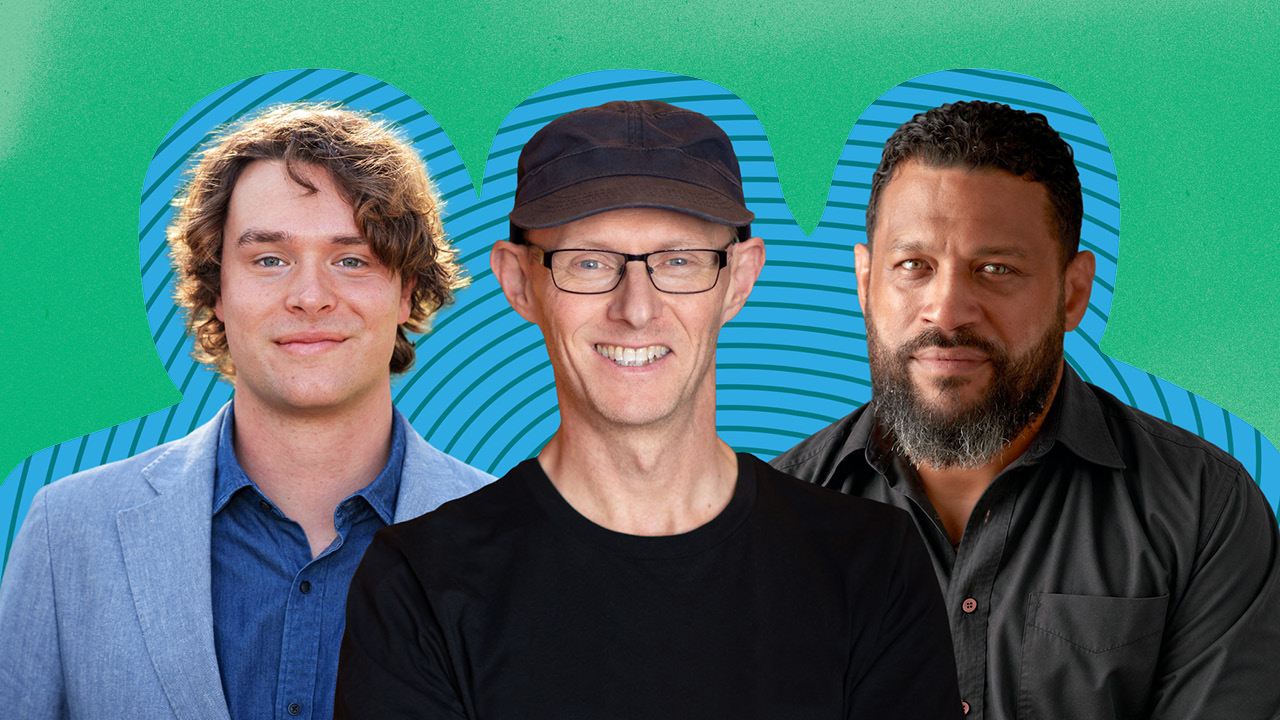
Human vs Machine: Barbara Wilby and Joel Pearson in conversation
It’s not another technology, it’s intelligence. And that is something fundamentally different. And when you start ramping that up, you start changing everything.
The development of AI has brought humanity to the cusp of a seismic change the likes of which has never been seen before. Workforces of the future will be dramatically different, as some jobs become obsolete and people scramble to learn new skills and ways of working. But just as this intelligence revolution has called into question the role of humans, could it be the catalyst for more purposeful leadership and smarter working? Could the very essence of being human – empathy, creativity and collaboration – become skills more important than ever as AI increasingly takes over dull, dirty, difficult and dangerous tasks?
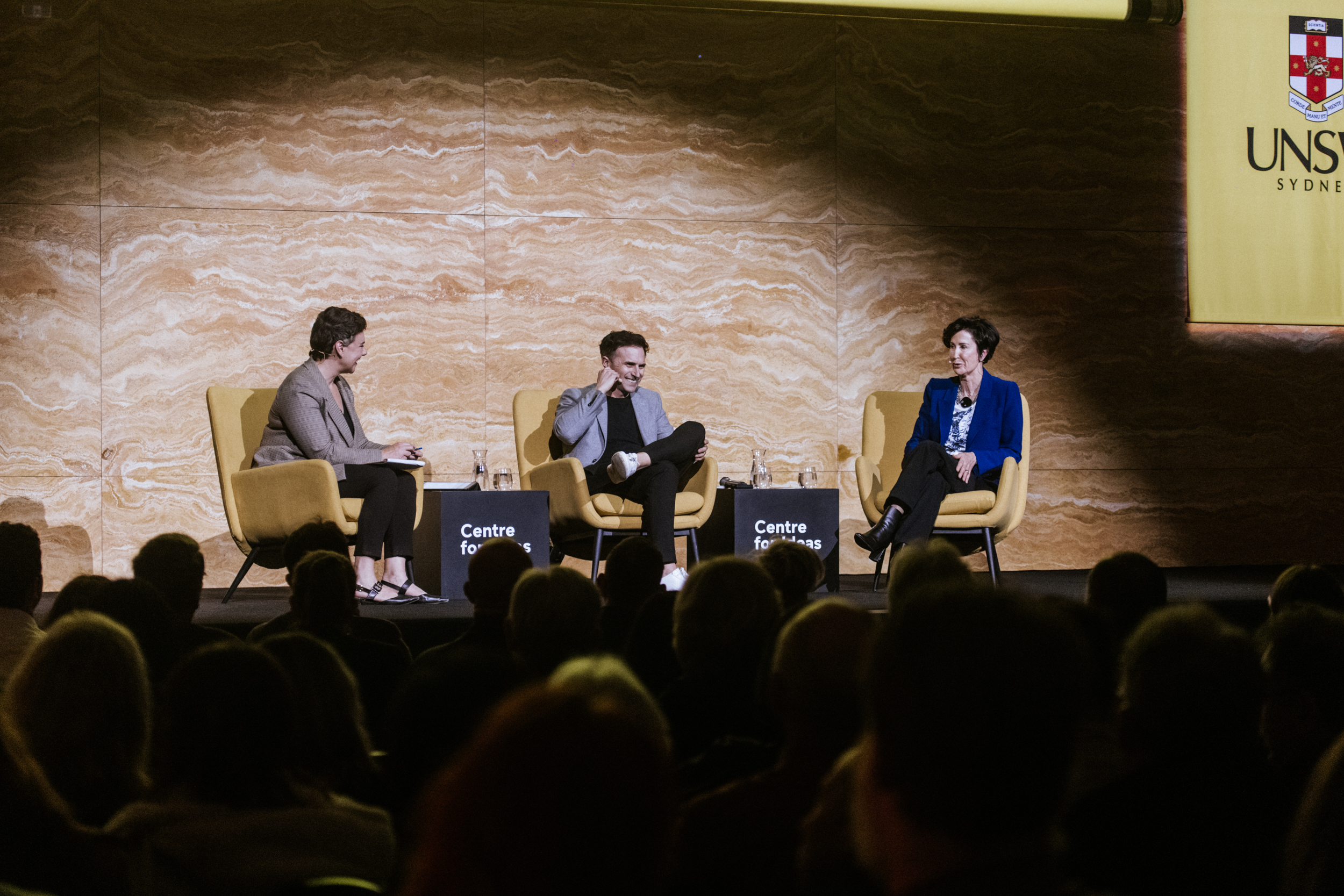
Join the world’s first neuro-futurist, Joel Pearson, in conversation with leadership coach and transformation expert, Barbara Wilby. Hosted by the ABC’s Tegan Taylor, Wilby and Pearson will examine how we can respond to AI by actively using it to enhance decision-making, amplify human strengths and lead through uncertainty.
Part 1: Barbara Wilby and Joel Pearson in conversation
Podcast Transcript – Part 1
Tegan Taylor: We haven’t even said anything yet and they’re already clapping. This is a really good sign.
Okay, who’s been told to adapt, to innovate, to learn, to adapt some more? It’s a cycle we’ve always had to manage but it’s only been supercharged by the explosion of AI. We’re being told that AI is going to disrupt life as we know it, a complete paradigm change. So how on earth do you adapt to that?
How do you prepare for it when it’s so hard to predict what’s on the way? Are there fundamental principles we can draw on here to help us prepare for the AI future even if we’re not exactly sure what that looks like yet? Well that is exactly what we are going to explore tonight.
My name is Tegan Taylor. By day I host Life Matters on ABC Radio National and a show called What’s That Rash? But tonight I am your host and moderator for this Centre for Ideas event, Human vs Machine.
And I’d like to start by acknowledging the Bidjigal people who are the traditional custodians of this land. I pay my respects to their elders past and present and extend that respect to the Aboriginal and Torres Strait Islander people here with us today. Now during tonight’s event we’re going to do a lot of talking but we want you to be part of the conversation as well.
And the people to whom you’ll be directing those questions are my illustrious panellists. First up Joel Pearson, neuroscientist, neurofuturist, author and the director of the Future Minds Lab and an ARC Future Fellow here at the University of New South Wales. He initially studied art and filmmaking at the College of Fine Arts but then he turned to the scientific mysteries of the human consciousness, the complexities of the brain.
His debut book, The Intuition Toolkit: The New Science of Knowing What Without Knowing Why, came out in 2024. Please welcome Joel.
Audience applause.
Tegan Taylor: And also here with me is Barbara Wilby, a leadership transition specialist, an MBA with over 20 years experience working with senior leaders and teams across sectors including finance, healthcare, aviation and professional services.
She’s the founder of Corporate Wisdom. Barbara’s worked with McKinsey as a lead coach and facilitator on large scale cultural transformation. She also has a book.
It’s called So You Want to Be the CEO. Please clap for Barbara.
Audience applause.
Tegan Taylor: So we’ll get into it and I think Joel probably the question on everyone’s mind since they heard your job title is what on earth is a neurofuturist?
Joel Pearson: It’s a brand new title, a brand new field that we made up and or I made up. So it was to solve a problem and the problem was the last few years we’ve been looking at and I’ve been looking at sort of the effect of technology, of AI on us, on our mental health, on our brains and trying to make those predictions about what the future might look like from a very human point of view. And so there wasn’t really a word for that.
It didn’t really fit into neuroscience or psychology. You got your standard futurism but it’s very tech focused. So I wanted something that sort of summarised that trying to look around corners, trying to predict you know if we’d been around you know 10 years ago could we have predicted the effects of social media on our youth by bringing together everything we know about the mind and brain and making sort of looking forward-looking predictions.
So it’s really that combination of neuroscience, psychology and tech futurism put together to understand what’s happening at this moment and what’s likely to happen but also what we can kind of do about it.
Tegan Taylor: So tonight I mean AI is such a huge topic. It affects, it’s going to affect so many facets of our lives, all facets of our lives as we’ll discuss. I think the lens we want to bring tonight is really about leadership and workforce.
Barbara, you’ve been in this space for 20 years now. How has it evolved in that time?
Barbara Wilby: Well it’s got faster. It’s got a lot faster. In fact there’s some research I just glanced at briefly today. I haven’t had a chance to get really into it yet but it talks about leaders feeling that they’re beyond their bandwidth with the pace of change. So things have got a lot quicker. In terms of my work, coaching with leaders, it’s become less strategic and more tactical.
It’s “give me a quick bit of information, give me an insight here in real time” rather than, you know, the deep dives that we used to go into and lock ourselves away behind closed doors for two hours, three hours, four hours. People laugh at you if you’d discuss that these days. So yeah.
Tegan Taylor: With that move to being less strategic, more tactical, is that a pace thing or do you think we’re losing depth?
Barbara Wilby: I definitely think we’re losing depth. I think what’s happened is I arrived in leadership development about 2000 actually, so it’s 25 years rather than 20 and that was the start of leadership development in Australia in a serious way. And of course 2002-2008 was this incredible growth spurt in Australia.
You know, every companies were growing. There was loads of money to spend on leadership. We took leadership teams away for three days into the bush to meditate and do all sorts of weird and wonderful things, which was great fun. If you suggested that now to a leadership team, I think they’d say, I’ve got 10 other places I need to be and I need to get it all done by lunchtime.
So, you know, then we had the GFC, which is a bit disruptive and the big disruptor, of course, was COVID for leadership development. So I think people have become, got less resources now to spend on time and money and there’s a waning of interest in going deep, which goes completely against my grain because I think that when you get as chaotic as we’re getting at the moment and as distracted, and AI is adding to that, AI has many gifts obviously, but one of them is the distraction, you need the stillness and the silence to actually come back to yourself as a leader and become integrated and balanced around something and get a bit of space, a bit of distance from it.
So I’m slightly worried for leaders, some of them.
Tegan Taylor: I mean, you mentioned a couple of disruptors there, the big one, the big disruptor that we’re here to talk about is AI. Joel, what do we get wrong when we’re thinking about AI as a disruptive force?
Joel Pearson: Lots of things. How long do we have? I mean, a theme that I’ll touch on a bit later on, and it’ll come up again and again, is the idea that it is simply a technology like the internet, like the phone, like the printing press. There’s a lot of these analogies people will use. And when you frame it like that, it feels very comfortable, we’ve been through it before, we kind of know what to expect, but it’s something fundamentally different this time.
So really, it’s intelligence, right?
And those other revolutions were not intelligence. And intelligence is something very, let’s say, very human for now. Let’s say our society is built around that, our jobs are built around that, most of our relationships are built around that.
So when you start unpacking what you’re scaling up intelligence, making it cheaper, making it ubiquitous everywhere, you start to realise that this is going to be a fundamental disruption to every part of society, every layer of society, our relationships, our education. And I really think it is people are under predicting it massively, or the hype you’ve been hearing is about the wrong thing, or it’s massively under hyped, would be another way to say that. So I know that sounds kind of scary.
And some of the things we’ll talk about tonight will be scary. I will try and frame them in a more positive way. I’m a massive optimist when it comes to this stuff. I’ll say a bit more about that later. I think we are on the way to somewhere amazing. But whenever you go through change, it can be very difficult.
So I see this as the biggest change event in human history. And I don’t say that lightly.
Tegan Taylor: Really? What about the agricultural revolution?
Joel Pearson: No, much bigger. That was agriculture. This is intelligence. This is like, it’s much more like an alien species coming to earth and living amongst us and learning to work with us. And it’s changing the way we live. And that probably undersells it as well.
Tegan Taylor: See, that’s crazy. Because I think about the sorts of seismic shifts that humans have dealt with in our history, and they’ve been catastrophic for some people, for some parts of our societies. People have been harmed by those sorts of changes.
What are the risks here?
Joel Pearson: Well, there’s a huge array of risks. And we’ll carve out some we’re not going to touch on tonight, whether it be the environment, whether it be warfare. There are a lot of risks we won’t have time to get to.
But I think front and centre, and you’ll see this a bit later when I do a sort of a solo talk, that I think just change and everything that change brings. People are not great at change. We particularly find it very uncomfortable when we don’t have control over it, when it’s sort of thrust upon us, and which this change is.
And it brings uncertainty. And uncertainty is a very scary stimulus. I’ll do a bit of a deep dive on this later on, but it puts us in a very sort of fight or flight anxious state.
So what I see, those are the two big sort of pillars, front and centre. We could also talk about the misalignment, the Terminator stuff. But I’ll say a bit more about that later, why I think that should not be front and centre at this moment in time.
But we are vulnerable in so many ways. So of course, the job disruption thing is on everyone’s mind, most people’s minds at the moment. So what’s going to happen?
Are we going to see a sort of collapse of human jobs? What is this labour disruption thing going to look like? And the AI companies are more or less building AI to take humans out of the labour economy, if you want to say it like that.
And they’re very careful how they word that in interviews. And some of them have pulled back in the language they’re using now. And I say this, but it’s not like, you know, by the end of the year, there’s going to be no jobs left or anything like that.
That’s not what’s happening at all. We are seeing a shrinkage, if you like, in the number of human jobs. And we’re seeing job cuts.
But we’re just not seeing companies at the moment, not hiring new people, particularly at that graduate level, that early junior level. And what was the question?
Tegan Taylor: Existential threat, exclamation mark.
Joel Pearson: So jobs is front and centre. But we’re, you know, we’re also seeing just human relationships being disrupted. What was the latest stats? That 50% of teens in America are using some kind of AI companion on a daily basis. So we’re going to see a fundamental shift in young people. You know, their idea of what a relationship is shifting rapidly at these AI companion that they’re using are very different to humans. And the relationships between this human and AI is very smooth. It lacks friction. There’s no arguments. There’s no compromise needed. So this generation is going to come through with a very different idea of what relationships even are.
And so a lot of you may be thinking about, you know, that, yeah, I’ve used ChatGPT or Claude or Gemini. And that is the sort of the very first sort of stage of what’s happening with AI. And it’s already moved beyond that to these so-called AI agents that, in terms of work, can operate asynchronously. So they can go off and do work while you’re doing something else. And these are large language models.
But there’s a whole range of other kinds of models, which are object models, world models. And they’re doing things to everything from games to protein folding to military applications in the mining industry to communicating with whales or wolves or dogs and cats.
Like, there’s just so much happening behind the scenes that is not part of these large frontier models that, when all these things come through, we’re going to start seeing amazing changes to our world. And we’re going to see, you know, breakthroughs in medicine and curing disease and cancer and all kinds of things. So there’s huge and plenty of upside to this.
So it’s not all going to be scary. And like I said, I am an optimist when it comes to stuff. I do think we will get to some kind of AI utopia when that’s a much, much harder thing to predict. But there are some big changes coming. And I think of it like a decade or two sort of this almost like a metamorphosis that our species has to go through. And that is going to be uncomfortable for many, many people.
Tegan Taylor: When I’m listening to you speaking, the two words that are coming to mind for me are uncertainty, which is what we hear a lot about, but also opportunity. And I’d love, Barbara, for you to talk about leadership and what we can sort of come back to as maybe fundamental characteristics of good leaders that transcend time.
Barbara Wilby: So it’s very interesting to hear that from Joel about the level of uncertainty. I mean, leaders are containers of tension in organisations. You can think about an organisation’s tension as operating within a band. And the job of the skilful leader is to actually create a bit of nervousness in the system, but not too much. Now, the thing with AI is there’s so much external input coming in, you know, that becomes even more difficult to fathom how leaders do that. And many leaders are really struggling with that at the moment and more pain to come, I predict.
But the thing about AI strikes me is that, you know, we can subcontract out a lot of the knowledge. Knowing stuff as a leader is not a currency anymore. You’re not going to get hired because you know stuff, because most of it’s available for free, right? Or you can buy it very cheaply.
What leaders are going to get hired for is basic human relational leadership skills, like truly connecting with people, truly connecting with people, like emotional intelligence, the ability to create relationships. Because if things are going to get as, as one was saying, they will get as tense and scary sometimes, as Joel’s suggesting, what else do we have but strong cultures built on strong relationships, whether that’s in a community or an organisation, wherever it is, you know, that people can have honest conversations with each other, that they can, that leaders can be more authentic and vulnerable and give their followers permission to do the same. All of those things become doubly important.
Tegan Taylor: Agility feels like a real necessity here. How do you, how do you help develop that in someone or how do you develop that in yourself?
Barbara Wilby: Well, do you, do you mean agility in terms of how you perceive things? What do you mean by agility?
Tegan Taylor: It just feels like no matter what world we’re heading into, it’s going to be changing for a while and being able to adapt to change on the fly. Yeah.
Barbara Wilby: So the first thing I work with leaders on is to get themselves out of the way, because we’ve all got fears and guilts and hopes and dreams and what have you. And sometimes our fixed ideas of those get, get in the way of being agile, right? Because we want it to be a certain way. And that’s really being tested in people right now, that they, leaders, that the form is morphing constantly. The form is morphing and changing. So that’s, that’s one thing.
It’s, it’s also the need to be agile in terms of what can be done on the organisation. What’s the work of the organisation? Where can that work be done? Is it better done in a different way? Can it be done partly by AI agents? You know, all of that sort of thing.
And the other thing is we used to think of leadership as being in certain bands. You know, there was crisis leader, there was a relational leader, there was leaders who created best practise systems, leaders who created meaning and purpose with their followers. Now a leader’s got to do all of that on any one day.
And that’s, the real shift is you don’t get the luxury of being in best practise mode or meaning and purpose mode or building communities mode. You’ve got to be able to range across all of that really, really fast. So when I said at the beginning, you know, leadership’s got faster, that’s one of the ways it’s got faster.
Tegan Taylor: Joel?
Joel Pearson: Yeah, I was going to jump in. Yeah, on terms of that, like the expertise sort of, you know, many people in leadership have built decades of a career built on sort of expertise. They’re the go-to person for this or that, and they have all this knowledge, but AI is disrupting that in very fundamental ways. And knowledge is not that, it’s reducing in its value, let’s put it that way. And then these other skills like agency and agility, cognitive flexibility, and all this range of these soft skills, such a terrible name, because they’re the hardest skills, the emotional intelligence and critical thinking.
And we’re going to see an increase in the value of these things and the value of things that are human to human connection. And so as expertise drops, then what, you know, the agility, agency, learning and unlearning is becoming very popular. We’re seeing, you know, how quickly can you adapt to new situations and reevaluate with these fundamental sort of tabula rasa questions about what a business is and what this industry is, and is this whole industry going to be around in a couple of years or not?
And these are very fundamental questions. And if you’re not used to dealing with those kinds of questions, it can be very threatening and difficult to deal with. So yeah, this idea of how quickly can you learn new things, how can you unlearn and let go of these very sticky habits that some people have developed for decades and have served them really, really well.
So there’s a sort of some tectonic shifts in the kinds of things that are these skills are needed, I think.
Barbara Wilby: Key to it, I think one of the keys is perceptions. There’s three things leaders can manage, perceptions, their decisions and their actions. Perceptions are the key because they form the basis of everything we see.
You know, we perceive things when we look at people, we perceive things when we look at a situation. So if you really unpack your perceptions about something, you’ll find out some amazing things. You’ll find out all of the assumptions, beliefs, values behind those perceptions.
Tegan Taylor: So you mean your own perception, not how people perceive you, but how you’re perceiving the world?
Barbara Wilby: Yes.
Tegan Taylor: How do you know what the alternative way of perceiving something is?
Barbara Wilby: By exploring how you are perceiving it. Yeah. Do you perceive it as positive or negative? You know, what do you think about yellow chairs? Just a silly example, but you know, you’d be amazed when you put those sort of things in front of people. They really have quite strong beliefs about things and have made many assumptions cognitively processing all that. So I think, yeah, that’s the kind of fundamental of my work.
Tegan Taylor: I wonder if, Joel, you were talking before about soft skills, bad title for something that’s really, really important, but when you sort of say them out loud, they sound very vague. How, I’m interested to hear from both of you, how you foster them, how you communicate to an employer that these are skills that you genuinely have and not just sort of say, I work with compassion. Like how do you show that you actually have these skills?
Barbara Wilby: Well, three things, three modes of communication, show, tell, ask. So telling is the least effective in skill transference. Telling is great to build a framework, but it’s more about asking and showing. So showing through experience, demonstrating, doing the things you’re actually suggesting other people do. Because people, you know, like it, we all want the world to be more egalitarian, but people take cues from people and authority. So the minute the leader does something, people feel they have permission to do the same.
So it’s really about, and it’s tapping into the person you’re communicating with, what are their values, what’s important to them, and translating your message into their value system. Because that’s when people start paying attention.
Tegan Taylor: Did you want to add anything there, Joel?
Joel Pearson: Yeah, I mean, yeah, I agree with all that. And I think just elevating these things that often get left behind or people think because they’re called soft, they’re, sure, they’ll just take care of themselves. We don’t have to worry about those. But just naming them and putting them front and centre that they’re very important and they’re only going to get more important as we move forward.
Tegan Taylor: I’m interested in talking about how we can tailor our response to AI. Joel, do we have an idea, in the workplace, what areas are most likely to be affected in the short term?
Joel Pearson: Well, yeah, anything that gets done on a computer, I would say it that way. Anything that’s digitised and is doing things, that’s obviously where things are being affected initially. And it’s not that, AI is just going to do a job of a person. It’s more that another person isn’t able to do so much more in any one day, but then take on extra skills and just do extra things. And so they don’t need the team that they used to have. So it’s the idea of a team shrinking.
So anything that’s easily digitised, the first wave, and then the agents, as these agents get sort of more and more capability to do more and more things, we’ll see that spread more and more, whether it’s legal, banking, everything in the media industry that’s digitised, customer service is being affected already. And that is the first wave of things. And then we’ll see, I’ll do a bit of a deep dive into sort of this idea of humanoid robots and how dexterous they are and how they can just do amazing things fully autonomously now.
And that’s really going to be the second wave. And you can think about that as the humanoids, but also the vehicles, right? Driving as a category of employment is huge. You know, it’s the biggest employer in the US and we’re shortly going to see that be heavily disrupted. And so this is sort of, this is happening. It’s kind of locked in.
The AI is behind these physical things with AI with a body is already capable of doing these things. And I’ll also note when it sort of, one interesting thing is that what the frontier models are capable of now, and the way they’re actually being tasked and used in businesses is very different. So there’s different ways of measuring that, but there’s a gap there, which is really interesting.
And so the sort of bottleneck in the system or what’s slowing down the sort of labour disruptions, not the AI itself now, it’s how companies figure out how to put it to task or how to use it. And it’s been interesting the last two months, all the big frontier AI labs in the US have started all these new ventures to solve this problem because they’ve realised that this is bottleneck. The companies are really struggling to figure out how to use AI.
They’re misunderstanding how to apply it. They’re lacking the change management. They’re lacking the infrastructure change and the data system changes. And so, yeah, even these frontier AI companies are now starting that as a business to accelerate these things.
Tegan Taylor: I mean, change management there, Barbara, what is the role of the leader in a landscape like this?
Barbara Wilby: Well, to determine what change is needed to serve the strategic direction of the company and achieve its performance targets, definitely, and also to resource the company with the talent and systems, assuming any of those systems are left at the end of the AI, I don’t know, I’m beginning to wonder. Yeah, to ensure that it’s adequately resourced. And that also means retaining, attracting and retaining key talent, really key.
Tegan Taylor: Do you have a framework for how you would approach if you were, I mean, without putting you on the spot too much, but like a company where drivers are a huge part of your workforce, how you would lead through that when you know that a lot of people in your organisation are going to be very heavily affected?
Barbara Wilby: Well, I work with leaders on their perceptions of it and then I work to get them balanced around what’s happening so they’re not bought in emotionally to what’s going to happen. The worst thing a leader can do at the moment is wobble, and people wobble when they get emotionally affected by things. So the job of the leader is to remain objective in mind and open in heart, so connected in a heartfelt sense to their followers, but objective, able to make the balanced decision.
So certain decisions are going to need to be made and they need to be communicated well and in a timely way and with compassion and all the support systems and so on. But the fact is masses of people, yeah, they’re going to be job losses. So it’s really keeping steady yourself as the leader through that because as you go, so does the organisation.
Joel Pearson: For any CEO, you know, it is a choice if they’re going to try and replace people with AI or a machine. And we’re kind of seeing there’s sort of group dynamics where whether you’re talking about the AI sort of race and the countries and the companies, or the pressure to use and adopt AI, whether it’s from the CEO or the employees or students, there’s pressure there as well. Because if you don’t, then if you’re a CEO and you see other companies, other CEOs deploying AI and they let people go and their stock price goes up and then that CEO gets a bonus, there’s immense pressure on that CEO.
And then the similar thing happens at an employee level that there could be downsides to outsourcing your thinking to AI, but the pressure is there and you need to do that. Same with students here at a university. But I think a nice framework is that change management piece around that.
And what we really need is AI specific change management models across all these scales, whether it be a family at home or a student or a whole company or a whole country. And that’s the kind of thing we’ve been working on. So there are interesting ways in which change around AI is very different to traditional change management frameworks because they’re designed for a one-off change.
You go from A to B and then things settle down for a period. Whereas with AI, we’re just going to be in a sort of period of change after change after change. And so we do need sort of iterative ongoing frameworks to manage this.
And the stakes are much higher in terms of emotion, mental health and stress. And so you need a lot more support around those things in any of these situations.
Tegan Taylor: It seems to me that when anyone who’s in this room tonight does not fall into this category because you chose to be here because you see that something’s happening. But I feel like conversations that I have, often people are like, I don’t know about that stuff. I don’t know about that stuff. I’m just going to like, I’ll probably be fine. Is any change better than no response at all, Barbara?
Barbara Wilby: Is any change better than no response? Change in an organisation?
Tegan Taylor: Yeah.
Barbara Wilby: Yeah. Well, of course, we’ve got to adapt. I mean, we’re going to be adapting faster and faster to things.
So, no, I think that the dinosaur, the fossil in the cave or whatever is just not an option. Even for people who really, you know, don’t think they’re done or whatever, I’m getting towards the end of my working life. No, we’ve all got to get on this wagon because it’s going to affect us much more than in business. It’s going to, you know, communities. It’s going to, yeah, it’s going to be very all-consuming. The thing I also want to touch on, which I forgot about before, was trust.
So, trust is a key thing that a leader can cultivate and trust is much needed now. You know, we need to be able to trust each other, connect with each other in order to have the resilience we need to get through this.
Tegan Taylor: Trust doesn’t come out of nowhere, though. How do you build it?
Barbara Wilby: You demonstrate as a leader that you’re trustworthy and if you make a decision that’s opposite from what you said you’re going to do, you explain it and you take people with you and you build, you work on relationships and you work to get people to know you and to get to know them and how you can be of service to them. It’s a sort of service orientation. The old servant leader model is, I think, coming more to the fore in this sort of environment because ask not what your country can do for you but what you can do for your country.
So, it’s the leadership and followership version of that.
Tegan Taylor: Joel, it really feels to me that this could be applicable across, no matter whether you’re managing a small team of four or five people or whether you are the Prime Minister of a country, that this is relevant.
Joel Pearson: The trust piece?
Tegan Taylor: Yes.
Joel Pearson: Oh, yeah.
I mean, trust is taking a hit at the moment with all the deep fakes with, let’s say, half or 60-70% of what you see on any social media platform now is probably synthetic media. And you have conspiracy theories on the rise at the moment and it is getting hard to trust what you see online. And so, I think that’s going to get a bit more difficult before it gets better and we start solving some of those problems.
But I think we have to use more sort of an institutional models where we will only trust content that comes from a source or an institute that we know that those are their fact checks so we can trust that. And, of course, direct communication like me talking to you guys in person here right now, that’s very different because that’s in-person trust. It’s not going via some sort of digital media.
But, yeah, trust, political trust, all kinds of trust is really taking a hit at the moment.
Tegan Taylor: So, Joel, you say that we need decisive action today to harness AI while we mitigate harm. What kind of harms are lurking if we don’t take this action?
Joel Pearson: Well, we could start with labour disruption. Let’s say unemployment starts rising by the end of the year, 5 percent, then next year, 6 percent and 7 percent. And then it may be a period where it takes a steep jump.
I don’t know if it will go past 10 percent, but some entities have been predicting the 30, 40, 50% unemployment, and any big city is a fundamentally different place in that situation. So, that would be one example. Then, you have education. What happens to education? It has to evolve, has to change in an AI-saturated world. The very idea of education needs to transform.
So, if we don’t start thinking about these things and taking action and having safeguards, not just to safeguard the sort of safety of the model itself, but to safeguard the sort of the change amongst people and systems and frameworks to help people on this journey, then I think the quality of life’s really going to take a hit and people are going to start behaving differently, we’re going to see greater political swings than we’re already seeing in the last, you know, in this year already, and so there’s lots of things just to safeguard to look after the Australian people on that front before we even get to the environment or any of the nefarious and scams and all that stuff the way they act, so putting all that aside, ways in which we can look after people, trying to reduce that uncertainty, build out psychological toolkits for people to use everywhere, and scale those up, and for people to think about the next two decades as a period where we are going to need very different habits that support our mental wellbeing, our mental health, and our physical health, and building new habits.
I’m a huge fan of habits, they’re very powerful, and so ways of, you know, I’ll mention in a minute, emotional intelligence and emotional awareness, and just understanding when you’re being triggered or you’re being pushed into that more anxious state, and then having the toolkits at your disposal, having built those habits now to bring that physiology back down again at will when you need to.
We, we know the science of this. We have the technology. It’s just a matter of turning it into things that people can build into daily habits and have at their fingertips when they need it. So, those kind of things I think are going to be very important.
Tegan Taylor: I can hear you nodding, I can see you nodding there, Barbara. When people are coming to you with these anxieties in the work you’re doing, what kind of north star are you pushing them towards? What strategies are you recommending for them?
Barbara Wilby:
Well, again, start with perceptions, boil down the fear. What exactly are you fearing? Get really specific, and then look at I actually take people through a process where they look at where they’ve handled a fear like that before and been successful, because once you anchor, once you bring that to the surface and anchor that in the person’s mind, they actually become more resourceful, because, as Joel says, it’s there’s a lot of anxiety out there, and more to come.
Tegan Taylor: Now it’s your time to shine. I want to hear your questions. You get to put them to Joel and Barbara to get us started. I might ask this question from Pamela: When is AI going to create new jobs rather than take them, or is that AI washing? Our economy needs people paid. Joel, that’s kind of what you were saying before. We need to have our purpose. Are there jobs that are going to come from AI?
Joel Pearson: Yeah, I mean, there are already lots of jobs that AI is creating at the moment. They’re mostly AI oriented, not surprise, surprise, so there’s lots of jobs in industry about AI change, about AI leadership inside companies, so there’s all of those kinds of jobs, but zooming back, I think one of the ways I like to think about this is, as far as we know, AI is not conscious, and maybe it will be one day, but it’s not at the moment, and that’s a whole other evening’s discussion about whether it could be or not, or what is consciousness, but things that rely on human experience, on being conscious, and I sometimes call these like sommelier style jobs, right? So, sommelier, the tasting of the wine, the smelling of the wine, it’s really about that flavour, and the qualia is the word that we use in neuroscience, the conscious experience of those things, so let’s say AI can’t do that.
So, what are the sommelier style jobs of the future, which rely on conscious human experience? So, even if AI does become conscious, it’s going to have a different qualia and a different conscious experience of these things. So, what are those kind of jobs that will emerge, and I think many. You will, which is, you know, special to us and our experience.
Tegan Taylor: Can you please spell that word?
Joel Pearson: Which one? Qualia.
Tegan Taylor: Yeah
Joel Pearson: q u u a l a. Qualia. Yeah.
Tegan Taylor: All right. I love it. Okay.
Joel Pearson: That’s a word from philosophy that’s moved into neuroscience.
Tegan Taylor: I’m going to drop that into a conversation. People are going to think I’m real smart. All right, let’s hear this question over here. Go ahead.
Audience Member 1: I just wanted to follow on what you were talking about, the idea of cognitive offloading and brain rot. I was at a having to be at a paediatric mental health conference, child conference right here on different part of this campus, and I was surprised that the best and brightest there, some of them didn’t have a full awareness of some of these, these issues, and one thing I mentioned is the fact that there’s quite a few studies have shown, and this was confirmed, me talking to a leading neurologist that the white matter in the brains of some children who have grown up in the AI digital age are a lot lower than they should be, because it’s not a case of brain right in the sense of use it or lose it, it’s use it or it won’t develop in the first place.
And there are other issues with the eyesight, and maybe too much texting, and getting an RSO with your risk. I mean, all those kind of, but the main point I want to ask you about, and Barbara, how do you actually stop that happening?
And this other point I made was at a prospect that there will be a lot of young people who maybe will never work in the way that we consider work in their lifetime, and you said purpose is intrinsic in human health, physical and mental. What are the strategies? I mean, not everybody’s going to want to be an artist, or was capable of being an artist, or a poet, whatever. And then, if you’ve got millions of artists and poets around the world, as we found out on the internet, with this lot of crowding in terms of creativity, how many podcasts can you actually create or listen to? What is the fulfilling part of life, the real purpose in that context, assuming, of course, that we don’t have an artificial super intelligence that decides to snub us out in the first place, but that’s another issue.
Joel Pearson: Yeah, so quickly, so we used to all navigate by map or by brain. Now most of us use GPS, and so you could, you could do a study, and you could map how our brains have atrophied in certain areas and changed because of that. Whether that’s a good thing or a bad thing, or we’ve picked up other skills in the meantime, that’s a bit harder to unpack, but when it comes to our decision making, our, you know, our critical thinking, we don’t want to lose that.
And I think the analogy of going to the gym is a good one for this, right? If you go to the gym and you put on an exoskeleton, like a robotic thing, around my arms, and that lifts the weights for me, I can work out all day, every day, and my muscles aren’t going to do much.
And it’s the same for outsourcing your decisions. Your critical thinking to AI is absolutely going to change your brain, like I said. So, we have to find a balance there. What I think we’re already seeing is we’re seeing things shift one way, and we’re going to have to correct. I hope it doesn’t go too far in that direction before we start correcting back to the centre.
Part of the problem is that there’s huge advantages to using AI, and you can achieve a lot more with using it. So, there’s like I said earlier, there’s pressure all the way down from the very top to the very bottom, whatever the bottom is, to use AI as much as possible, but we have to figure out ways of governing that, of being aware of these things.
So, the first step is people understanding what happens if they stop making decisions themselves and they stop doing the work themselves, so they understand the consequences. Whether that kind of thinking will be, let’s imagine a future scenario where people go to mental gyms to think like they do go to physical gyms now to do exercise, maybe that’s a scenario in the future.
Or maybe what I think is more likely to happen without going to the whole future of work thing, is that what we’ll see is people become rather than playing a single instrument, we become more conductors of orchestras, and we do conduct multiple things, there’s caveats there, and there’s brain fry, and some other things going on there. Like I said, upsize and think about bigger, juicier problems to solve these things that resonate, and we find purpose in those things. If I keep talking like this, it sounds like we should all go and do a startup, but that’s kind of what I’m the way I’m talking, for a reason, because finding the right kind of startup, whether it’s for profit, not for profit, or whatever, you have an ownership there, you have an opportunity to find purpose, and the jury’s out. People would say that, you know, entrepreneurship is not for everyone, but the problem with that is we’ve most of us all been through schooling systems who have taught us more or less to be employees, and it’s very different to if you redesign the education system to have ownership and purpose and aligned over very project-based work, I think I’ll leave it there for now.
Barbara Wilby: Yeah, there’s a famous study called the Nuns Study, where nuns in their 90s rebuilt their neural pathways by doing things manually, like, as in mathematical, you know, adding things up, dividing things in a whole range of things, so there are there are exercises we can do to actually keep our brains active and neural pathways intact in some sort of form.
Anyway, the other thing I think really behoves all of us to keep our critical thinking alive is to actually do a bunch of stuff regularly that doesn’t involve AI, so try and solve a problem from first principles, or try and make a decision from first principles, without going, “Oh, I just put that into, you know, Claude or Chat GPT.” It’s, you know, it’s really difficult, because interesting, because sometimes it actually becomes difficult. You think, "Oh, just loved it.” No, so I think we’ve got to be a bit disciplined and challenge ourselves, because AI at the moment is enormous support for people. We need to bring in our own level of challenge, so we don’t actually, you know, our brains don’t wither away.
Tegan Taylor: I love the idea of going to brain gym, I guess you could call it a university. Yes. Ask your question, please.
Audience Member 2: I’m just curious to know almost all of those sites that you put up on your presentation, Joel, were American sites. Now, how do you both feel about the influence of American oligarchs, but also, as we already are and probably have been for a while, operating under US law, not under Australian law, how do you make that distinction?
I mean, we have things like pre-publication papers on sites in the US, we have - we don’t have any access to papers that are in JSTOR and elsewhere, they have the concept of freedom of speech that we don’t have. They’ve dropped the concept of the Fairness Doctrine, which we still have to a certain extent in Australia. So, there’s a lot of difference, and even right down to searching individual words on AI, for in my case videos, American prudishness even has an effect on that. How do you both feel operating under that system?
Joel Pearson: It’s worry, right? And the all the big frontier, the sort of three big frontier labs at the edge are all, you know, in the US, and you know, operating from a very, very local area, and that’s a worry for all the reasons you said, and other reasons, and the fact that if we have a sort of invasion of AI agents taking our jobs, where is that money going, and does any of it stay here in Australia, and how much does, and that we don’t know much about any taxation, and would there be a local AI tax, and it’s very different to other people working in this country, whether the money stays here.
So, yes, culturally and otherwise. And there has been pushed to do sort of sovereign AI models, and a lot of countries around the world are working on this idea of a sovereign version, sort of a local AI model that would embrace more of the local culture or language, depending on where you are. What I think we’re going to see shortly is the open access models from China are going to start flooding the market very soon, and at the moment, yes, they’re not there, whatever it is, three or four months behind the frontier models, but they’re going to be 80 to 85% as good at 30% of the price, and then, like we’ve seen with manufacturing, whether it be solar or electric vehicles, the quality of those models is going to go up very rapidly, and so I think we are going to have an influx of Chinese models. Now, that doesn’t really solve the issue you’re asking about, because then you just have, you know, models from two different zones on the planet, but those, they are open access models in terms that you can download them and run them locally and rejig them to have more of a local rules and laws and culture and those things, so it’s going to be interesting to see how this plays out, whether those frontier models hold the edge and everyone has this sort of has to sort of sign up to these very American companies or not, but it is something that we should be very aware of when we’re using the models, and people probably aren’t.
Barbara Wilby: I don’t know what I think about that yet. Actually, I need to do some more thinking. That’s the truth.
Tegan Taylor: All right, let’s let’s hear from this person over here.
Barbara Wilby: Good question, though.
Audience Member 3: I wanted to, we’re in university at the moment, so I want to ask a question about grads. So, I work in HR, and I have for quite a number of years, and go back to like 10 years ago, and there was such a push from organisations to put grad programs on. How do we get the best and the brightest grad minds in, whether it’s writing hackathons or internships, or just the programs that lead to employment, whatnot. And touching back on something that you said, Joel, but I’ll put it up as well from a leadership capacity.
What does the new world of grads entering employment look like? It’s something, it’s a conversation I’ve been having with my boss in my current job, around, you know, if we’re going to be automating or AI-ing all of the lower-level tasks. Those are the tasks that the grads would usually fill, grads or interns. So, what happens to that career pathway when the pipeline dries up right at the beginning? How do they get the experience that employers need to then hire them into more senior roles?
Joel Pearson: Yeah, I mean, I’m not going to sugarcoat it. This is that is the painful, the pointy end of what’s happening at the moment, and that’s where we’re seeing the unemployment numbers start to go up in the US, and also here, and it, it sucks, right? You know, you’ve, you’ve gone and you’ve studied something for a number of years, and then that transition period, and those, the number of those entry-level jobs is where we’re seeing the shrinkage at the moment, so like a lot of things, like social media, this is hurting young people first, which is sad and unfortunate. And it will have follow-on effects to those businesses later on, because you don’t have that sort of entry-level pathway that then flows on, and you don’t have the human to human kind of learning that you would normally have in an institute organisation.
The advice I normally give to young people on this topic is to, as early as possible, yes, still go to university, still study, but start changing the way you think. Try and change that mindset, to use a very general term, but this idea of rather than being an employee, what would it feel like to own something, to be the owner of something, and that’s more of that sort of that startup mentality. Try and embrace these tools to create the own, your own thing that you want to do, and it can be easier said than done, but start thinking like that as early as you possibly can, you know, before you go to university, even in school. And what I think we’re going to see, and what I’ve been pushing here, for example, is that we need more of university coursework to be project-based, so that young people can start practicing what it feels like to be fully responsible to be the owner of a project. And sure, use whatever robotics and AI, and whatever you can, whatever you need to do those things, but it also lets people get runs on the board for trying to figure out this purpose thing, like, what is what is purpose? What does it mean? What do I like? What do I don’t? What motivates me? What gets me excited? And trying to start playing in that, because the idea that you’re just going to get the purpose thing right the first time you try something like that, I don’t think is realistic.
So that’s normally the advice I give. It’s too early not to study in the classic existing systems. Absolutely, still do that is by far the best thing a young person can do, I think, or other trades and things like that, but practice that different ownership mentality.
Audience Member 3: Just to ask, as well, more pointed for you, do you think that there is a responsibility for leaders to be taking this into consideration and maybe changing the systems a little bit.
Barbara Wilby: Well, I think just back on what we’re talking about, I think that what companies are not doing well enough at the moment is workforce planning and thinking about capability development. And I think companies, I hope, are going to make some conscious decisions, not just based on the dollars and what makes sense now, but what’s going to make sense in 2030 years’ time. Now, of course, it all could be completely different from what we’re planning for, but you know that’s life, right? And particularly life with AI is to actually make what I’m saying is retain more of the capability development at lower levels than they would otherwise do in a financially driven scenario, is what I’d love to see, because this is a, otherwise, yes, you can build a generation of entrepreneurs, but the company is going to lose the ability to creatively process stuff at some level, right now, maybe in the future AI will take over that, I can’t even imagine.
Tegan Taylor: We have time for one more quick question.
Audience Member 4: My main concern around AI is the way that it’s slowly overtaking our interpersonal connections and our creativity and the things that make us human, so you can see more rise of AI art and music and poetry and all the things that we should be able to do, because AI is taking over our jobs, and I know that the natural response to that would be, well, we need to, like you’ve been saying, continue to challenge ourselves and still follow those avenues in ourselves, but when companies are making money off our exposure to that and off our use of that, how do we then get around that when it’s so pushed onto us and those kind of choices and creativity is being taken from us?
Barbara Wilby: Well, switch it off is part of the answer. Yeah, because you can’t do that all the time, because we live in a socially driven, media driven world. I think the other thing is to really own your own creative agency, and what it is AI provides an enormous opportunity for us all to connect with what we love, particularly young people. I’d say, you know, really hone in on what you love doing and go after it. Find a job in that area, any job, and start getting experience and start contributing. Because, yeah, there’s a whole lot of digitally driven AI driven things, but there’s still room for original human creativity. I believe that otherwise, where’s the human race going?
Tegan Taylor: Well, to finish, I want to ask each of you, if there’s one message, if there’s one action that people take after tonight, what do you hope it is? Joel, I might start with you.
Joel Pearson: It’s those two pillars, change and uncertainty, and start thinking about what that means to you. When I said, like, use your quality of life as your north star, what can you start thinking about now? Think very differently. This era, the next two decades, we are going to need a very different set of toolkits. It’s a very unusual time that we’ve never been through before. There’s going to be so much change that’s happening, so you do need to upgrade your habits, your psychological toolkits. Yes, go to the gym and do exercise and sleep well and eat well and all that stuff, but we need to start thinking about what are those activities we can do for the mind, not just to hang on to our critical thinking capacity and decision making, but to sort of learn to control our physiology, so we aren’t triggered by these things. And so that’s one of the things we’re trying to do here at the university, is what does it look like to build out these psychological toolkits and scale them up, so everyone can use them as a free service.
And the other thing you know that what to think about is what kind of larger change frameworks does the whole country need, and I feel very strongly we have decades of research from organisational change management that a lot of that applies to the whole nation, and we very quickly start need to have these conversations in different levels of government and start putting in these frameworks for how we can manage this change, so that we can hang on to our quality of life.
Barbara Wilby: Personally, I love working with young people, and I encourage everyone who has a lot of life experience in this room to go and work with a young person and try and help them navigate this new world that we’re entering, because you’d be surprised what your ability to ask questions and to share your experience, even though it’s experienced in a vastly different era, you’d be surprised how that can help people, young people, and they’re our future.
Tegan Taylor: Prepare for change and uncertainty. Throw a hand down for someone else up the ladder. Joel, Barbara, thank you both so much for joining us tonight.
Part 2: Joel Pearson on staying optimistic about the intelligence revolution
Podcast Transcript – Part 2
Joel Pearson: I love this little stage here. I do feel like a bit of a Taylor Swift moment. So it’s, yeah, all my dreams come true.
All right, let’s start off with a little game. So I’m going to play you guys two videos and you have to tell me which one’s the real Joel and which one’s the synthetic AI Joel. Okay, so I need to turn up the dials of intuition.
Look for any cues you can see and I’ll quiz you afterwards. Ready? Here’s the first video. That’s video one. Here we go, straight on to video two. All right, what are we thinking? Let’s do video two, AI, hands up. Let’s see those hands. Okay, video one, AI, hands up. Ooh, maybe video one has it, an interesting crowd. Well, they’re both done by AI.
So this is an example of where we are now that seeing is no longer believing. You heard me say before that, yeah, over half of probably what you see on social media now is synthetic. And you can upload a still of yourself now and make these kind of videos.
You can even do it in real time. You can, you know, appear on a Zoom or Teams call or on a WhatsApp call as anyone you like now. So you can map on a real-time avatar and change your voice and appear as anyone.
So seeing is absolutely no longer believing. And that’s where we are. We find ourselves now in 2026 and it’s changing everything already.
So let’s start off with a few of the things I was saying before. The first wave of AI, yes, that’s the chat window you’ve already used. I’m presuming most of you used it.
Then we’re moving into sort of the agentic era where these AI agents do work while you’re asleep, while you’re eating dinner, while you’re at the gym. And as I said before, then the next phase is this humanoid robots. And we saw the press in the last few weeks that this one here, this figure three humanoid, they ran a bit of an experiment which was live streamed around the world.
It started off in this experiment for eight hours with three of these humanoids sorting mail, unassisted by humans, completely autonomous. And then they extended it for another day and another day. And it went for about five days, ran fully autonomously.
So these systems have their own onboard AI. They can learn, they can move into a novel environment and do all kinds of things. They’re in factories sorting mail already.
And soon, yes, they’re going to be in our homes, in hospitals and nursing homes. So this is this next sort of phase or next wave of AI. And you can think about the disruption that that is going to ensue in terms of the so-called blue-collar work.
Xpeng or Xiaopeng, you can buy one of their EVs here in Australia now, they’re also building humanoid. There’s about 80 companies around the world working on these things, including Tesla, furiously. And they’re really looking at how to ramp up manufacturing as fast as possible.
So they’re all building up the factories ready to make millions and millions of these humanoids. So here’s a quote from Brett Adcock, the founder and CEO of that first one, Figure Robotics. They’re going to be as common as iPhones in just a few years.
So this is next phase of disruption that I want you to understand and realise that it is on the way now. So you heard me say before that confusing AI as another technology, using that idea of that lighting analogy, is really leading to a big misinterpretation, a categorical error from us. It’s not another technology, it’s intelligence.
And that is something fundamentally different. And when you start ramping that up, you start changing everything. I know that sounds like a big deal and like an exaggeration, but I really do think everything that relies on intelligence is going to be disrupted.
And that’s pretty much everything, not everything in our lives, but most things in our society. So everything is going to take a big hit. So trust, reality, human relationships, human IQ, of course, jobs, companies are going to become AIs.
Whole economy is going to be disrupted. The things we use to understand our economy, GDP, these things are going to become more or less useless. And even capitalism itself at some point is going to be disrupted as we move to this sort of new world, this AI utopia.
So this is really a big deal. I cannot state it. I call this the everything disruption.
So what happens to us when we start disrupting everything? It can make us feel very uncomfortable, scared. And that’s just really the heart of everything I like to talk about is change and uncertainty, how we can deal with these things. And to some degree, like I said before, this is already locked in where the models are and how they’re being used. There’s a gap there.
And so even if you could somehow magically freeze AI development in some of these frontier labs, we’d still see this disruption go on for a year or two or maybe more. So a lot of that is already baked in now. And people often don’t realise that. They think it’s due to the advances of the tech or the AI itself, but it’s not. It’s how it’s sort of moving into our society and into the workplace.
So the extinction risk, the Terminator stuff, I’m sure you’ve heard about this. You’ve heard people, if you’ve seen the AI doc that came out recently, it’s pretty scary stuff. But these ideas and these theories, these hypotheses, which they are, they’re not happening, are all somewhere in the future.
They’re a hypothesis. And we don’t know whether they’re going to happen or not. It is a nonzero probability. But it relies on a few assumptions. It relies on a lot of anthropomorphism. So mapping on very human and animalistic ideas to AI.
So I think this is something we need to absolutely pay attention to. But the other change, the labour disruption, the human relationship disruption has already begun. It’s been going for a year or two.
So these are the things that are happening already on the ground. And these are the things we need to really pay attention to and try and understand and work with.
So, let’s talk a little about why very smart and capable people don’t always see this coming.
So if I took a piece of paper right now and I started folding it, each time I fold it, it doubles in thickness. It gets a little bit thicker, but it looks almost the same. If I keep on folding, it’s getting thicker and thicker and it’s doubled each time.
Once I folded that paper about 42 times, that piece of paper now goes from the earth all the way to the moon. That’s the thickness of that piece of paper. And that is exponential change, doubling and then doubling and doubling again.
And our brains cannot comprehend this. We fail to do it. Our intuition fails.
We think in very linear terms. We’ve evolved in a linear world and we walk in a linear way. So we just don’t get this exponential change. And it’s one of the main reasons that all kinds of people in all positions of power under-predict what’s happening at the moment.
So if you look at this, this is sort of human prediction, right? We predict out in a straight line, we think linearly. And what AI is doing, we’re just hitting this vertical exponential.
AI is doubling in speed and capacity every four to six to seven months, depending on what you measure and how you measure it. So there’s a big difference in those two things. And that gap is really where we’re going to be caught flat-footed.
It’s surprise. Whether you’re a company, a leader or a politician, all of a sudden things are going to start changing in ways that you just can’t. They’re already changing that fast now, but they’re about to get even faster.
So we need to try and think very differently in ways that may not feel comfortable. And it’s not just a single exponential. AI is really this tide that lifts all the boats in the water.
And we’re already seeing exponential change in lots of other fields. So this means that everything starts to change so rapidly that trying to predict the future becomes really, really hard, almost impossible. And when you can’t predict the future, that brings us to the elephant in the room, this idea of uncertainty that you’ve heard about already.
And like I said before, uncertainty hurts. It really triggers some circuits in our brain, these fear circuits in the limbic system and the amygdala. And it’s really like a fear stimulus.
Trigger warning. I’ll take them away. I put those snake and spider up there because that’s what uncertainty is.
And it can be strange to think about it like that, but simply not knowing the future, not being able to predict the future is like a venomous snake slithering by. And we have to understand that it’s, that’s what happens to our brains when we can’t predict the future. So I’ll sometimes talk about this as an uncertainty pandemic, scary language, but I think it’s true at the moment.
Everywhere I go, I see this spreading. Students, employees, everyone is getting very scared about the future, their mortgage, what their kid’s going to do at school, whether they’ll be going to university, whether universities will exist. There’s so much uncertainty.
So it, I think it’s right to think about it like a pandemic at the moment. So we have to think about this transition, how to think about uncertainty, fundamental uncertainty as the new normal. How can we live? How can we thrive in this world of structural uncertainty? So the first thing is to embrace it.
You can’t fight uncertainty. You can try and surround yourself with certainty, but you’re going to burn yourself out. It’s like trying to fight your way out of quicksand. You’re going to sink deeper and deeper. You have to embrace it and accept the fact that the world is fundamentally uncertain in ways it’s never been before. And second is a point I just made to understand that if you feel anxious, if you feel like you’re in this fight or flight state, that’s not your fault.
It’s not a failing, it’s not lack of education or intelligence. It’s simply the nature of having brains like we do. In fact, all animals get triggered by uncertainty.
So they’re the first two things. Second is something we call reframing or cognitive reframing. So there are situations where people actually really like uncertainty. So you’ve got your roller coasters, your scary films, your fancy meals, where you might get all kinds of courses. You have no idea what the chef’s going to bring out. They’re all sort of controlled uncertainty, but people pay good money for it and they like it.
So I invite you to think about finding, exposing yourself to uncertainty a little bit each day and practising reframing that. If that triggers you, makes you feel a bit, I don’t want to do that. I don’t know what’s going to happen. Sitting with that feeling and reframing that as something full of opportunity, full of excitement. The difference between that sort of exciting part of uncertainty and the scary is really just that story you wrap around it. In terms of the brain architecture, the brain response, they’re very similar.
So by changing that story and practising that reframing every day, it becomes more and more automatic and it gets easier and easier to do each day. This is something my kids are amazing at doing. They can take something that seems bad and reframe it like that as a positive.
So this might be a good point to do a bit of crowd work. So I’m just curious. Put up your hand if you’re feeling the anxiety around everything to do with AI at the moment. Put up your hand if, let’s say, let’s say medium, medium uncertainty. Okay. A lot of uncertainty keeping you up at night. One or two hands staying up. What about the other end of the spectrum? You’re not worried. You’re loving it. It’s exciting. You’re thrilled. You’re looking forward to it. Hands up. Anyone there? Oh yeah. Put up your hand if you’re not going to put up your hand no matter what I ask you.
Yes, there we go. Tricked you. Got you.
Is there anyone who would like to say a few words about what they’re anxious about when it comes to AI? You don’t have to. There’s one person over here. Do you want to come up and just say a couple of quick words?
Audience Member 1: So my neighbour, her son has AI psychosis and he’s been into the hospital with all this. He’s been talking to Grok every night. He thinks Elon Musk’s his friend. We’re starting to learn more about AI delusional spiralling. And that’s where I see a problem going forward. They’re trying to bring in psychologists to try to make the chatbots less prone to spiralling. I’m not confident that they’re actually going to do that. But anyway. Yeah. Thank you.
Joel Pearson: Thank you for sharing. Round of applause. We’re just going to do just the one. I don’t have time. But this AI psychosis is a real thing and it’s not limited to young people, to old people, to highly educated or not. We’ve seen people working in the tech industry suffering from this. And it’s important to know that if you are using an AI chatbot a lot, that you go into the general settings and change, give it some general instructions. Don’t tell it not to be, you know, sycophantic. Tell it not to be overly positive and encouraging everything you say.
Because this is one of the entry points to this AI psychosis. That whatever you ask it, it’ll say, oh, amazing. You’re the next Einstein. I’m absolutely amazing. And you’re, oh, fantastic. I’m going to cure cancer. I’m going to, you know, solve quantum mechanics. And you end up staying up all night working on this. You start to build these beliefs over and over again.
So one of the things you can do is put in the general instructions to not do that. And it’s important you think about that and do that. You can do that on all the platforms, I think.
And it will really sort of safeguard the way you use AI.
So let me quickly say a few things about stress and emotions. When it comes to stress, a little bit of stress, the right amount of stress, the Goldilocks zone, is actually really good for us. Performance goes up. Cognition goes up. Too much, everything else, everything starts going down.
So you want to have that sweet spot there. And a few other things to say about that. We’re talking about short-term stress. Long-term stress that a lot of us suffer from ends up being really bad for our physiology. Think about the animal kingdom, right? That have a few minutes of high stress, life or death, the rest of the day might be relaxing. And so this modern phenomena where we have this ongoing stress about work, about relationships, about mortgage is really a new thing in evolution.
And so that is where you sort of, that stress, that fight or flight response will start to sort of downplay other important functions in your body. And what you really want in terms of sort of the optimal is your physiological response to be able to go up and down very dynamically. So you need to perform, you can bring on that stress, you can bring it on.
And then afterwards, you can downregulate your physiology back down again, relax. The same way a bodybuilder, someone performing the Olympics would do the very similar thing in terms of physical training and physical work. The same applies to the mental side of things.
The first stage in understanding where you are in your physiology, of course, is being aware of that. And emotional awareness, emotional intelligence, something we mentioned earlier. And so if you’re not even aware that you’re triggered, that you’re anxious, you can’t do something about it.
So the first step is to sort of train yourself to be aware of it. There’s a really nice app. I have nothing to do with this app. So there’s no conflict here. It’s called How We Feel app. And it will simply pop up at different times of the day.
You can zoom in, zoom in, and you’re giving a colour and a very specific word to how you feel in that moment. And it sounds super simple and it is. But doing that over and over will train you to be aware and name how you are in any moment of the day. So you know if you’re overly stimulated, you’re under stimulated, and you can do something to adjust that physiology.
What can you do? I’m a huge fan of this idea of box breathing. Very simple thing. The idea is you count out loud or quietly in your mind, hold your breath, breathe in, sorry, hold your breath, say for four seconds, breathe out, four seconds. And it’s important to count while you do this. So it occupies your visual working memory, your mind. So the thoughts will stop going everywhere. Then you have the other kinds of categories of things that I’m a huge fan of. The sauna, the cold, the exercise, getting good sleep, all these more general things that I won’t go into anymore.
But you have the specific things in the moment, the acute things, and the more general things to modulate that stress response. Also the idea of resilience. Just very quickly, the idea that resilience is something that means that nothing ever knocks you off, that you’re this bulletproof, super strong person. The wrong way to think about resilience completely. It’s more about the habits you have, the toolkits you have, so when something does knock you over, how these habits and toolkits can bring you back really quickly. And that’s a better way to think about resilience.
So let me say a few things about this idea of cognitive offloading or brain rot. It’s something that’s going around a lot at the moment. So yes, if you outsource everything to AI, all your thinking, all your decision-making, you will lose that skill set.
Your brain wiring will change 100%. So this is pressure at every level to outsource as much to AI as possible. So the consequences of just doing that blindly are that your ability to do critical thinking, even your IQ, will start to go down and down.
And there’s a lot of talk at the moment about the first generation of young people that will have a lower IQ than the generation before, and that’s never happened before. So taken to the extreme, we might expect something like this. You remember the film WALL-E? When the little robots up in the spaceship, the humans have this full what’s called enfeeblement.
They can’t function without AI, without robotics to help them, and we don’t want that. So the solution is something I call cognitive upsizing. So yes, outsource to AI as much as you can. You have to do that now. But don’t treat it like a holiday. Don’t treat it like retirement or a coffee break.
As soon as you do that, occupy your mind with bigger, juicier problems, decisions, things that AI can’t do, more human things. And the point here is to keep that pressure up. Keep that pressure on your thinking up, just like you would if you’re going to the gym and lifting weights.Keep that up, keep thinking, and keep your brain working, and try and find a balance of those two things as we move forward.
So as I said, I’m an AI optimist. I do think we are on the way to somewhere amazing when it comes to AI.
When we get there and how we get there is probably the more important point. AI is going to deliver absolutely amazing benefits, but one of the key things to understand when it comes to change that we’ve been talking about tonight is that it’s not always about just change being bad. So even if we get to this utopia, let’s say we could magically jump to a utopia, even positive change can be hugely disruptive.
And there’s fascinating research from people back in the day who won the lottery, won millions of dollars, and it destroyed their life. You come back a few years later and they regret the whole thing. And it’s really hard to understand the idea that positive change can be hugely disruptive and bring chaos.
And so what did the lottery companies do? They brought in change specialists to help people manage them through this change, and now large sporting franchises do very similar things. So the point is simply that we need help with change, whether it’s good or bad change. That’s the only point I’m making there.
So as I said before, we’re working on AI-specific change management models that you can scale up to a national scale. So let me finish up just saying a few things about the bigger picture. Yes, let’s imagine somewhere on the horizon that we do get to this universal basic income thing. We don’t need to work. Is that going to be like a new renaissance where we can all just go about our business and write poems and play music and sit on the beach or watch films? Sounds kind of nice. Sounds like retirement.
The problem is retirement’s actually bad for our health. And we don’t want to think about an AI utopia like that at all. Purpose is hugely important for humans.
Competition is important. There’s a whole range of things that are really naturalistic to us that we need to sustain. So this idea of early retirement as AI takes over work and labour from us is a very dangerous one, and we have to be very careful how we think about this and how governments model it out.
So the way I think about this is we have what it is, eight billion people on the planet right now, and we have somewhere in the future some kind of AI utopia. And we need to build a bridge that’s wide enough and strong enough to carry all of us over that bridge, over this sort of dark valley beneath, where all this chaos and disruption of change is going to be. So we need to start planning that bridge and start the blueprints for it and start building it right now.
We should have been doing this already. And so if you have any links with government or any influence, please send that message forward to your governments and your local members.
So I absolutely think we can get to this AI utopia and we can hold on to our well-being and even thrive through all this change. But the key is not to focus too much on the AI, the tech companies, the tech CEOs. It’s to focus on us humans, on how can we maintain our quality of life, our humanness as we move forward. And I’m a huge fan of this, having our quality of life as our guiding North Star as we move forward over the next decade or two.
And that’s a very bespoke and individual thing for each of you in this room, right? It all starts with you going home and thinking about this, thinking about these ideas. Yes, they’re a little bit scary and they can be emotional, but I think it’s better we think about it and talk about it. We don’t put our heads in the sand.
Talk about it with your friends, your family, your colleagues. What are you thinking? What habits might you change? What are you going to start thinking about over the next few years to build up that resilience and build up that sort of way of maintaining the quality of life of you and your family?
So I do think we can have our cake, AI and all its amazing benefits, curing diseases and solving climate change and all the other problems it is going to solve. And we can have a cake and eat it too.
We can minimise the downside by really paying attention to the human side of everything. So thank you very much. I hope that wasn’t too stressful or emotional.
-
1/6
-
2/6
-
3/6
-
4/6
-
5/6
-
6/6
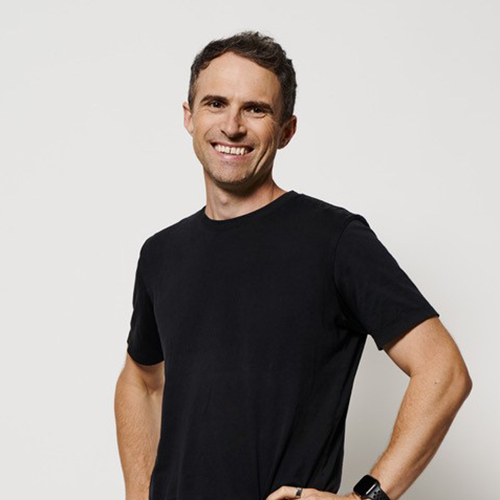
Joel Pearson
Joel Pearson is a neuro‑futurist who turns the mysteries of intuition and consciousness into mind‑bending science. He is the Director of the Future Minds Lab, and an ARC Future Fellow at the University of New South Wales. His debut book, The Intuition Toolkit The New Science of Knowing What, Without Knowing Why, came out in 2024.
Blending his art‑school roots with cutting‑edge neuroscience, Joel decodes how the brain responds to AI disruption, observing the intersection of humanness and AI. A key focus is exploring how imagination can supercharge our relationship with AI, whilst talking through practical steps on how to be ready for an AI shaped future.
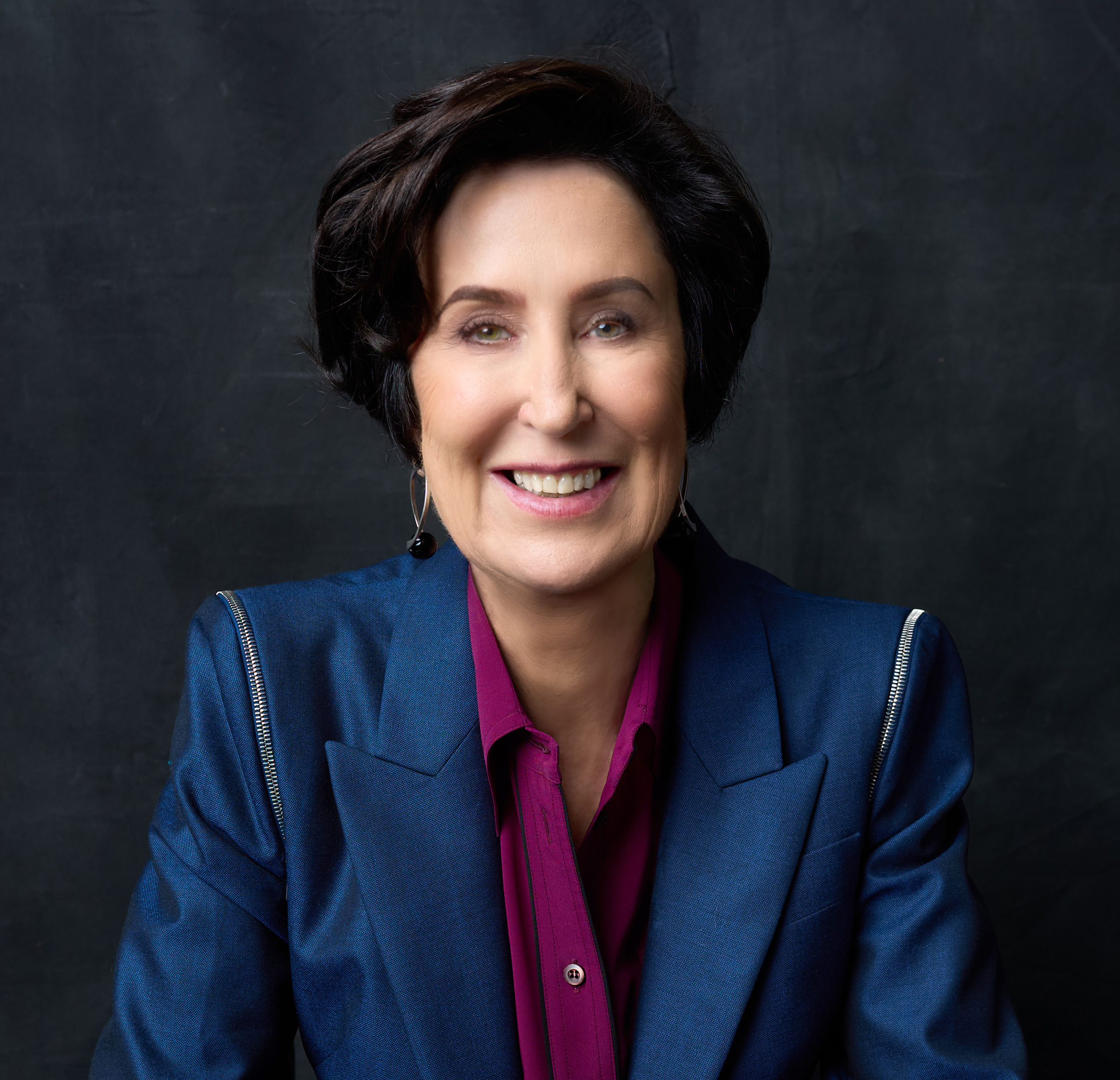
Barbara Wilby
Barbara Wilby is a leadership transition specialist with over 20 years' experience working with senior leaders and teams across sectors including finance, healthcare, aviation and professional services. With an MBA and a background in turnaround marketing, she founded Corporate Wisdom to help executives and organizations' overcome internal barriers and unlock strategic potential. Barbara has worked with McKinsey as a lead coach and facilitator on large-scale cultural transformation. She has supported dozens of executives stepping into CEO roles, and is known for her sharp insight, strategic clarity and grounded, practical approach. Her book So You Want to be the CEO was released in June 2025.