
History of Sex
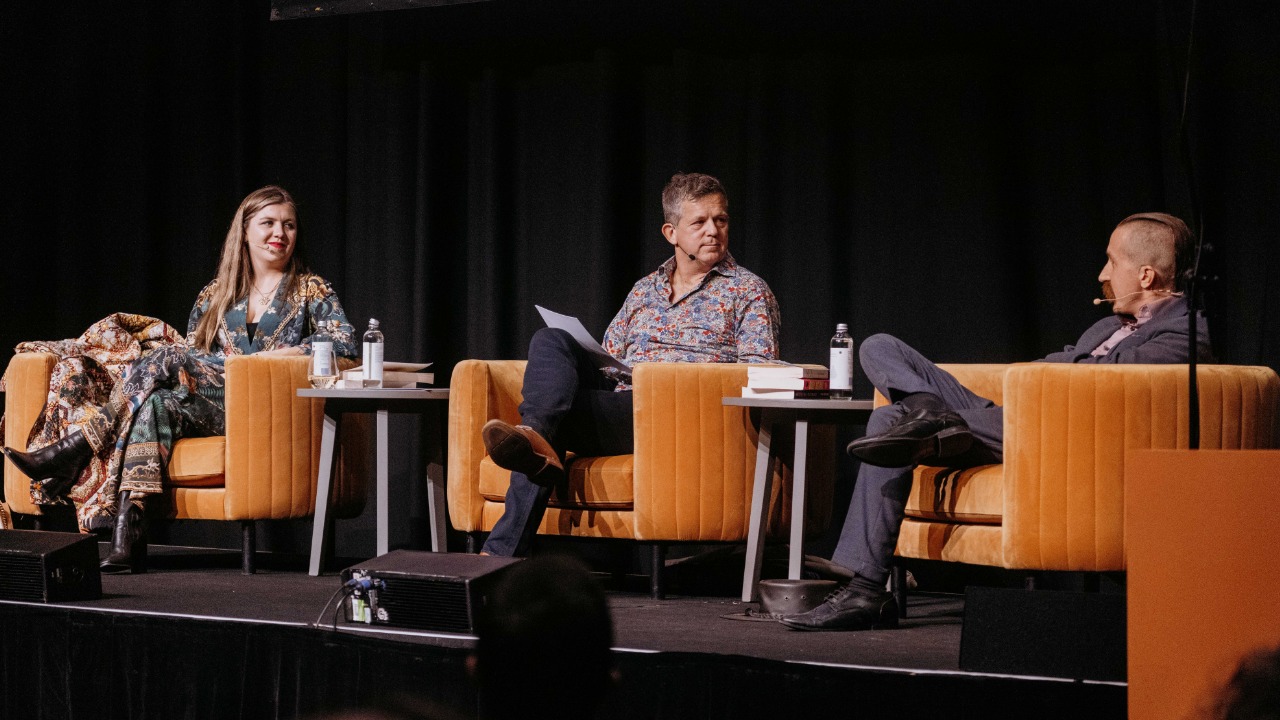
I think for men, but also for women, the big thing that’s going to come out with technology are these AI intimacies. Because that’s, I think, what most people desire, and feel is missing in their lives.
David Baker | Rob Brooks | Esmé Louise James
How did sex begin? How did it evolve to become so varied and complex in humans? And what could sex look like for future generations?
Hosted by evolutionary biologist Rob Brooks, this blush-worthy panel discussion features sex historian Esmé Louise James and historian David Baker. Esmé adapted her wildly popular TikTok series into a book, Kinky History: The Stories of Our Intimate Lives, Past and Present, and David’s Sex: Two Billion Years of Procreation and Recreation charts sex’s evolution from early life to sexbots.
Listen to bone up on carnal knowledge across the centuries and find out what the future of fornication holds.
This event was presented by the Sydney Writers' Festival and supported by UNSW Sydney.
Transcript
Robert Brooks: Hello everyone. Welcome to Sydney Writers' Festival 2024. My name is Rob Brooks. I'm Professor of Evolution at UNSW Sydney and author of Artificial Intimacy, which is kind of future history of sex.
I'm delighted to welcome you all here tonight to our discussion of the history of sex and our discussion, I mean my guests and I. Before we begin, I'd like to acknowledge the Gadigal people of the Eora Nation, the traditional custodians of the land on which we meet tonight and pay my respects to elders past and present and to Aboriginal and Torres Strait Islander people who are here today. Tonight, the program promises that we are going to bone up on carnal knowledge across the centuries.
Now I must emphasize, as the guy with the microphone, that there will be no boning here tonight, up, down or in any direction. We're all professionals here. It's an expression that I haven't really heard since the heyday of the Pauly Shore movies and mid-1990s Encino California is where boning up will remain for now.
But here to explore the history of sex, and in many cases I mean the deep, deep, deep history of sex, are two wonderful writers and multi-talented entertainers. Esmé Louise James, TEDx speaker, writer, creator of the Kinky History TikTok account with over 3 million followers, nominated for the best digital creator at the 2022 AACTA awards. Esmé's book, which is what we're here today to talk about, is Kinky History.
First published in Australia by Pantera Press, it's about to celebrate its worldwide release, published by Tatcha Perigree. While she's been navigating all that, she has also been completing her PhD at the University of Melbourne and is in the very, very, very, very final throes of thesis completion and defence, so we are doubly delighted she's made it up to Sydney to be with us tonight. Welcome Esmé Louise James.
On my left, in the green corner, David Baker is a science historian, script writer for SimonWhistler.com and podcast host based in Townsville, Queensland. He holds the world's first PhD in Big History and has taught at several universities, including the Universities of Calgary, Amsterdam, Macquarie University, and he is currently a visiting lecturer at the University Paris-Sorbonne. David was a big contributor to Bill Gates's Big History Project curriculum, and he's also known, I'll have you know, for writing harrowing three-hour epics on the world's worst serial killers for the casual criminalist.
His most recent literary works are The Shortest History of the World and the book we're here to talk about tonight, for which I have the green cover, Sex, Two Billion Years of Procreation and Recreation. Welcome David Baker.
Now, when I was a boy and I went to school, I learned that sex was ineffable, unattainable, and very, very, very complicated. I didn't learn it at school, but at the time I was at school. Most of all, I somehow formed the impression that it was invented in the 1960s, but both of these myth-buster historians right here have managed to convince me otherwise. So, David, your book talks about two billion years, which is a long time in anybody's book.
What are the broadest lessons that we learn by looking back so very, very far?
David Baker: Context. I found that, particularly looking at social media, there seems to be a lot of misery expressed about sex and romance, whether it's, I can't find a relationship or I'm miserable in the relationship I'm in. And I thought it would be a lovely antidote to all that, to go through and just show people where the messed up world of sex came from.
The anatomy, the base instincts, the evolutionary reasoning behind it, the conflicting instincts that are the bedrock of human sexuality, and then how those instincts have interacted successfully or not so successfully across thousands of years of history and different cultural practices. That's the important thing for me, is just maybe someone out there is going to feel a little bit better about the world we're in in regards to sex, just knowing where everything came from.
Rob Brooks: So, if you think your Instagram world is portraying a kind of sex that you're not having, and you're really, really, really jealous, imagine what it's like for two T-Rexes trying to get it on?
David Baker: Yeah.
Esmé Louise Brooks laughs
Rob Brooks: Sweet. Esmé, you also have a historic take, but your focus is a slightly narrower time period, because it's really the time in which people were writing stuff down, and a different suite of materials. What is Kinky History, the book, and what are the broad lessons from that?
Esmé Louise James: What a fantastic question.
So, the whole idea of Kinky History, when it first started and when it's become a book, which I really got to work and flesh out with my editor, Tom Langshaw from Pantera Press. We use kinky in its kind of dual meaning. So, we have the connotations of kink and fetishes. But kinky is also just something that deviates from the norm, something that kind of sits outside of what we consider to be normal and every day. And so, when we came up with Kinky History, it was about having conversations that we don't normally address when it comes to sexuality, vulnerable parts of who we are. I have to say that I was very impressed with my book being the oldest fact in it, 28,000 years. I thought that was great. I've been absolutely humbled by seeing the timeline in David's book. But I do think that this kind of duality speaks to the fact that we've been having these conversations about sex and sexuality and identity, in the same way in ancient times when we first started writing and we have those records, as we do now.
And Kinky History was really about putting together those modern-day conversations, just kind of looking back to see in some ways we haven't changed. And that's actually lovely.
Rob Brooks: Do you think we talk about sex more now than we have ever before?
Esmé Louise James: No. And that was something that has been really fun to explore, because we do have this, I think, you know, a bit of a guise in the media that we're a sex crazed society and Gen Z is teaching everyone to love whipping. But that's just simply not the case. And when we do put history back into the conversation, we can see that these parts of who we are have always been parts of who we are.
And we say that we need to learn from the past in every other aspect. So, I guess what Kinky History was aiming to do was to bring it back into those modern-day media conversations as well. We can learn from the past, from the conversations we were already having. It's a continuation. And that's kind of lovely.
Rob Brooks: Kind of nice to know that I'm trying to think of some of the big literary figures, but...
Esmé Louise James: They always like to be spanked. All of them. Like any author.
Rob Brooks: Is there something submissive about writing?
Esmé Louise James: I think so. Well, I think one of the funnest facts, I'm tangent, like doing a tangent now, but one of the funnest facts that we had in the book was Victor Hugo, who wrote like Les Miserables, The Hunchback of Notre Dame.
Rob Brooks: That's talk about self-punishment.
Esmé Louise James: Yes. He used to just take off his clothes and wouldn't let himself get his clothes back until he finished a chapter. And I didn't do that with my editor, Tom. He shut down that idea. But I do think it's quite an interesting thing. Authors are gladdened for punishment.
Rob Brooks: Was that to stop himself playing with his clothes?
Esmé Louise James: No, he was freezing.
Rob Brooks: So, he could play with himself. Okay.
Esmé Louise James: Just let himself freeze. So, there's that.
Esmé Louise Brooks laughs
Rob Brooks: Oh, Paris in the winter. David, big history. It's really, really, really big. Right. My own interests as an evolutionary biologist are of course big and long-term. And so, I was fascinated by your book, I must say. But it's been interesting to see you as a historian and somebody who studies well before written history, grappling with these questions. What propelled you into the study of big history in general?
David Baker: I started in the genre of French Annaliste history, which is a lot of demographics and a lot of environmental history.
And what would be for a conventional historian be considered a long time period, but just a few centuries. I found in my master's that something was missing. And so, in my search to find what that was, I did a graduate course in the biological sciences for the 200th anniversary of Darwin's birth and the 150th of the publication of The Origin of Species.
And what we did is biologists, psychologists, philosophers, and me, the lone historian, sat around for an entire semester reading the first edition of The Origin of Species from cover to cover. And I thought to myself, with all these different disciplines in the room around the table, we are coming up with observations and conclusions that we could not have done if we were just locked in with people of our own specialization. And so, from there, I fell into cleodynamics, which is looking for mathematical patterns in history. And from there, again, big history, which is 13.8 billion years and involves a lot of hard science. And I've actually been blessed to work over the years with some extremely prominent scientists and just looking for the common thread that unites the natural world and human society. And there's a surprising number of things.
Rob Brooks: So, if we're going to talk about shifting units for a moment, let's talk about Yuval Noah Harari. Where does he fit in terms of his account of history and the history of storytelling and culture? Does that work? Does that hold?
David Baker: I would have my criticisms of his approach, particularly to what makes humans different. It's a bit more than just working with symbols.
The idea that humans are fairly unique amongst species, that we retain more information generation after generation than is lost by the next, which allows us to accumulate learning and tinker with ideas and improve upon them, which is what took us from stone tools to skyscrapers within just a blink of an eye in terms of evolutionary time. And I don't know how far I want to go into Harari's stuff. He did thank my PhD supervisor for inspiring him.
So, there's that. I did look in the acknowledgements. My supervisor's name wasn't there, which is something.
Rob Brooks: Did the bastard cite you?
David Baker: Oh, I don't know if he did.
Rob Brooks: Surely you know. You go to the back of the pep book.
David Baker: Yeah, no, no, he didn't cite me. But when his stuff came out, I was still just a humble PhD student.
Rob Brooks: All right. Fair enough.
David Baker: Yeah. I hadn't really written much that was citable, except a few obscure papers that 12 people read and maybe six people understood.
Rob Brooks: We tried to get him out at UNSW and it was something like $500,000 for an appearance fee. So, I'm like, not even Hillary Clinton charges that much.
David Baker: No, I'm a cheap date by comparison. That's for sure.
Rob Brooks: So, the two of you, I don't know who wants to go first, but what is history for? Maybe David, we were talking history there. What's it for? What do we do with it?
David Baker: Okay. Cicero, to not know what happened before you were born is to forever remain a child. So essentially, if you don't read history, you live one life. And if you read history, you can potentially live thousands of lives and gain the experience and wisdom therein. From my own genre, that includes learning about and living by one remove through billions of years of history and looking at the world around you. It seasons us as individuals and gives us a better view of the world.
Sometimes it's imperceptible and you won't know that your historical perspective is coming to the fore, but it does frequently in just everyday life.
Rob Brooks: So, it's the quintessence of cumulative culture, which you were just speaking about.
David Baker: Mmhmm
Rob Brooks: Sweet. Esmé, what's history for? What's your kind of history for?
Esmé Louise James: I think, and especially, I guess, the through line of the book is that for me, history has always been a practice of empathy. It is this practice of learning to understand people and humans who are so far removed from you in an entirely different time, culture, place, and getting into their minds and their heads. And it's something that fro me personally, I think has helped to make me a better person.
So, when it came to putting together Kinky History and bringing sex and sexuality into that conversation, it's really big for me that people walk away with this experience with empathy placed back into the centre of these conversations. And there is something about, and maybe this is just like book nerd in me, but there is something about reading people hundreds of years ago that just resonates. It's like, you know, when Shakespeare put on plays and he couldn't set them, you know, in England.
So, he would set them in Vienna so that people could experience their world and everything that they wanted to critique, but they had to do it somewhere else. And I think that's what history is. I think we learn about what's happening today and we learn to conceptualize that we learn what we think about it, if we can remove it from ourselves and bring it back in. So, I guess my summary would be empathy. And that's not a quote from Socrates or anything.
Rob Brooks: So, when Mozart, and to quote, tells us to “shit the bed”
Esmé Louise James: Yes.
Rob Brooks: or James Joyce talks about the smell of his wife.
Esmé Louise James: My sweet little whore-ish Nora /
Rob Brooks: There you go
Esmé Louise James: / you let out a cacophony of farts that night, darling, and I fucked them out of you. When he says that, that is a practice of empathy, isn't it?
Rob Brooks: If empathy involves relatability, well, I refuse to answer that question.
Esmé Louise Brooks laughs
Rob Brooks: So, sex, I mean, it's a lot. It's mind blowing in almost every good way and every bad way imaginable and many that don't occur to the typical human imagination, although historians will know all about them, which is why we need you. I want to know some of the weirdest, oddest, wackiest, fucked up things that you discovered during your research. And I'm really going to go with who wants to go first here.
Esmé Louise Brooks laughs
Esmé Louise James: I mean, I've just recited James Joyce's letters for you. We could do some Mozart.
Rob Brooks: You've got some more gold than that.
Esmé Louise Brooks laughs
Esmé Louise James: Do you know, I was thinking about this today. I won't tell you why, but I was thinking about that there was one point in the book where we kind of made the connection of Shakespeare kind of accidentally inventing the word horny. And it came from the history of the cuckold, which we speak about at length in the book.
And especially in that 16th, 17th century, Europe was just going cuckoo for cuckolds. Like we had these images of people who had horns coming out of their head and a cuckold is someone who is being cheated on by their partner. And Shakespeare starts really riffing on this joke and, you know, throwing around words like thou wouldest be horn mad if you get aroused and, you know, you want to fuck someone else. And so, which helped to give us horny.
But on top of all of this, as this kind of like horniness is going along, if you wanted to insult someone, Shakespeare says, you know, you make these figures of horns at them to be like, you're a cuckold. You don't know you're being cheated on.
And if you really want to land the insult, you sneak them behind their head, which gave us bunny ears, which is a photo bomb trend that's still going on. And so, in like Francois Bernal's Commedia dell'arte picture of the actors, it's really weird. From like the 1600s, you see this picture of the actors and one of them is just giving bunny ears. And it looks like something that's AI generated. But I think it's a really fun example of just history continuing itself. When I realised, when I was reading that part of the book and it was like, you're doing bunny ears. I'm like, bunny ears? And you just boom. That's where that comes from. I was doing that in year five and I was calling like Jared in my class a big cuckold.
Rob Brooks: That's pretty highbrow for year five, but cumulative culture again.
Esmé Louise James: They said I was an advanced child.
Esmé Louise Brooks laughs
Rob Brooks: Did you believe that or were you just being patronised?
Esmé Louise James: Oh, it went straight to my head.
Esmé Louise Brooks laughs
Rob Brooks: David, something weird and trippy that you discovered?
David Baker: Well, let's start with the origin of sex. Two billion years ago, prior to that, for the previous 1.8 billion years, we just cloned ourselves. We were single celled microbes at that point.
There is a very intriguing hypothesis about how sex began, because really in evolutionary sense, sex is not to your advantage, at least not at the door. Because if you clone yourself, you copy 100% of your DNA. If you have sex, 50%. So there has to be a good reason to get into that entire process.
Rob Brooks: With an entire random.
David Baker: Yeah
Rob Brooks: It's not even related to you.
David Baker: Indeed.
Esmé Louise James: Well, not always.
David Baker: That's true. There are exceptions to that rule. But the interesting hypothesis about how all that began was during a snowball Earth phase where the entire Earth was encased in ice. We're not just talking an ice age. We're talking from pole to equator. And then it seems like under that environmental pressure, certain microbes began to eat each other. And at that point, they didn't have their DNA contained in the nucleus.
So, there was an accidental exchange of that DNA. And that might have been the first sex act, cannibalism, an act of cannibalism.
Rob Brooks: Eating and then fucking.
David Baker: No fucking involved, unfortunately, just the eating part. But that led to an exchange of DNA, which then created a whole bunch of evolutionary advantages, one of which is it speeds up your ability to adapt because there's more genetic variation. But all of the sex, all of the sex might have emerged from essentially a microscopic version of Hannibal Lecter, which…
Esmé Louise Brooks laughs
David Baker: … do with that what you will.
Rob Brooks: Nasty anti.
David Baker: Mmm
Esmé Louise James: It's like autoeroticism and it's like immediate form then. You know, like when people just have sex with themselves
David Baker: Yes
Esmé Louise James: Today,
Rob Brooks: Is that even possible?
Esmé Louise James: That's like the OG kink. Well, apparently the autoeroticism is kind of blowing up on TikTok at the moment as a concept. I love that this is my area of expertise. And people are talking about, you know, feeling sexually attracted to themselves and kind of making out with a mirror.
And I just think maybe rather than critiquing them, we should be like, well, that's the OG sex. You're doing it the original way.
Rob Brooks: Safe sex as well.
Esmé Louise James: Safe sex.
Rob Brooks: So, kink. Let's talk about kink because kinky history here.
David, you take a very evolutionary view of kink practices like BDSM, arousal surrounding cockledry, foot fetishes. What's your argument here in terms of there being some kind of an adaptive or at least an evolutionary basis?
David Baker: Well, I mean, it'll vary depending on the fetish, but a number of fetishes seem to revolve around the idea that you're doing something that is perhaps not in your sexual best interest in terms of being able to reproduce. Cuckold fetish is a fine example of that.
But also, just in terms of fetishizing a dominant partner might be another where as humans, we have a mixture of instincts, some towards promiscuity, some toward polygyny and some toward monogamy. And a dominant partner generally exhibits traits that may not be the best monogamous partner, and yet it's a source of much arousal. There's plenty of other fetishes where you're essentially putting your partner up on a pedestal, and that increases their attraction.
Jealousy is also a factor in certain fetishes. And the list goes on and on. You can't apply an evolutionary explanation to something like a fetish for brushing your teeth. There are people who actually orgasm simply from the act of brushing their teeth. It's very rare, but that seems more of a quirk of psychology than it would be having a deep evolutionary explanation.
Rob Brooks: There are people who don't orgasm because their partner doesn't brush their teeth.
Esmé Louise Brooks laughs
David Baker: Touché.
Rob Brooks: We should check that out.
Esmé, your book's all about the kink. I have to ask, though, having been called E.L. James at birth, is that just the most serendipitous piece of literary foreshadowing? Or is it a bit of a pain given the dubiousness with which the Fifty Shades of Vanilla trilogy is viewed outside of vanilla land?
Esmé Louise James: Well, I have to say, I do have some ongoing beef with E.L. James. She doesn't know it, but I do. And actually, it goes back, I have to take it back in time, when I was 14.
Rob Brooks: Which is about when she was publishing this gear.
Esmé Louise James: It was. It was the year...
Rob Brooks: You didn't change your name at 14, did you?
Esmé Louise James: Yeah, I was like, do you know what? I aspire to be you.
Rob Brooks laughs
Rob Brooks: Sorry, carry on. You're beef.
Esmé Louise James: But in the same year, and I don't want to compare myself to a best-selling author, but 14-year-old Esmé did write her first book. And it was a Christian children's book. Yes, I know, things changed. But I was very excited, and I had like an American, very small publisher, and it was very exciting.
Rob Brooks: You published your first book.
Esmé Louise James: I did.
Rob Brooks: You didn't just like make it for your mum.
Esmé Louise James: Do you remember when I said I was an advanced child? Yes, really.
Esmé Louise Brooks laughs
But this was the biggest thing that ever happened in my country town. And so I was so excited about it. And I was like, you can buy my book on iTunes. You know, iTunes was really big back then when you got the vouchers as well. And so, everyone in my school went and searched in E.L. James, which I had published my book as. And I had, the headmaster of the school had to send round something to basically say, while we're really happy for Esmé's achievements, we do not recommend that parents buy this book. And I'm like, girl, that is a beautiful Christian children's book. And then I realised.
And so, she essentially ruined my debut. I could have been a best-selling author. Everyone in my country town was prepared to buy it. But then my headmaster, E.L. James, it was all thwarted. So yeah, no, I have beef.
Rob Brooks: Damn. You didn't tell me that in the green room.
Esmé Louise James: No, I thought I'd save it.
Esmé Louise Brooks laughs
Just in case you're here tonight, E.L. James.
Rob Brooks: So, your books are organised by kink. I mean, the sin kink, the pleasure kink, the queer kink, the kink kink. I like what you did with that one.
Esmé Louise James: Thank you
Rob Brooks: The porn kink. What is a reader to do with all this kink?
Esmé Louise James: I mean, have a really good time. First and foremost. I do say, I was like, it's the perfect book to read with a glass of wine or a bottle. Just, you know, it's quite great.
But I think it was really interesting when we kind of staged the chapters as well, when we do take this idea of kink, you know, that deviation from the norm. And when it gets to something like the kink kink, we, I think it was that we had the most fun writing this chapter as well, because this idea of kinks and fetishes and what they mean is such an ongoing conversation in, I think, all, like many different faculties of academia. And I was so excited, David, just before I got here, I was like, reading all of your work about BDSM.
And, you know, you mentioned the foot fetish as well. And there's something that is so fascinating about that, because we talk in the book at length, the foot fetish is a massive chapter, that there's so many different theories about where these kind of fetishes come from. And one that I thought was really interesting, and it reminded me of when I was reading your book, David, was that there was this study done that essentially found that foot fetishes are more common during sexually transmitted epidemics throughout history.
So, in the 13th century gonorrhoea epidemic, in the 16th and 19th century syphilis epidemics, and most recently during the AIDS epidemic, we see an increase in literature and media to do with eroticizing feet. And there just seems to be this ongoing thing throughout history that when the genitals pose too much trouble, we turn to feet.
David Baker: Seems like a good way to stamp out STDs.
Esmé Louise Brooks laughs
Rob Brooks: You're putting that away for later material, I can tell. So, you know, it's not always as fun as Esmé makes it sound. I'm not talking about foot fetishes, I'm just talking about sex in general. It's often very kind of bleak, you know. It's not sunshine and rainbows.
David Baker: No, bleak is my specialty.
Esmé Louise Brooks laughs
Rob Brooks: I kind of notice that from time to time, although occasionally cheerfulness does break through.
David Baker: It's a very humorous book. So yeah, you won't want to top yourself after reading it, just for a sales announcement.
Rob Brooks: Or give up sex. I mean, you're still interested in sex when you get to the end of it.
David Baker: Well, I mean, I'd be most gratified if people actually found any part of that book arousing or titillating.
Esmé Louise Brooks laughs
Rob Brooks: Well, that's why we have book signings.
Esmé Louise Brooks laughs
Anyway, sex is often associated with and perhaps a driver for some of the worst things that happen in people's lives. How do you, in a big book like this, navigate that bleakness and darkness in the stories that you tell and the way that you analyze history?
David Baker: If we're talking about aspects of sex that are particularly traumatic, I try to be as clinical as possible. It would be insulting and disrespectful to try to get melodramatic about an account of a sexual assault, for example. So, I just, I don't use a euphemism, which is disrespectful in a completely different way. I just, plain facts, plain speech.
And yeah, it's something we have to confront. The fact that many, many, many copulations in our own family tree probably were not consensual. And that's pre and post-human.
And that is a harrowing fact that we just have to live with. This sort of stain in our family tree.
Rob Brooks: And a very humbling fact, I think, the fact that, you know, everybody here comes from many, many, many, many, many successful copulations. None of our ancestors were unsuccessful at mating, but sometimes that notion of success is not what we talk about when we talk about social.
David Baker: It can get dark very quickly.
Rob Brooks: Yeah. Esmé, how do you navigate the darkness?
Esmé Louise James: Look, it's not an easy thing to do. And I encounter this working in this area online as well, because when you are opening up a conversation, it would also be irresponsible to leave these parts out. It's an important thing to remember and hold and recognize.
So, I think, especially when we tie together, there's places in the book where you can go from, for example, you know, exploring all the sexual proclivities of ancient Greece, but then you do need to get into a discussion about practices of pederasty, for instance. And the fact that that was continued in Europe until 1700s, this practice, and there is a lot of darkness there. So, I think what I always find really important to then contextualize with this conversation is what we can do differently via having exactly this kind of dialogue and the information, how we can now navigate more harmonious and ethical relationships today, because we do have the privilege of access to education, to access to information.
We are able to share and converse, and we're sitting here in this room being able to access to information, we are able to share and converse and we're, you know, sitting here in this room, being able to discuss hard topics.
When you add in that aspect, when you're remembering the past, I think it drives not only a sense of hope, but just a reminder about why we're doing this and how we can actually change relationships today, because there is still a lot that we need to work on and adjust. And so, I think, you know, for me, that's it, you've got to bring in that darkness, but also that reminder of in recognizing that darkness, we can change it in the future. And we are changing it right now.
Rob Brooks: This conversation is very important. And buying tickets to events like this and buying books at those events is very important.
Esmé Louise James: Yeah, buy our books.
Rob Brooks: But I mean, my grandparents, you know, who married in the 40s, and they would talk about the act of marriage, I didn't know what they were talking about for a long time. But you know, obviously, the sex that two generations ago, our grandparents were having was very much in a, you know, mommy and daddy who purport to love each other very much, maybe don't, kind of a way, but it was suppressed. In fact, the history of sex, and both of you do this so well in your books in very different ways.
The history of sex is really, in many ways, the history of suppression. It's the way people suppress one another, suppress other individuals to their own interest, suppress other groups of individuals, occasionally suppress even themselves. When suppression occurs, it's highly gendered. Yes, men tend to experience sexual suppression, but women to a far greater degree and far more extensively, people who are not sort of primarily heterosexually oriented, people whose gender expression isn't, you know, exactly within the sort of rules of the day.
You both spend a lot of time talking about this kind of stuff. But I'm really interested now in what you think in the context, as David put it right at the beginning, about, say, the contemporary Anglosphere, maybe even the climate that, say, 2024 Writers Festival attendees, although that may not be a typical group, might inhabit.
How do we fit in relation to your histories of restriction and suppression and subversion?
David Baker: The prognosis at the present time doesn't seem too rosy if you go by what you read on posts on the internet. There seems to be a revival, an intensification of gender war. Red Pill, Manosphere, all of that.
But regardless of which gender you are, what gender you are, there seems to be a prevailing sense of despair in a lot of these online spaces. And you get statistics about how, well, people aren't having sex as much, particularly young people. Or, you know, the marriage rate is in the toilet and the divorce rate is stagnating, but that's just because people are turned off the whole idea.
Or, you know, there's a whole bunch of negativity that you can generate just by yourself, if that's what you want to do. And I would say that people who are, perhaps for whatever reason, unhappy with their romantic life, they might gravitate towards that sort of behaviour. But you have to remind yourself that sex, as shown by history, has always been messy, chaotic, sometimes ugly.
But for generations, generation after generation, people don't erect sort of a perfect situation. They find someone and they do whatever works, and pursue passions and mutual attractions and affections. And we just sort of stumble our way through.
Rob Brooks: Fuck around and find out.
David Baker: In a positive way, as opposed to how that's usually employed. Yeah, we fuck around.
Rob Brooks: Thought that was how I ran my career, but anyway.
David Baker: Yeah, so I would say that one shouldn't focus on too much negativity, or lament how, you know, this rate of sexual intercourse or this aspect of relationship seems to be going down the toilet.
Just for yourself as an individual, which is how it's been for everyone throughout history, just try to find something that works for you and your partner or partners, as the case may be.
Rob Brooks: Do we think, though, that this is one of the least suppressed times in history, or we're kind of in the middle of the road?
David Baker: It depends on what area of society we're talking about. Certainly, in popular spaces and on the internet, I mean, pornography is now readily available, and more so than in history.
More people are actually working as porn actors than at any time in history. But you could also make the argument that proportionately, per capita, there are now more sex workers. We're approaching the point where we're matching something like 19th century London, where there was just an immense number of sex workers back then.
That's all coming back. Yet at the same time, we have a significant backlash to that idea. The rise of trad as an internet meme, trad wives and so forth, purporting a very, well, what they would say, a classic version of male-female partnerships.
Though, generally speaking, trad seems to ape Norman Rockwell paintings from the 1950s.
Rob Brooks: The weird kind of status signalling trend on the internet in which you sort of deify slash worship women who stay home and cocktail to the door with a ribbon in their hair.
David Baker: The funny thing for me there is, technically, it's not that trad, because the nuclear family stay-at-home mom thing is actually was around and available to the majority of the population, as opposed to just, say, the upper class. It was only around for a very brief window of time before it went away again. It's not particularly trad.
Rob Brooks: The least traditional tradition ever.
David Baker: Yeah. If you want to be a trad wife, you need to be on a farm…
Esmé Louise Brooks laughs
..mucking out a pig pen, because that's how it was for the majority of people throughout agrarian history for 10,000 years, is you would contribute to the farm, not just domestic duties.
Rob Brooks: Doing all the work
David Baker: You would be out in the fields quite frequently, because that's a matter of life and death.
Rob Brooks: What are you thinking about where we are in relation to the history of suppression? Are we, you know, David's pretty upbeat about it. Where would you say we are?
Esmé Louise James: I mean, I have to first stop and say, when you just turned to me and said, what are you thinking about, I was going on to describe the farm that I was now picturing in my head. And so, I've got to move past that moment really quickly.
Esmé Louise Brooks laughs
The conversation is a lot more dynamic than I think we initially think. As you said before, when you asked, are we more sexually liberated than we've ever been? And it's really, it's not the case. And I think there's bringing up this conversation about what's currently happening on the internet and this, I guess, clap back in a lot of ways.
We're seeing big rises of glorification of masculinity. I don't know who the guy who kicks the ball, who decided to give that speech the other day at the graduation ceremony was. But, you know, I think that's a fantastic example of the fact that we are seeing this rise again of what people deem to be traditional gender roles, which are not traditional in any uncertain thing.
But at the same time, we're seeing this clap back because there is this threatened sense of the status quo. We're seeing opening, vulnerable conversations being able to take place. We're seeing people's identities being validated.
Being able to, in our queer kinks chapter, one of the main things that I hoped to give people the tools to do was to go back through history books and literature and find the words to describe non-binary and transgender that we, because we don't have the same terms as we have today. So back 200 years ago, 300 years ago, a thousand years ago, these went by different terminologies, but they've always been there in the history books. And once you have those terms and you find them, that's a validation of our sense of self.
And when you have tools like this, when you have the information there and we are validating, I think that's why we're seeing this clap back. I don't think we're seeing a suppression so much, but I do think we're getting into a bit of a boiling point of people who want to deny that. And that's a scary reality. It's a genuinely scary reality. But at the same time, I think that's the time where we come together as allies in a community. And we have seen that, especially in Australia, that sense of security and safety within a community.
So, and I can still enjoy the trad wife content. There's someone who like makes cakes on TikTok. She claims to be like a trad wife, but she's always like, I wanted to make bubble gum for my kids. And therefore I made it by scratch. I'm like, who makes bubble gum from scratch? Do you know what? You've got to give her some respect for that. That was very impressive.
David Baker: I will say one thing. It's not, what concerns me isn't just clap back. I also am genuinely distressed at the alarming percentage of young people who are swerving relationships altogether.
Some of these figures are just astounding. And I think the internet actually plays a role in some of that, that sort of isolation people have. And the dependency we have on apps, which by the way, in my opinion, are the kiss of death for people's reproductive success.
Esmé Louise Brooks laughs
Men, but also women.
Rob Brooks: Your smartphone's getting in the way of getting it on.
David Baker: Yeah. Like men, it's a very desert-like experience on an app, unless you are extremely good looking. And for women, it seems like they might be spoiled for choice, but how many of them are creeps, sociopaths, and assholes, it seems like it's a bad recipe for most people. But because of that dependency, I see the statistic that something like, I think it's 69% of men under 30.
Yes, 69. Nice.
Rob Brooks: Grow up, you people.
Esmé Louise Brooks laughs
David Baker: The numbers are what they are. But yeah, 69% of young men under 30 have either not approached a woman in public to flirt in the last year or have never done so. 69%.
Young men who should be out, looking for a nice girl to date, or sow their wild oats, I guess.
Rob Brooks: Another expression
Esmé Louise James: So much farming.
David Baker: Yes. Sorry.
Rob Brooks: No, that's good. You're a historian.
Esmé Louise Brooks laughs
David Baker: Maybe it's the North Queensland in me coming out. But at the same time, same survey, same study, 75% of young women, single young women under 30, wish they were approached more. And we're not talking in a harassment way. We're talking in a polite way. And so, you've got these people, this huge chunk of young people who are apparently immensely lonely, a lot of them, and yet they're just living worlds apart far too often. And that trend, I do find distressing.
Rob Brooks: So yeah, I mean, in my own book, I talk about sex robots and virtual friends, like chatbots, that you can fall in love with and all this stuff. And I kind of saw it as a, maybe on the whole, a force for good, in that it took a lot of heat out of the market, in that people weren't just desperately racing around going, gee, I need to find someone to screw. And that might generally make them think a little bit more before they do stuff and behave a little bit better.
And I think, you may have convinced me, I'm not entirely sure. I'd have to read both books again. But in your final chapter, you take this fairly gloomy view.
I have to say, I have to find the quote that I had about it, because, you know, you said we've just escaped this suppressive, this is not your words yet, the suppressive hold that agrarian living had on human sexuality. And then you predict something that's arguably worse, which is the technologies that are invading our social and sexual lives leave us with, and these are your words, grim possibilities confront us regarding the future of sex. So, you're really not feeling very optimistic about the technology-infused future of sex.
David Baker: Well, I mean, you could use new sexual technology as a pressure valve, right? Though I do not see incels descending on us in hordes.
Esmé Louise James: I don’t know.
Rob Brooks: They don't go to Writer’s festivals.
David Baker: There will be mentally unwell people. But it seems to me that generally, the sexless men aren't becoming angry and violent as a population level. They are just disappearing into their own homes.
Rob Brooks: You know, historically, they would go out and wage conquest and fight in the streets. And in fact, incels have probably been sedated by porn and virtual girlfriends.
David Baker: Yes, porn seems to be already be working as a pressure valve.
I think when it comes to new technologies around sex, perhaps there's a niche market for a few interested people who want to use a device that simulates fellatio. Sure. But for men, mostly, when it comes to that sort of activity, the old hand shandy is perfectly sufficient. You don't have to get too fancy with your tech. You just essentially drain that like a cyst so you can get on with your day.
Rob Brooks: Could you perhaps paint a word picture for us?
David Baker: But I think for me, but also for women, the big thing that's going to come out with technology is these AI intimacy. Because that's what most people desire, and feel is missing in their lives.
It's also why if you talk to strippers, sex workers, OnlyFans girls, whatever, a lot of them will tell you, well, actually, you know, a lot of what I do is just talking to people. It isn't necessarily about the sex thing. It's the intimacy thing. And I think AI might be a way to fill that void. But it depends on how quickly people overcome the uncanny valley effect.
You can have a conversation bot who's very articulate. But nevertheless, people might have niggling in the back of their minds. But this isn't real. I'm shouting into the wind here. Um, so I don't know that whether people can move past that and suspend their disbelief, that'll sort of determine how much this...
Rob Brooks: ChatGBT 4.0.
David Baker: Yeah.
Esmé Louise James: No, but ChatGBT does it now. I was just about to chime in with the ChatGBT voice.
David Baker: They've pulled it.
Esmé Louise James: Have they?
David Baker: Yeah, because Scarlett Johansson was not impressed.
Esmé Louise James: Right. Because I was gonna say that there's a really sexy, like, man voice there. And when I was reading A Court of Thorns and Roses quite recently, and I finished all the books, and I felt a bit sad. And I got up the voice thing. And I was like, could you speak to me as Rhys from A Court of Thorns and Roses? And they're like, of course, Esmé, darling. I'm like, so I had a really fun night. But my partner did walk in, and I was just like, gotta go. And he's like, I will see you up in the castle later. So, I think that there's something.
I actually, I don't have anything intellectual to contribute to that.
Esmé Louise Brooks laughs
Rob Brooks: It's lived experience. Well, that's, yeah.
Esmé Louise James: It was fun. It was fun.
Rob Brooks: Well, your last chapter is called Aftercare.
Esmé Louise James: It is.
Rob Brooks: And you seem to be a bit more optimistic about the future. I think in that final thing, because you talk about, you know, and you've spoken a bit about this already tonight about how talking about sex might just make it, you know, a better future.
And Zizek, the philosopher, says, I can't wait for sex robots, because then my sex robot and her sex robot can go off and have sex. And then we can share a glass of wine and have a great conversation. But you're a great believer in talking about sex.
Esmé Louise James: I am
Rob Brooks: Is that where the future lies?
Esmé Louise James: I want both the robots to come round and we'll have like a fantastic, not like that dirty, but we could like have a great little chat. If they could speak like A Court of Thorns and Roses. I think there is a lot.
Laughter
That's so embarrassing. I can't believe I've said this. But I do think that there is a lot of optimism to be had about technology.
I think I use a line that I can't believe went to print looking at you, Tom, where I say that the age of vibrators, you know, my boyfriend's penis doesn't vibrate on multiple settings. A phrase that his mum read. But, you know, I think that there is something when it comes to our exploration of sexuality, that technology has given us in a way that we would either never be able to explore, but definitely not explore in the very empathetic ways that we are now.
I mean, if I want to, as I say, I can go on chat GBT and have my little fantasy romance. And when it comes to exploring anything that kind of non-normative sexual exploration, I speak in the book about how technology can actually be a really good way to start an experiment rather than coming into a space with a person for the first time and having that kind of vulnerability about expressing your desires, not knowing if you're going to like it or not. Something like, there was a lot of dom and sub relationships over the pandemic as well that blew up on Zoom. And for the first time people could kind of experiment either with chat bots or with someone via a computer to see if they actually liked this dynamic. And if they didn't, if they felt very bad, you know, they can shut the computer, and they've already paid their hundred quid or whatever. But it, you know, there's something that's so wonderful about that aspect as well, that it's a safer place to explore in some capacity that I think if we invest and educate it in the right way, that can be to a benefit of our sexual exploration.
David Baker: I would agree. Net positive in that respect, the internet has made it much easier for groups of to come together figuratively and literally.
Esmé Louise Brooks laughs
Rob Brooks: Find each other, find their community, find people like themselves.
David Baker: Yeah. Which I think is something that for the majority of history, you just, you would have your own dirty thoughts and just keep them to yourself.
Rob Brooks: And virtual sex, if you, you know, can drop in and out of a scene a continent away, no walk of shame.
David Brooks: I think technology, generally speaking, is more than capable of filling a void. I guess I just lament the fact that there's a void to fill.
Rob Brooks: But that's because of this ancient conflict.
David Baker: Yes.
Rob Brooks: I have so many more questions. You have so many more questions. Esmé is now signing Sarah J Maas books as well as her own.
Esmé Louise James: I am. I'm coming for all the authors.
Rob Brooks: Yeah. And old EL James issues. But I have to thank these two for an absolutely fabulous conversation.
I had no idea how this was going to work out, but I'm very, very pleased that they've been so generous and open and willing to make the worst gaffes in the world. And you have been so generous in forgiving them those gaffes and laughing at all the funny parts, most of the funny parts. There were a few there that you missed.
Anyway, thank you all very much. Thank you, Esmé. Thank you, David.
Audience Applause
UNSW Centre for Ideas: Thanks for listening. This event was presented by the UNSW Centre for Ideas and the Sydney Writers' Festival. For more information, visit unswcentreforideas.com
-
1/4
-
2/4
-
3/4
-
4/4
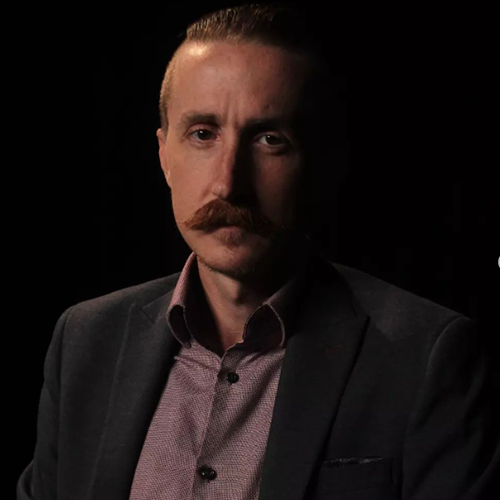
David Baker
David Baker is a science historian, script-writer for SimonWhistler.com, and podcast host based in Townsville. He previously taught at University of Calgary, University of Amsterdam, Macquarie University, and is a visiting lecturer at University Paris-Sorbonne. He created a quarter of the content in the Bill Gates Big History Project curriculum, and worked with John Green and Hank Green on a special series of Crash Course. His most recent literary works are Sex: 2 Billion Years of Procreation and Recreation and The Shortest History of the World" He is also known for writing harrowing 3-hour epics on the world's worst serial killers for The Casual Criminalist.

Rob Brooks
Rob Brooks is Professor of Evolution at UNSW Sydney and a popular science author. He has spent his career understanding the complexities and conflicts that sex and reproduction bring to the lives of animals, including human animals. His popular writing explores the murky confluence of culture, economics and biology, and how new technologies interact with our evolved minds and bodies. He has won the Queensland Literary Award for Science (for his first book Sex, Genes and Rock ‘n’ Roll), and the Eureka Prize for Science Communication. His articles have been published in Psyche, CNN, The Atlantic, The Sydney Morning Herald, Areo, and many other publications. His latest book Artificial Intimacy: Virtual Friends, Digital Lovers, and Algorithmic Matchmakers considers what happens when new technology collides with our ancient ways of making friends, growing intimate, and falling in love.

Esmé Louise James
Esmé Louise James (@esme.louisee) is a PhD Candidate, TEDx Speaker, and creator of the Kinky History with over three million followers. She has produced a range of non-fiction articles for publications such as The Age, the ABC and The Conversation, as well as short stories and poetry, for publications such as Hardie Grant Press and Archer. Esmé's book Kinky History was published by Pantera Press in Australia, and TarcherPerigee worldwide, in 2024. She received funding from Screen Australia's Every Voice initiative for the TikTok series, SexTistics, and was nominated for Best Digital Creator at the 2022 AACTA Awards. In 2023, Esmé was honoured with the University of Melbourne's Rising Star Alumni