
Genevra Hart | Dopamine Habits
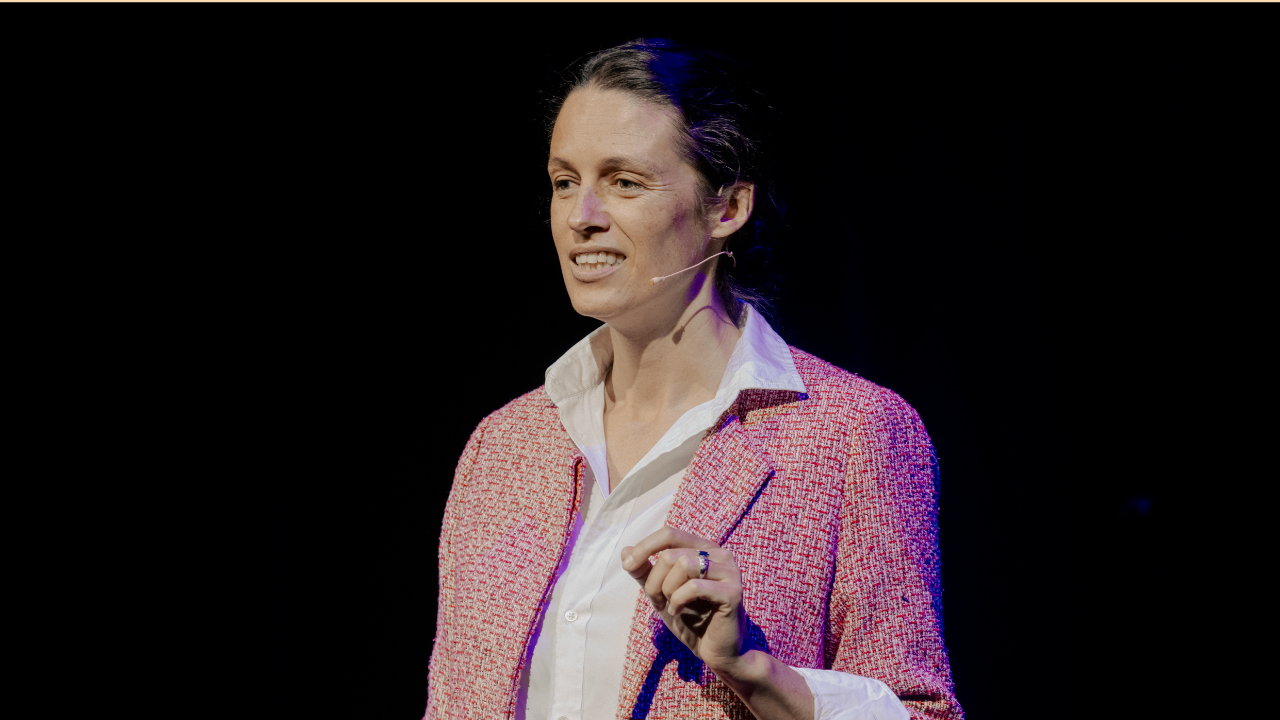
Treatments don’t start at the hospital, they start under the microscope.
Embark on a journey into the labyrinth of the human brain with Dr Genevra Hart, as she reveals the staggering complexity of our neural networks. Within the billions of dense microscopic neural connections that make up the brain, Hart isolates the importance of dopamine in controlling our thoughts and actions. Drawing from her research on decision-making, she illuminates the pivotal role of dopamine in refining our choices, and creating habits. With a focus on potential treatments for addictions, Hart advocates for advanced techniques such as deep brain stimulation. This exploration underscores the endless possibilities of neuroscience and its impact on our lives.
Hear more from Dr Genevra Hart as she unpacks the endless the possibilities of neuroscience and its impact on our lives.
Podcast Transcript
Rob Brooks: Welcome to 'Progress? Where Are We Heading?' a mini-series from the UNSW Centre for Ideas, where we'll explore the ideas shaping our future. Today we're diving into the intricate world of our brains and neurotransmitters. Some habits don't stick, others seem impossible to break, and addictive behaviours can override even the most serious consequences. Well, dopamine might just be part of the answer. Joining me today is Dr Genevra Hart, a researcher who's uncovering the role dopamine plays in how we learn, form habits, and in extreme cases, how addictions take hold. Genevra, thank you so much for joining us.
Genevra Hart: Thanks for having me, Rob. It's great to be here.
Rob Brooks: Let's kick off by breaking down what dopamine is and what it does. Can you explain for our listeners this really important molecule?
Genevra Hart: Yeah. So, well, I mean, actually, the funny thing is we've been studying dopamine in a fairly high level of detail now, a fairly long time, and we still don't fully know what it does, but I'll tell you ballpark what we do know. Dopamine is a neuromodulator. It's a neurotransmitter in the brain, but it's called a neuromodulator because its effects aren't exclusively to excite or quieten cells. It can do both. But it's a neurotransmitter that's really, really highly concentrated in a very small number of areas of the brain. And what we know about dopamine is that it's tightly linked to rewards, things that are rewarding. And obviously, that means food, but also drugs. And we know that its effects, it's not specifically about imbuing a sense of reward. It's not that dopamine gives you that euphoria. A lot of people think that's what it does. But actually what dopamine does is help you learn about things that are rewarding. So, it actually changes the way the cells are connected in the brain when we get a reward to help us learn to do those things again, to get rewards again in the future. So, it's actually a learning neurotransmitter that helps us learn.
Rob Brooks: It's in the education business.
Genevra Hart: It is in the education, some would say it is the education of the brain.
Rob Brooks: Right.
Genevra Hart: Yeah.
Rob Brooks: So, what makes it such a powerful player then, in shaping habits and behaviours?
Genevra Hart: Well, in essence, I mean, the data is still sort of coming out, but it seems to be almost central to that process. And I'll explain that in two ways. One, if you lose dopamine, right, transiently when there's a reward or something, you can't learn those relationships between actions and the reward. And two, if you stimulate dopamine, if you increase dopamine release in the brain, you can actually form habits. And we see that in the lab, but we also see that in people who receive medication for synthetic dopamine. In Parkinson's disease, one of the side effects is aberrant habits. And they can be quite strange kinds of habits. You know, suddenly, you know, gambling addictions or suddenly promiscuity or, you know, things like that, that these people didn't have before. So, it seems to be entirely causally linked to the formation of habits.
Rob Brooks: Now, in my social media timeline, and maybe this is revealing a little bit too much, but I keep getting advertisements, amongst other things, for dopamine detox programs. What is... Is there such a thing? Is that even a thing?
Genevra Hart: No. I see them too. And then there's like, you know, some of them are like, oh, you know, maximising dopamine, and then there's other ones like dopamine is really bad. And, you know, I think I'm assuming there's some kind of link to, like, screens and us getting too much stimulation from screens and linking that to, you know, too much dopamine is bad. And, I mean, I could definitely find a way to, like, twist it to fit some aspects of what we know about the science, but I don't think there is any actual science looking at those questions. But I mean, if I were to twist it in a way that would fit the science, you could perhaps say that if you're living in a world where you get a lot of stimulation and a lot of things going on that are causing dopamine release, so instead of just your regular, you know, you have a meal and that causes dopamine and then there's not for a while, you know, you're in between, you're on your screen, you're getting likes on social media or various things like that. And if they were also causing these sort of bursts of dopamine release all the time, perhaps it's possible you would become less sensitive to those naturally sort of occurring dopamine bursts that occur from natural rewards, like food. And maybe you would be more needing to get more of those hits with your social media and things like that to make up for it. It's true that receptors get, you know, they desensitise if you get lots of... So, but look, that might be one way that that could work. But there is no science right now that would suggest necessarily that we're less sensitive to natural rewards if we have more screen time. That's a hard thing to test.
Rob Brooks: Well, I'm super reassured by that. I'm just sort of thinking of the layers of irony, of people paying Meta the company to advertise for a product where largely the end result is switch your phone off for a period of time and don't look at social media.
Genevra Hart: Yeah.
Rob Brooks: That's very meta in itself.
Genevra Hart: I mean, they're also killing their own business model, right?
Rob Brooks: Yeah.
Genevra Hart: How is anyone going to hear their message, if they're not on?
Rob Brooks: Wonder if Zuckerberg's aware that they're doing this. So, habits can be great, but they're also part of our downfall, particularly when it comes to things like addiction. So, how do we get from a healthy habit to something as destructive as addiction?
Genevra Hart: Yeah, it's a really good question. It's a very important question. And it's one that a lot of people have been trying to find the answer to for a very long time. We don't know. But the ideas that have been out there for a long time, probably one of the earliest, was that drugs themselves cause drug addiction, right? Obviously, you can't get drug addiction without taking drugs, that definitely is true. But we also know lots of people, most people, in fact, who take drugs don't develop severe addiction. So, that isn't the full ingredient. But the theory that went along with that idea was that basically drugs cause levels of damage in prefrontal parts of the brain that reduce your ability to control behaviour. And therefore, you know, through a variety of cycles that involves dopamine as well, change the way the lower parts of the brain function and lead to addiction. That would be like a neuroanatomical kind of explanation. But we, there's some fairly powerful studies that show that reduced social, positive social environments, enriched environments, all of those kind of things are huge vulnerabilities. So, there's enormous sort of societal and also personal vulnerabilities that feed into that. And yeah, it's like a lot of things in the mental health space, you know, you can have probably some vulnerability at the level of your brain, but without the environmental factors as well, that's not going to be a problem. The environmental factors on their own won't lead to it. And you put the two together. And that's when you have things like addictions and, you know, those kind of things happen.
Rob Brooks: How far along are we in combining that sort of very neuroanatomical kind of almost deterministic view with this environmental view?
Genevra Hart: Yeah, a great question. Look, I would say that that will be perhaps the last piece of the puzzle. I would say, from my little bubble of area where I work, I would say that the two areas of inquiry largely exist separately, and that's as much to do with the methods required as anything, you know, things that involve, you know, really sort of societal impacts, environmental impacts, things like that, that involves community level stuff, that involves things that, you know, people that are struggling with addictions and things like that. The neuroscience when we're doing, you know, the really, really hardcore neuroscience, you can't measure dopamine release in humans at the level that you can in, you know, slices in cells, in mice, in rats, even in monkeys. So, you know, that work is existing separately at the moment, and I think it has to.
Rob Brooks: Yeah.
Genevra Hart: And at some point, I think we will get to a place where we can isolate the neurobiological mechanisms that lead to addictions and hopefully start to identify some of those things that might be pre-existing in people. And then we can start to look at those patient populations and see if we can identify those factors in those people and combine it with, OK, and what life experiences did they have that might have brought them to this point? So, I think that's probably how it will go. And I don't think that's detrimental on either end. I think that these two aspects can be viewed kind of separately, to some extent.
Rob Brooks: So, it's really complicated in terms of the interaction between what's happening out there in the world and what's happening in the brain, but the brain is incredibly complicated too. I don't think, I mean, I'm a biologist. I don't think I'd ever appreciated just how intricate and complicated it is until I heard you talk about it. Do you want to give us a little bit of a sense of the scale in which we're looking at complexity?
Genevra Hart: Yeah, well, actually, I hadn't either until I started. Well, that was the thing. We agreed to do this, you know, this insomnia thing, and I sort of planned that. And at the same time, this article came out in Science, you know, like, up the top of journals, for people that aren't familiar. There's Nature, there's Science. In our world that's like, that's the pinnacle. And they had mapped this very, very tiny piece of human brain tissue, one millimetre of tissue, and the scale of what that tiny piece of tissue contained, 57,000 cells. You know, it was just this extraordinary 150,000 connections between the cells in this tiny piece of tissue. It was the size of a grain of sand. And I actually also found that really daunting because whenever I look at cells in the brain, I'm looking at a specific population or a subpopulation, a really tiny slice. And in that really tiny slice, they look quite spaced out. But when you put it into a more dense sort of cube like that, you realise this stuff is just like... And you're capturing everything and all the scaffolding and all the processes in between and stuff, you're like, this is intense. How are we ever going to figure all of this out? Like, that's insane. Like, we don't have, you know, the level of data required to even hold the information, let alone understand it or make any sense of it. It is daunting. It's exciting as well because, you know, we've got a long way to go. And I think that can be a source of optimism because it means that what we've done so far is really just scratched the surface, and we're going to get really good at understanding stuff, you know, and coming up with amazing tools to help us. But, you know...
Rob Brooks: How many dopamine receptors in that one millimetre cube?
Genevra Hart: Oh, God, I don't know.
Rob Brooks: You haven't counted them?
Genevra Hart: No, I have no idea.
Rob Brooks: So, treatment now for things like addiction. Obviously, the current treatments have their limitations. They're certainly not perfect. You've been looking into possible alternatives, you know, way downstream from here, but still treatments nonetheless. Can you explain some of those treatments and what's new, and sort of possibly going to be available in the future?
Genevra Hart: Yeah, yeah. So, I mean, look, to put the context, I think, for addictions in particular, it's one of the, among mental health disorders, it's one of the ones that we don't have particularly great treatments for. It's a chronically relapsing condition. The existing treatments are not effective, at least the first, second, third time, often, for most people. And after that, you know, it improves, but, you know, it takes several goes most of the time. So, we do need to, we're working hard on trying to find better treatments. One of the ones that's really exciting that I've talked about and that I'm focusing on is deep brain stimulation, which is a really, it's a really, actually, quite an old treatment. It's been used for Parkinson's disease for 40 years, and we know it's effective in that, very effective for that. But there is a small number of trials now, very early stage, that have been testing the effectiveness of deep brain stimulation for the treatment of addictions. It involves implanting an electrode into the brain to basically trigger very small electrical pulses that will regulate the activity of neurones in that region, and particularly dopamine levels. And that's... This is using similar targets to what's used for Parkinson's disease, obviously... Well, not obviously, but to clarify, Parkinson's disease also involves, in that case, it's a loss of dopamine neurones. So, it's also a dopamine dysfunction. So, that was the reason that people thought it could be effective in addictions because it's sort of the same neurotransmitter system, the same parts of the brain, and so far there is evidence that it is effective significantly in patients who other treatments haven't worked for them. So, these are people that are at a, you know, fairly serious stage and chronically relapsing and all of that. And yeah, it does seem to be really promising. So, that's really great. And I think, and this is sort of where my research feeds into it, I think that one of the reasons why this treatment is so effective and why it really has the potential to be far more effective than medications, for example, is that dopamine modulates habits in a very specific part of the brain. But if you affect dopamine in a different part of the brain, you'll impact goal-directed actions. And so, if you're disrupting or enhancing or changing dopamine globally across the whole brain, like any pill would do, then you're obviously not selectively targeting a habit system or a goal-directed system. You might just as well be disrupting their ability to behave in a goal-directed way, which would obviously undermine their ability to overcome their habits because they're actually two sides of a coin. In order to beat a habit, you need to really set goals to not do that. So, you can't be affecting both systems at once. That would be counterproductive. So, that's the real benefit that deep brain stimulation has, is that it's actually just targeting a very small subset, you know, area of the brain. And so, you can selectively affect different parts of the dopamine system.
Rob Brooks: How do you know or learn where to target and what to prod?
Genevra Hart: Well, we know from other studies what parts of the circuitry are important for habits and what parts of the circuitry are important for goal-directed actions. That's kind of, you know, separate bodies of work that have fed into that. And there's a lot of that. So, we actually have a really good basis for understanding what places should be the targets of deep brain stimulation on the basis of that. And I'm not sure that they are exactly the targets that are currently being used, which is good, because what it means is that this treatment could be a lot more effective if it's applied in a just slightly different area.
Rob Brooks: Is that something you have suspicions about, or that you have inside knowledge of, or?
Genevra Hart: This would be my very strong suspicion based on my own work, but it hasn't been done in humans, so it would be great to see it done.
Rob Brooks: And you're doing work on different ways to apply deep brain stimulation, is that right?
Genevra Hart: Yeah. I mean, at the moment, it has not been using deep brain stimulation.
Rob Brooks: OK.
Genevra Hart: I've got a grant in to do that. So, I hope that it gets funded. But right now, we use probably slightly more precise ways to stimulate populations that are not, you know, with electrodes, but they're, you know, targeting specific cell populations. And we know doing it that way that we can, you know, promote habits or suppress habits. And so, we sort of know in a very specific way that this works, but of course, then you expand it into humans, you get a little bit more messy, you get a little bit less precise, and you need to see if it still stands up at that point. And that's always the challenge, I think.
Rob Brooks: So from the, you know, very applied kind of ideas about how do we, you know, improve treatments and what works in treatments, etc, I mean, that's all built on a foundation of sort of very fundamental, curiosity-driven research. You speak in your insomnia talk about the importance of that fundamental research. Can you just give us a bit of an appreciation, I guess, of why that's so important?
Genevra Hart: Yeah, I think that this is something I've really noticed, particularly in the direction that funding is going in Australia. There seems to be more and more emphasis on benefit, even in schemes that are historically targeted towards basic research. Now there's this benefit criteria, and it's very, very short timeline benefit. It's like, how is it going to help the Australian population tomorrow, you know? And I understand that there is a very important place for that. But I think that we lose a lot if we put 100% of the emphasis on that, because all of the things that I described that we can now do in the brain, and this was with regards to tools and things, but, you know, even beyond that, you know, if you look at, you know, the Nobel Prizes that were given this year, you know, this is for work that was done 40 years ago, stuff that really the benefits of those things have not been realised until now. So, you know, there's a vast array of things. And I mentioned in the talk, you know, we have the capacity to change our DNA. We have the capacity to, you know, change activity of cells using lights. You know, there's so many things that we can now do that are a product of, in essence, when people develop these tools, they didn't know what they would be used for. They might have had some ideas, but they probably didn't know what the most hard-hitting areas of those tools would be. But they were given the opportunity to build them anyway. And I think we just can't always know. You know, the Nobel Prize that came out, you know, like, last week or whatever was for the guys that did the neural network modelling. And then, you know, people are saying, well, they basically invented AI, which I think computer people would argue with. But the point is, this was foundational research that led to, how could anyone have guessed 40 years later that AI would be one of the products of that foundational work. So, you know, we have to have a long vision when it comes to what we want to support. And I think if it answers a truly fundamental question about how systems work, in my case, it's how the brain works, but whatever your system is, that really deserves a space because it will be useful at some point. And otherwise, it's just shortsighted. And it will be incremental, won't it? It has to be.
Rob Brooks: Yeah. It can't be anything other than that.
Genevra Hart: Yeah.
Rob Brooks: Well, you get no contest from me on the question of curiosity-driven research. I'm a curiosity-driven researcher myself. And, you know, almost to a fault, really. I would be very interested in knowing, I was going to ask you about where the treatments are going to go in the next ten years, but I think I'd rather know what in biology would you like to see progress on? What, you know, obviously, it's an unknown unknown. But where do you think all the action is going to be in the next ten years?
Genevra Hart: Hm. OK. So, in biology, so, in my view, the last ten years has been about tools. It's been an enormous kind of just boom of... And maybe a little bit longer than ten years, 15 years perhaps, but this incredible kind of just skyrocketing of tools. And sometimes there's been a criticism of the research where people have got the fancy tool without having necessarily the question. And I think we're getting to the point now where we're catching up with the questions. And I think this will be a time of proper, proper discoveries in biology because we're now starting to get a handle on using the tools, but we're getting over that now. We don't just use them for the fun of it. We're now back to our questions, and we just suddenly have this incredible toolbox. So, I think we're actually at a really exciting time. I think we'll see some extraordinary discoveries.
Rob Brooks: Well, that's really promising. I mean, I do remember when DNA microarrays came out, when sequencing projects were all going, and it was all about the tools, and we didn't know what to do with them. And folks were saying exactly the same thing you're saying now. And yet, you know, you don't see a lot of microarray studies, do you? But you certainly see the things that have come downstream from them.
Genevra Hart: That's right.
Rob Brooks: And it's been very question-driven in other areas of molecular biology, etc.
Genevra Hart: Yeah.
Rob Brooks: Cool. Well, that's very interesting. It's amazing to think of how something as small as a molecule, obviously, one molecule of dopamine can't change the world, but that type of molecule can, that it can have such a big impact on our lives both, you know, in terms of habits as well as in terms of goal-directed actions. And the scale on which it operates has just been really interesting for me to hear about. So, your research is fascinating. It's also incredibly important. I hope that you get that grant and get to do the stimulation. And, you know, that somebody somewhere down the track will benefit from it without probably even knowing that they're benefiting from it 'cause that's the way science goes.
Genevra Hart: That's the way it is.
Rob Brooks: Thank you so much for joining us on Progress today.
Genevra Hart: Thank you, Rob, thank you for having me. It's been fun.
Rob Brooks: And to our listeners, I hope today's episode gave you some insight into the incredible inner workings of your brain, and maybe a little motivation to think about the habits you form every day. Until next time, keep exploring and stay curious.
-
1/3
-
2/3
-
3/3

Dr Genevra Hart
Dr Genevra Hart is a lecturer in the School of Psychology at UNSW Science. Her work investigates how the brain controls decision-making, by guiding our choices towards current goals. While this function sounds simple it becomes challenging when our goals don’t align with ingrained habits. When the brain is in conflict between choosing new goals or old habits, specific neural processes need to be engaged to drive goal-directed choices, and these are the processes thought to be disrupted in addictions. She has published over 20 papers on this topic, which have been cited over 900 times.