
Ending the 'Tyranny' of Pregnancy
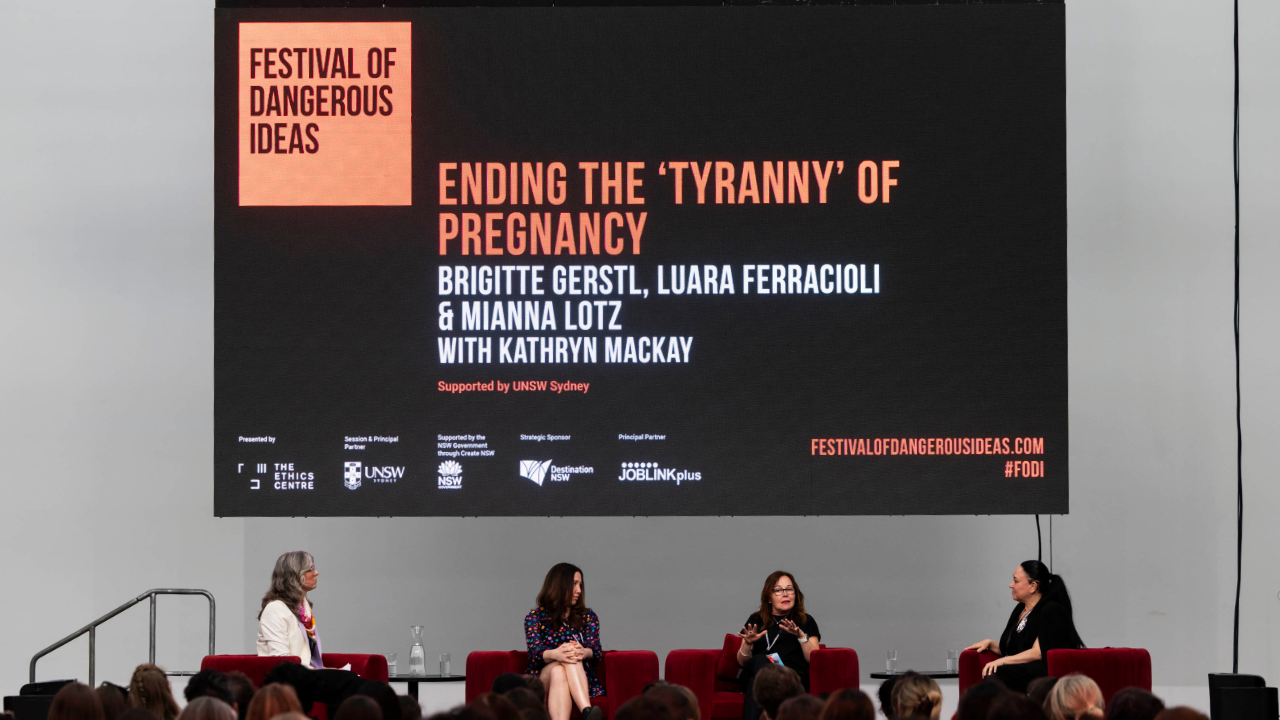
We also need to ask whether gestation, this process of having someone who's part of you, is something of value for us human beings that we don't want to give up on. That when we give up on that, maybe we lose something significant about the kinds of creatures we are.
Brigitte Gerstl | Luara Ferracioli | Mianna Lotz | Chaired by Kathryn MacKay
Is the emergence of artificial wombs and womb transplants a ‘boon’ or a ‘bane’ for women? Listen now and explore the transformative possibilities for reproductive autonomy that could redefine the very essence of motherhood.
Presented as part of The Ethics Centre's Festival of Dangerous Ideas, supported by UNSW Sydney.
Transcript
Kathryn MacKay: Hello everyone and welcome to the session Ending the Tyranny of Pregnancy. My name is Kathryn MacKay. I'm the panel chair and it's my pleasure to welcome you here for what I hope will be a very stimulating discussion.
I'm going to quickly introduce our panelists. I won't read the full bios because those are available for you to read and then we'll launch into some discussion. But without further ado, welcome panelists!
At the end of the stage here we've got Brigitte Gerstl. Brigitte is the program manager for the uterus transplant program at the Royal Hospital for Women. Brigitte played a pivotal role in establishing Australia's first live donor uterus transplant research study program at the RHW and she's currently developing the Deceased Donor Pathway. In this role she oversees patient screening ethics and governance while also monitoring patient progress and clinical and psychosocial outcomes.
Next we've got Professor Mianna Lotz. Mianna is an academic, ethics advisor and associate professor of philosophy at Macquarie University where she specializes in and teaches ethics and applied ethics with a research focus on emerging reproductive technologies, adoption, surgical innovation, family ethics and the welfare and rights of children and parents.
And then we've got Dr. Luara Ferracioli. Luara is an associate professor in political philosophy at the University of Sydney. She's currently undertaking an ARC DECRA project that's entitled Life Without Birth, the Ethics, Politics and Law of Artificial Wombs. Her main areas of research are the ethics of immigration and family justice.
And then finally there's me. I am a senior lecturer at Sydney Health Ethics at the University of Sydney. Most of my research is on virtue ethics but I have also written about ectogenesis and issues to do with reproduction in the past.
So welcome, thank you for being here.
To get us started off I thought we would just introduce the audience to these ideas, ectogenesis, uterus transplant. So Luara, I wonder if you could just describe what is artificial womb technology, what is ectogenesis?
Luara Ferracioli: So ectogenesis is the gestation of human beings outside the body.
Now we already do a little bit of that because we have conception outside the body with IVF, and we also sometimes keep quite premature babies alive when they wouldn't otherwise, because we have the incubator and a lot of knowledge when it comes to assisting those quite vulnerable babies to survive and then hopefully thrive.
So we already keep human beings, you know, we gestate human beings outside the body to some extent, up to 14 days at the beginning, and then around the threshold of viability around 22-23 weeks for quite premature babies. But the idea is that we could potentially do all of the gestation outside the human body and that raises a bunch of very interesting ethical questions and political questions as well.
Kathryn MacKay: How possible is this at the moment?
Luara Ferracioli: People disagree deeply about that question. Some are very optimistic because, you know, we already have managed to gestate sharks and lambs outside the body for a few weeks and they've actually done quite well. I mean they're hiccups but I think researchers were quite impressed by some of the results.
So it looks promising, there's a sense in which it looks promising, but the placenta is also quite the intricate body part and some are skeptical that we could ever replicate such a fascinating body part, which is a placenta. Which brings those two creatures together. Some have argued, makes the case that the fetus is actually part of the gestator. There are some certain views on the metaphysics of pregnancy that tell us that in fact we don't have, when you're pregnant, you don't have a fetus inside you. What you have is a body part that's growing and at some point when that body part is born, then we have two creatures, the newborn and the parents.
Kathryn MacKay: Thank you, super interesting. So full ectogenesis is different from the idea of something called ectogestation. Mianna, I wonder if you can describe the difference between full ectogenesis and ectogestation?
Mianna Lotz: Yeah, I think Luara has sort of done a fair bit already to kind of classify and distinguish the different forms that we can have. But just to reiterate and clarify, with ectogenesis, either partial or full, we might create the uterus initially, ex-utero, it may, sorry not the uterus, the fetus or the embryo, it may then be transferred into the human body.
And that's what we would refer to as partial ectogenesis. Then we've got ectogestation, which of course is where in the neonatal context, as Luara was talking about, a neonate born very early needing that extra life support in the ICU, the NICU, would then be gestating ex-utero in that context. And then full ectogenesis, ecto meaning outside and genesis actually meaning developing, rather than necessarily originating or generating.
So full ectogenesis, though, I think is the term we would use for what Luara was talking about as artificial womb technology, where right from the get go, the IVF, the in vitro context and the petri dish, we create the embryo there and then it is transferred into a bio bag of some description and it gestates for the entirety of its development. So it never is inside a maternal body. And that's quite interesting and raises a bunch of questions that Luara already started to point us to, but we'll come back to that.
Kathryn MacKay: Yes, we definitely will. Yeah. So one option I suppose then for people who are struggling, especially with gestation is to use these artificial wombs, which are a little bit like a soft bag with all kinds of tubes that come out of them and pressure moderation and all of this stuff.
Another option is to pursue a very kind of cutting edge technology, which is uterus transplant. So Brigitte, can you tell us what uterus transplantation is?
Brigitte Gerstl: So uterus transplant is taking the uterus out of a live or a deceased woman and transplanting it into a recipient. At the Royal Hospital for Women, we have done, we have conducted three successful live transplants, uterus transplants.
We've been successful in both recipients having live births from those transplants. One of the things about uterus transplant is that we're not in the business of transplanting an organ, although the organ will lead to the outcome, but we really want to look at whether this reproductive modality will lead to a live birth. So it's, so far we've been extremely successful and we're under clinical trial, clinical research at the moment.
We've done three, we’ve got three to do, of which we've done already three live donors. And we're moving into a deceased donor model, which will be removing the uterus as the last organ from a deceased person and transplanting that organ into a recipient, for our deceased model uterus transplant.
Kathryn MacKay: Great.
Mianna Lotz: And I might just add to that, Brigitte was talking about the Australian context and the trial that Brigitte works for is the first trial in Australia to be approved and to go ahead and commence.
But internationally, we have had around about a hundred successful transplants, and we've had somewhere in the vicinity of 40 healthy live births from uterus transplants internationally. So we're actually with that particular, sorry, I don't mean to.
Brigitte Gerstl: No, it's fantastic that we get to have chat about this.
Mianna Lotz: We're actually with uterus transplant…
Brigitte Gerstl: Yes.
Mianna Lotz: Although it's very new to the Australian context, we're actually at the point really where a lot of people are calling for it to become standard clinical practice or treatment for infertility, and taking it out of the research experimentation category. We're not there yet, but we're very much moving towards that with uterus transplantation.
Isn't that right?
Brigitte Gerstl: That's true. So we're still under trial. We've only done the live donor pathways. We're just about to move into our deceased donor pathway. You know, it's, we are the first site in Australia, but as we see more live births coming out of this modality, there'll be other sites around Australia that will be offering this reproductive modality and hopefully as a treatment option for parenthood.
Kathryn MacKay: Which I think is, yeah, which I think makes it very timely to be talking about the ethics and all of the various questions around doing these kinds of treatments.
And I think, so, I mean, the first question that I wanted to ask each of you is, I mean, this session is called Ending the Tyranny of Pregnancy, why? What do you think is ending about the, well, what is the tyranny of pregnancy, and what's ending?
Brigitte Gerstl: My list of women who are contacting our program as potential recipients is ever growing. We have over 90 women who are interested in this particular space of reproduction, although this is one option. There are several other pathways for parenthood.
So, for us, it's, you know, these women really are committed to starting a family and they present with many different diagnoses. Unfortunately, at the stage of their life where a parenthood, you know, they're trying different avenues to experience parenthood, of which we are one of them, being able to successfully show that uterus transplant in Australia is an effective model for reproduction.
So, we have a very large list of women who really are very pro-parenthood, who very much look at us as one of their last opportunities to have a family.
Kathryn MacKay: Which is maintaining the tyranny of pregnancy in a way, if I might. Mianna, what do you think? Luara, what do you think?
Mianna Lots: Yeah, I mean, I would want to say this for sure. I don't think it's pregnancy itself that is tyrannical. I think that the conditions in which women, at this point, are pregnant. It's the conditions that are, if not tyrannical, may not be quite the right word, but oppressive in many cases because of the prevalence of certain norms that are sexist and very heavily gendered, that bear heavily on women, but they also actually bear on all genders because they're very rigid about what it is to be this or that sex or gender. So, I think that there are conditions that we currently experience pregnancy in that are, we could call them tyrannical, but that suggests that there's a tyrant there orchestrating it, which isn't the case.
I think that there are some really problematic norms, which maybe I'll come back to later, that contribute to these quite oppressive and coercive conditions in which many people feel that they really are incomplete unless they experience pregnancy, and that's not to belittle it, because it's a genuine trauma and psychological difficulty in a context that is strongly pronatalist as our society here is, and many in the world. It's perceived and experienced as a real harm to be infertile and to be unable to fulfill that function or that goal. So, I think that the norms are very operative and various aspects of the system and structures in which we live create this kind of really difficult space for women, for everyone to think about their reproductive options.
Kathryn MacKay: Mmhmm, mmhmm, thank you.
Luara Ferracioli: Yeah, so I actually have three children and I gave birth to all of them and I always felt this very strong urge to procreate, to have children, and until I had my third child, it was always this, I felt like so much of my life was involved around, you know, creating them and, you know, breastfeeding them and caring for them, and so I feel very sympathetic towards people who have struggled to fall pregnant and to give birth. But when I put my philosopher hat, I do wonder whether we as a society give too much weight to procreative parenting over other forms of parenting, so in particular adoptive parenting. Just before I fell pregnant with my third child, I really wanted to adopt and everyone I spoke to was very discouraging.
They were discouraging for all sorts of reasons, though the main reason was that it was just going to be almost impossible. It would have been such a much harder than falling pregnant, in my case, right?
And so I think as a society we need to think about that. Why is adoption so difficult? Why is there a stigma around adoption? I myself was raised by step-parents and biological parents. They're all parents. All my parents are equal moral parents. They all contributed to my leading a great life. I don't rank them. I don't see my biological parents in any way superior to my step-parents and I think that tells me, so there's this kind of primitive desire to fall pregnant and procreate, and it's not to be ignored or dismissed.
But at the same time, once we step back and think about what's valuable about the parent-child relationship, it's so much more about the relationship, about someone being there and, you know, taking charge of someone's interests and promoting their good and facilitating their leading a good life, and that's what we should cherish and value and hopefully make adoptive parenting more accessible and desirable for citizens in a society like Australia.
Kathryn MacKay: Mmhmm, mmhmm. And again, it sounds like that goes back to the norms around what we think of as parents and families and sort of like what family building looks like.
So I'm curious to follow up, Mianna, with you and these problematic norms that you mentioned. So, I mean, not just Mianna, but to all the panel, what are some of the problematic norms that structure our thinking around pursuing reproductive technologies in the first place?
Mianna Lotz: So the first one is what I referred to before as pronatalist norms, a sort of set of beliefs or attitudes or perhaps we could cynically perhaps call them an ideology, call it an ideology. The idea that one is only truly fulfilled if one has children and that it's, you know, the pinnacle of one's rich and flourishing life for everyone to have a child.
So that's a sort of pronatalist norm. But then what I was also referring to before are what we might call essentialist norms or biological essentialist norms that tie what it means to have the identity of woman to certain biological functions, to pregnancy, to breastfeeding, to mothering more broadly, and tie the value of one's identity as a woman to one's reproductive function. That's what we would think of as an essentialist or biological essentialist norms.
And then Luara was just talking there about what often gets categorised as a third set of norms, which we refer to as geneticist norms, which are those norms that place such a premium upon the existence of a biological and genetic relationship between parents and children, and consequently sort of subordinate and devalue and stigmatise, as Luara also said, purely social relationships between parents and children and make options like adoption for many people seem like a second best option. I'm an adoptee myself, so I come to this question with interest.
I also have a child who's here today. Hi, child, wherever you are. So, you know, I kind of feel like I come to it from a range of perspectives. But those norms, I think they press upon all of us, as I said before, not just on women, but they structure the way we think about what it is to be a woman and to be a man, and what it is to be a family and what it is to be an ideal, the ideal kind of parent /
Kathryn MacKay: Mmmhmm.
Mianna Lotz: / and to have the ideal /
Kathryn MacKay: Mmmhmm.
Mianna Lotz: / kind of relationship with one's children.
Kathryn MacKay: Absolutely. Brigitte, how do you see this playing out in the appetite for something as drastic as uterine transplant?
Brigitte Gerstl: Very interesting question, because I have weekly at least 20 plus women contact me for family. Adoption in Australia is difficult. It's a slippery slope. It's not easy. There's not a huge array of children available to be adopted, and it is a difficult process, the adoption process.
Secondly, with surrogacy, there's no commercial surrogacy in Australia. Most of the women who've come to us, to our program, have tried mostly international surrogacy and has been incredibly disappointing for them and expensive. It's a really difficult process in Australia, surrogacy, to find someone who's going to carry your baby. It's expensive. It's very expensive. It's expensive overseas.
And when they've come to us, they feel like this is the last option. Now, we're only doing six women as part of our trial. We've done three. We've got three more to do, and we've actually closed our list because we're only taking expressions of interest. There has been so much interest around uterus transplant.
What does this look like? Well, overseas, in Sweden, who are the inaugurators of this particular surgical procedure, it's the norm. People can go and get a uterus transplant. Similarly, in the United States, in Cleveland and in Dallas, people can actually go and get uterus transplant. In Australia, we are the first site. It's very novel. Will there be other sites offering uterus transplant? Likely, but at the moment, we're under trial, so we'll just watch this space and see. I mean, IVF was in the days seen as very sci-fi, very sci-technical, and people are just mind-blown by uterus transplant.
The fact that you can take a uterus from one woman and put it in another, and we've shown internationally, as Mianna mentioned, globally, there's 70 pregnancies, 40 live births, and the deceased births are actually lower, but still, they're happening, so we'll just watch this space and see.
Kathryn MacKay: Mmhmm. Luara, what do you think the pressures around, like, sort of family formation are that drive these sorts of technologies? You've worked a lot on the family, and I'm curious to know what you think about that.
Luara Ferracioli: Yeah, I think people are motivated to say, put their names on the listing when it comes to uterus transplant and really try all the different treatments to fall pregnant, either because they want to experience pregnancy or because they care about the genetic connection, right? If you don't really care about experiencing pregnancy, you might be more interested in having that genetic connection. Maybe surrogacy then is an option on the table for you, although you're absolutely right that it's expensive. In Australia, it's very difficult. Commercial surrogacy is not available, and of course, going overseas carries the risk that you might engage in exploitation because we know the conditions in many countries are terrible.
So, yeah, so I think some people want to have a genetic connection to their child, and I think the motivations there are, there are all sorts of motivations that play a role. So, you know, some people believe that, you know, that they think that it's valuable to pass on their own traits, right? They want to have a child that maybe they feel some affinity, more affinity towards, and they think maybe the genetic connection is going to help with that, or they want to see what they value about their partners in their own child.
But I think one thing I've thought a lot about when it comes to the genetic connection is that sometimes I think it gets in the way of good parenting. I've caught myself doing that as well, kind of explaining away the behavior of my children on the basis of some genetic connection to myself or other family members, right? So, oh, you know, my four-year-old having this massive tantrum, oh, you know, he's just like someone else in the family who is very impatient, and when maybe there's something about his environment that's triggering that. Maybe he's not very happy at school, maybe his relationships are not being very, you know, fulfilling.
So, I think as a parent, in a way, if we focus too much on the genetic connection, we might not see the environmental factors that could be playing a role in the kind of responses they're having to their lives. So, I think there's a danger also when it comes to what kind of parent you become when you give too much value to the genetic connection, because it's almost like, well, what's the point of good parenting if it's so much about just, you know, having those traits and then displaying them? When it comes to the gestational connection, I think, like Mianna was saying, there's so much, the culture around pregnancy is so strong. There's this association between pregnancy and womanhood, and pregnancy is kind of, it's celebrated, and then it's not surprising that some parents want to experience that. They want to have the fetus develop inside their bodies.
But we need to ask what really is the value, apart from the fact that we celebrate it as a society? Is there something there that we're going to say, if we have ectogenesis, are we going to, is that something of value that's going to get lost? And I think that's a difficult question, because pregnancy can be very dangerous, right? It's risky. The three times I was pregnant in my life were the three times I was most at risk of dying, and childbirth were the three moments where I was the closest to dying. So, and, you know, we don't talk much about that as a society.
Kathryn MacKay: We don't recognize that aspect of it. So, I want to follow that up, but this is going to sound like it's a little bit of a tangent, but I promise that it's connected, because the original idea behind the tyranny of reproduction goes way back to the 1960s, Shulamith Firestone, who was this very radical feminist thinker. The 60s and the 1980s were, like, way more radical than now, I can assure you all.
And Firestone's idea was that we should actually blow up the family, like, we should, like, restructure all of society. Blow up the family, which meant that parents would not be linked to their own sort of genetic-related children. She proposed ectogenesis even, you know, obviously something like 60 years before it was even having any, even before it was even, like, being tested, as a way of doing this. And so the idea was just to completely reform human relationships so that we moved away from all of the hierarchies of class, gender, race, religion, etc., and came out with something that was, you know, radically equal. And there are all sorts of social experiments that attempted to do something like this, which we can all listen to fascinating podcasts about.
So, I wanted to ask you, this is how this links in, how does the use, the potential use of ectogenesis, or uterine transplant, or really any of these, how does it have the potential to change our ideas of what counts as a family, thinking about, you know, moving away from the heteronormative space? What does it mean about, say, three-parent families, or same-sex couples, or whatever it could be? How does this change our notion of the parent-child relationship and the family itself?
Luara Ferracioli: Should I go first? Well, I mean, the obvious one is that you can start sharing the labor from the get-go, right? So, if we have ectogenesis, if we are gestating the fetus in an artificial womb from the get-go, then there's a sense in which all parents are in a similar position from the very beginning. And so you don't create a culture within the family where one member of the family is kind of seen as the primary carer, because that was the person who gestated the fetus, right? So the feminist reasons for ectogenesis are very strong.
You can share the labor, I mean, there won't be much labor for the parents, because it's going to be in the...
Kathryn MacKay: In the bag.
Luara Ferracioli: In the bag!
Kathryn MacKay laughs
Luara Ferracioli: But you are in this kind of position of equality from the beginning, and I think that is a reason for ectogenesis. But like I said, we also need to ask whether gestation, this process of having someone who's part of you, is something of value for us human beings that we don't want to give up on, that when we give up on that, maybe we lose something significant about the kinds of creatures we are, right?
Yeah, so I think there is this feminist reason to go for ectogenesis, but we can disrupt the family in all sorts of ways, right? And maybe we need to anyway because of climate change. Many have argued that now we need to start having, I mean, I can't really say because I have three children, but fewer children and more parents, that that is one way to deal with population growth, given climate change, and so we should be moving towards a model of more parents and fewer children.
That's also going to be disruptive, that also allows for us to challenge certain gender norms, and frankly, as someone, you know, my partner is also an academic, we both work full-time, we have three kids, we don't have any family, the idea of us having more parents around is kind of wonderful, right? I think we all would really, thereAnd you ’s lots to be said for this model where we have more parents and fewer children, because ultimately, as I said before, it's all about this deep, robust form of love where you place someone's good on the same level as yours, and you make all the sacrifices to pursue their good. Imagine having many people doing that for you, right?
Kathryn MacKay: Mmhmm, mmhmm.
Luara Ferracioli: So I think we can't, we don't need ectogenesis to question some of the norms that are so strong, and we should be thinking much more creatively about the family.
Kathryn MacKay: Mmhmm, mmhmm. Mianna?
Mianna Lotz: Yeah, I mean, not a lot to add to that, but I think the potential, yes, to expand our conception of what the family looks like, because when an infant or a neonate, depending how we think about birth, of course, which is going to look a bit different as a concept, if we're starting ex-utero and continuing ex-utero.
But thinking about the potential there to, in a very tangible way, involve more adults in the early stage bonding and nurturing, in a sense, with their developing child, I think it does, as Luara said, open up the possibility and create the foundations for what quite a few philosophers have argued is actually in the best interests of a child, which is to have more than two, or maybe even more than three primary parent caregivers, with legal status as well as the moral role of being, of having what we call fiduciary responsibility, the caretaking responsibility for a being that is vulnerable and dependent.
So I think it does create the foundations for having more adults involved, and if we think that being a parent is a good, some kind of good for, at least some people, then we get to share the goods a little more widely. I think the potential is there to destabilise inequality. It's only a potential, it's an opportunity that is offered for those who would want to do parenthood this way, an opportunity that's offered for shifting the balance a little bit and creating greater equality from the get-go.
I think it's also, and this actually bears a little bit on something Luara said a little while ago as well, I'm quite interested in the way in which having this kind of ex-bodily development of a child might alter the way in which we think of our children as our own products, our own creations. It's not exactly proprietarianism or the kind of concept of ownership of another person, but I do sometimes feel that there's a sort of level of possibility that's offered to us through this mechanism, if it was to become available, to think differently about the extent to which our child is our immediate extension of ourselves as the progenitors or the procreators.
Maybe that will help with what can sometimes seem like a parental overinvestment and the idea that our child is somehow like an artistic creation that reflects who we are and mirrors who we are, perhaps, and that we can shape and mould as though they were a blank slate.
So I sort of wonder whether it might not be quite healthy in some cases to create a little bit more of a sense of the individuality of a developing person, whether that might free it up. Of course, it's not just where they gestate that might do that, but also the involvement of more people. Of course, I just want to make clear that I don't know any philosophers or bioethicists or philosophers of a family who think that we can have an unlimited number of adults playing a parental role.
I think, you know, we definitely, it's not in a child's best interest once we get to a really high number of such people. So we're not thinking about interchangeable adults coming in and out of the child's life throughout the duration, but maybe three or four people who both morally and legally have the status of being a parent and the responsibilities that go along with that.
So I think, yeah, I think there are, there is some scope that the sort of parental ownership investment is much more speculative, I think, but it's perhaps an opportunity that we get to reflect more about the way we see ourselves reflected in our children and the extent to which we seek to create and mould and shape our children through instilling our values or our conceptions of ourselves and sort of imposing them onto our offspring, as we know happens a lot within our society.
Luara Ferracioli: Yeah, can I pick up on that? I think absolutely, and yeah, I love all the points you've made, because it would be wonderful for us to rethink the scope of parental authority. Even though we don't think of children as our property anymore, we have for a long time, there is still, I think, the scope of parental authority is too wide. We just let parents get away with a lot, that if we really were taking children's interests very seriously, we wouldn't.
And so anything that helps us, that puts us in a position to at least reflect more about the scope of parental authority and that protects the development of children's autonomy and this idea that they really are independent. A child is an independent creature with independent moral status and an equal status to the adults around them. And they can't consent to that relationship, right?
So they're in this intimate relationship with us where they're very vulnerable to us, and they can't consent to it, they can't exit the relationship. And so at the very least, we need to be guided by their interests rather than do what's in our, you know, we wouldn't accept that in any other domain, right? When it comes to adults, we wouldn't let, you know, we wouldn't accept a situation where I'm controlling Mianna's life for my own benefit, or because it serves some of my interests.
If I find myself in, for whatever reason, a situation where I'm controlling her life, maybe I'm rescuing her, maybe who knows, she's not conscious, and I need to make decisions about rescuing her, we all would think that I need to put her interests front and centre. And I shouldn't go, oh well, maybe she's going to, like, lose a finger, but I enjoy doing this, so I'm going to take a bit longer. We would never accept a situation where the interest of the rescuer would be given more weight. And yet often we do that with children. We let the interests of parents have more weight, and we need to question that as a society.
Brigitte Gerstl: I see it a bit differently. It takes a village to raise a family. I've got three kids, it's busy, and I work full-time, so it does take a village, I agree. I'm not sure, look, there's, people come to, people come to our program because they want to feel pregnant. They want to have those innate feelings of gestating. They want to go through the process of pregnancy and childbirth. They want to feel that.
I feel that we are getting a little bit away from the fact that, you know, I'm going to buy myself an embryo, or buy myself some eggs, buy myself some sperm, and I'm going to tick womb as well, and then cart check out. I just think we're moving a little bit, although science has come a huge way. It's fascinating. All of this is fascinating. That's why you've all come to this session. And uterus transplant is certainly fascinating. When I talk about uterus transplant, people are mind-blown.
But, and agreed, you know, that, you know, families make up lots of different formations. But, you know, the fact that we have so many interested donors who want to donate their uterus indicates to me that, you know, people want to go through that experience of feeling pregnant. They want to biologically feel that they are going through the motions of what it's like to actually carry their own baby and give birth to it, rather than have that baby in an incubator, watching it grow.
And yes, it's miraculous and marvelous and exciting, and it's fascinating. I don't know. I mean, there's a point there, you know, are we becoming too scientific in our approach, you know? Where people get to, you know, to commercialize and, you know, look at reproduction as a huge commodity. I'm going to buy myself all the gametes, make these embryos, make up a uterus, you know. And of course, sitting with these, you know, with ethicists, it's a fascinating journey.
But I don't know. I think we're going a little, I think there is a point where we're going so far away from the fact that part of, you know, being a woman is being able to have that experience of pregnancy. And there are many, although we are one option, making it very clear. People are drawn to this process, fascinatingly so, in drones to want to carry their own baby and experience this process and have those deep connections that pregnancy can offer.
Kathryn MacKay: But I think that that argument that you just made about ectogenesis can be equally applied to uterus transplant.
So my next question really is, because we can do all these things, we've proved that we can do them, but should we? Ought we to be offering uterus transplant at all? Ought we to pursue ectogenesis? What do you think?
Luara Ferracioli: So I've started working on this question, but I think we need to answer a bunch of really important philosophical questions before we find that we are in a position to really answer this question directly. So we need to ask questions such as; who counts as a moral parent? What is valuable about the parent-child relationship? What does justice require in gestation? What is the value of gestation?
These are all important philosophical questions that we need to answer before we can, you know, we are well positioned to assess that, make progress on the ethics of pursuing this technology. So I am suspending judgment on that one for now. I think we need to first answer those other questions.
But those questions, even if we didn't have ectogenesis as a possibility, these are questions we should be asking ourselves. We shouldn't be embarking on such a high-stake project – or also not – without reflecting carefully and deeply about the parent-child relationship, the value of the genetic connection, the value of gestation.
You know, it's a big deal. It's no, you know, once you start this project, there's no going back, right? I mean, of course, you can, if you're pregnant, decide to have an abortion, or you can give the child up for adoption. But once you start parenting a child, one would, many would argue, you now have a kind of lifelong responsibility to care for this person.
And so it's not something we should be embarking on without giving it much thought. So it's not just philosophers that should be thinking about those questions. Everyone should be thinking about those questions.
And unfortunately, we don't think much about those questions, right? I mean, it's, I find it very interesting that, you know, we have conversations about regret when it comes to career, when it comes to house ownership, relationships. You would, everyone would be very comfortable here if I said something like, you know, well, I was in a 10 years romantic relationship. It didn't work out. I regret that relationship. Or, you know, I, before I was a philosopher, I worked as a journalist, and that didn't work out.
But if I said that I regretted parenthood, everyone would start feeling very uncomfortable. And I think, but, but I think it would be very naive to think that that's not a thing. I think some people do regret parenthood. Some people feel that they've made the wrong decision.
So why? Until we start having those difficult conversations, we are failing ourselves as adults, because we might not have made the best decision for ourselves. But I also think we might be failing children. And, you know, we're kind of not using this ability that we have that other creatures, other animals don't have, which is to think critically about one of its, one of, kind of, the main biological events that take place in our lives. We can do that. We don't have to go through the motions without first deciding whether this is in fact something of value. Animals can't do that.
So we should treasure this ability that we have and make good use of it.
Mianna Lotz: Yeah, I think I would say on this in terms, if we're thinking about what we should do in this broad space, whether or not we should move forward with any of these high tech kinds of solutions or modalities to parenthood, obviously a lot comes down to the risks involved, both for women, which we to an extent can remove if we're thinking about ectogenesis, and uterus transplant is high risk, particularly for donors. It's a challenging process.
But we certainly have to attend to what the risks are for the women, but also for the embryos here, the developing child, because in both cases, we have to acknowledge that this is still experimental, even though we have had healthy children born, the numbers are still low and the oldest is now about 10 years old. So that's some reasonable longitudinal study of child welfare outcomes, in that case, but it's still very new.
But assuming we can, you know, minimise the risks and maybe even reduce substantially the risks for women in the use of some of these technologies, as well as achieving these other social objectives of perhaps supporting greater equality and disrupting some of our norms, I think whatever we do in this space, it's really important for me that we, at the same time, move ahead with our social programs and mechanisms, supporting people to be child free, I prefer the language of child freedom, rather than childlessness, supporting that opportunity for people to decide, no, you know, I've tried or I'm not even willing to try.
Supporting other programs, you know, I feel, I believe that we're under resourcing the meeting of really significant existing need in the case of children in out of home care, foster care, adoption pathways, we're very much under resourcing that area and there are significant needs of young people and children that are going unmet and it's not just those individuals that bear the consequences, it's also their communities and society, we're particularly failing in respect of First Nations people in this area as we are in so many areas.
So I believe that we can and must move forward, not just with the technology, if we're going to move forward with that, because we've deemed it to be safe and because issues about how it's funded, et cetera, have been resolved and we may come to that, then we've got to make sure that we're also attending to our social mechanisms and means to support other choices that form the ability for people to choose entirely freely and in an uncoerced way, whether or not to have children, which pathway to take, whether to be, you know, a social parent, or play the role of a social parent, rather than a biological or genetic parent. And that's really important because, as I say, these are existing needs of existing people already out there in the world, many of which are being, are going unmet at this point.
Kathryn MacKay: Mmhmm. And Brigitte, what do you think? So we can, but should we?
Brigitte Gerstl: Look, I think it's really interesting what the ethicists have said, and I think we need to take a broad landscape of approach to parenthood. It's fascinating to me. I mean, I want to make it very clear that uterus transplant is extremely complex. It's not like, oh, you're getting a uterus. It's a very complex process and pathway and you've got two people at risk. So it's not without its risks. There's a lot that goes into the process. It's an interesting space. I think we just watch this space, you know?
Kathryn MacKay: But I'm going to ask one more question to the panel and it is the justice question, from the resource allocation perspective. So, you know, what do you think are some of the main justice oriented questions about both UTX, uterus transplant and ectogenesis. In terms of sort of, like, how we make decisions within a limited healthcare budget? Who gets access? What happens to the kids? What if someone changes their mind? Those sorts of things. Do you want to, let's go this way, yeah.
Brigitte Gerstl: Well, we're doing six under research, as I mentioned, it is a very expensive process, uterus transplant. So you can imagine how many people are, you know, wanting to contact our program as an opportunity for parenthood.
My biggest issue when we're off trial is who gets access, given that it is a very expensive pathway to parenthood. And it just alludes to the fact that the very wealthy get access, and then there's the others who, you know, have to wait for it to become part of the, you know, public health system. And if it does, and, you know, if and when it will become part of the public health system, what is that going to look like? And I can tell you now, it will take years and years for uterus transplant to be publicly funded.
So does that mean that those who are very wealthy get the opportunity compared to those who can't afford it? That's not the Australian way, you know? That's not the equitable way for Australian health, that only the wealthy get to access these opportunities and everybody else does not. So it's a tough space for me.
Kathryn MacKay: Mmhmm, mmhmm.
Brigitte Gerstl: You know, as a medical epidemiologist /
Kathryn MacKay: Mmhmm, yeah.
Brigitte Gerstl: / Working in this area of uterus transplant.
Kathryn MacKay: Mmhmm. Mianna?
Mianna Lotz: Yeah, for me too, the justice questions are the most challenging.
I think we can do a lot, and have done a lot around risk and also informed consent and voluntary informed consent. But the questions of justice really are difficult ones, questions of equity of access, as well as questions of responsible use of what are limited medical resources. We tend to prioritise the meeting of health needs, medical needs, whether or not these reproductive technologies fall in the category of being a medical need, or rather being a reproductive preference or some kind of reproductive goal or aspiration. That remains unresolved.
I guess on that, we can note that just because we classify that something is a need, that doesn't automatically mean that we end up publicly funding all access to it. We don't treat all the things that we do recognise as medical needs.
On the flip side, the fact that we might designate access to assisted reproductive technologies as being more about fulfilling important preferences, doesn't mean that we automatically therefore offer no financial support or funding for that pathway.
So it's just really difficult to think about what justice requires and it does go to the question, as Brigitte raised, of whether we publicly fund such access, or make it available on a private basis, privately funded basis, opening up those problems of inequality and inequity within our society. You're right, Brigitte, it's not the Australian way, we can say.
However, we all know that there are many, many instances and contexts in which the wealthy get access to certain goods of society, including repeat IVF treatments and the subsidisation around IVF to stay in the reproductive space, cosmetic treatments of various kinds that can be really significant for a person's quality of life, are available primarily to those who have the money to pay for them. Look at housing in Australia as another example away from the reproductive space. So I think there are precedents for a private ground or basis for access to these technologies, but it does really concern me what the implications are.
I think also something that I've worked on a bit is what public funding by the state for treatments like this, what message that might convey in the way of perhaps entrenching some of these problematic norms that we might think are better disrupted and disturbed.
So I certainly have some concerns around public funding that I think maybe we can manage, but I think we need to think seriously about our decisions to publicly fund certain treatments, not just in virtue of the need to prioritise our scarce medical resources or our precious medical resources, but also in terms of the message that it conveys about the importance of the goal that's being sought with these technologies.
Kathryn MacKay: Thank you.
Luara?
Luara Ferracioli: Yeah, so I think there are interesting justice questions when it comes to prospective parents, and that has been covered, but when it comes to something like artificial worms, there are interesting justice questions when it comes to the fetus, and there, in fact, I think, there's a very strong case for artificial worms because we could potentially, with full ectogenesis, we could equalise the uterine environment, and we know the differences in uterine environment affect the kinds of talents and dispositions people have later on, right?
You can have a very healthy uterine environment, and that helps you when it comes to academic achievement and competing for desirable positions in adult life. Similarly, if you've had a less healthy uterine environment, that can affect your ability to compete for opportunities, academic opportunities, professional opportunities.
In other words, the gestational environment disrupts fair quality of opportunity in a liberal society like ours, and so artificial worms would allow us to give everyone the same, literally the same starting life, the exact same uterine environment.
So I think there is a very good, there is a strong case for artificial worms if you're only thinking about fair quality of opportunity. Of course, that's not the only thing we care about, but it's one consideration. That's what I said before when I said, there are a bunch of questions we need to answer before we can decide whether this is something we should be pursuing.
One question is, what does justice require prior to birth? Are fetuses even a subject of, are they subjects of justice in their own right? I said before that there's a way of thinking of pregnancy such that the fetus is part of the parents, so then that's something very strange about thinking of them as also as subjects of justice in their own right. So fascinating questions to address that I think will also help us decide one day, once the technology is, kind of, generally on the table, whether it's something we should embrace as a society.
Kathryn Mackay: Wonderful, thank you.
So if anyone has a question, please step up to one of the two microphones.
Audience Question 1: Brigitte, you mentioned about, that in terms of uterus transplant, that we would have to watch the space to make it available and government funded.
Would you be able to share with us probably top three next steps for where in your ideal world would be getting there? I know it's complex, I know you mentioned many years, but what would be the top three milestones we have to hit to make it there, like Sweden?
And for the other panelists, Mianna and Luara, have we thought about, of course I'm sure we have, what if artificial wombs are taken by the tyranny of someone, or a tyrant, and this is mass produced? Of course we have thought about that, but would you be able to address, you know, the questions and the polemical elements of someone actually start mass produce humans, and then how that of course unravels all the moral implications, and because so far it seems like we also only address like a family structure, but we haven't thought about what would be like a, I don't know, enterprise, sort of like, structure. Thank you.
Kathryn MacKay: Thank you.
Thank you, thank you, great questions. I would ask the panelists to keep the answers short if you can, go ahead.
Brigitte Gerstl: So I'll start, thank you for your question, it's very interesting, and I think what we need to show, we're not in the business for just doing an organ transplant, a uterus transplant, because it's ephemeral, which means it's not life-saving, it's life-enhancing, so we need to find that all of these uteri that are transplanted have the opportunity to give birth to at least one baby.
So that's very important, because that shows proven reproduction.
Kathryn MacKay: Great, yeah.
Mianna Lotz: And I think in terms of the second point or query that was being raised, the mass production. I guess it's, I guess you're getting there at the idea, it's more the technologization, perhaps the commoditization, perhaps the kind of conception that we have, that we're going to have these big clinics and these incubators, it's all going to be very clinical, we're going to, perhaps because we no longer have the embodiment, what goes along with that loss of that embodiment in the way of emotional and affective engagement, and what the costs might be for the child and for wider society.
I think that's a super interesting question, I don't have an answer to it, because I think it's a genuinely – I can't even see where you've gone now, sorry – I think it's a genuinely open question that ethicists and philosophers and sociologists and others need to pay attention to, and I think there may be ways to make that less problematic rather than more problematic, but I still think that there are going to be some costs involved here, of a non-financial kind, that I think as a society we need to really pay a lot of attention to.
There are also issues about the visibility or privacy of the developing uterus, that some people are concerned about, developing embryo, I keep saying uterus. so yeah, it's a really good point and I think one that really requires a lot of very serious attention being put on it, so thank you for it.
Audience Question 2: A question to Professor Ferracioli, you spoke a lot about the more optimistic possibilities of full ectogenesis, which I completely agree with, have you thought about the risks and maybe the short-term possibilities of all technologies being misused or potentially creating less equality or less equity, have you thought about, could you speak to some of the negative possibilities of the technology?
Luara Ferracioli: Yeah, great, one thing I'm concerned about is enhancement, so that just makes enhancement by the state much more likely. We don't have a world full of liberal decent states with the best intentions, and so this is not a technology you can keep just in liberal societies, so absolutely that is a very important concern, and also it goes back to the point before about inequality between prospective parents, at the very least at the beginning this is not a technology, if we get there, that will be equally available around the world, or equally available to all prospective parents. So there will be an increase in inequality when it comes to access to this technology, there's no denying, it's very hard to imagine it being something that's equally available to everyone across the world.
Audience Question 3: Hi, my question is a question about language, if there was a separation in the language we use when we refer to parents and the separation related to the birthing of a child versus the parenting of the child, do you think that there might be a shift in the demand for pathways to parenthood?
Kathryn MacKay: Great question. I can give a start!
Kathryn MacKay Laughs
Kathryn MacKay: So some people have suggested this, so in some of the academic work there's been like new language, so instead of talking about the mother and the fetus for example, they talk about the foster and the gravida, and how do we just think, how do we immediately stop building in our stereotypes when we start thinking about foster and gravida, the words are totally foreign, they don't come with any baggage, so like what can you begin to imagine and sort of think through in a different way when you change language like that? Language is so loaded that I think it's a really interesting and important thing, do you want to add anything to this?
Luara Ferracioli: I think more generally we should be using inclusive language whenever we can, so these kinds of disruptive technologies just allow us, it's more natural to use more inclusive language because we don't have this baggage. So I think there is always a case for using inclusive language if you can, but that's not to erase, you know, other ways of using language that are meaningful to people, we shouldn't be censoring language, but we should also be using, whenever we can, using inclusive language.
Kathryn MacKay: Over to you!
Audience Question 4: Hi, just in relation to the idea of ectogenesis, it's a bit of a dystopian question but it's valid. As scientists, how do you grapple with the idea that this could endanger women even more by making them disposable? When you break that protection mechanism from the male, from the woman who's gestating, that's, I mean, that's Margaret Atwood, that's The Handmaiden's Tale. How do you grapple with that?
Kathryn MacKay: Me?
Kathryn MacKay Laughs
Luara Ferracioli: No, I guess you should say something as well!
Absolutely. And, you know, I said before that, I said the most feminists were, kind of, excited about the possibility of ectogenesis. But some feminists have, are very concerned and they're concerned because they think women will lose their bargaining power in society, that's something kind of that, it's a bargaining chip we have. That we create human beings, you know, we do most of the creation, people with uteruses, again, if you want to use a more inclusive language. And so I think there is that danger, it needs to be factored in, on top of everything else we've discussed, and with many of those issues, right? There will be considerations from in favor and against, and we need to weigh them, but we shouldn't shy away from having those conversations, because then we might, kind of, end up going along with something without having had given it enough thought. But that's absolutely one of the main concerns.
Kathryn MacKay: Yeah, and I would just add on top of that, because that is one of the main arguments from a certain sort of set of feminists who are just really worried about this kind of technology, and the response from others in that discussion is like, well, then we need to make it really clear that women's value does not rest on our biological reproductive capacities, especially for those women who don't have them anyway, who would be people who would be looking for uterine transplant, for example, because they don't have a uterus, or their uterus doesn't sustain life the way that other women's uteruses do, or even women who struggle to breastfeed. That the woman's value, the value of a female of the human species is not intimately connected to the biological ability to reproduce.
So there would be a ton of social work to do, socio-political work to do, to sort of even more separate that, than we've managed to already, to whatever extent we've managed to already, debatable.
Mianna Lotz: And I would just add, too, that it also really, this danger, which is a real one that you point to, it also really speaks as well as addressing the socio-political needs to the need for strong and socially informed regulation, that is up to par for managing the kinds of decisions about how this rolls out, what the implications are, what the education campaigns are, all of these questions that need to be carefully attended to, so that hopefully we can prevent the, kind of, slippery slope into this kind of scenario in which women's value has been further decreased rather than precisely supported, as some feminists think that this offers an opportunity to do.
Kathryn MacKay: Thank you. And that is actually exactly at time.
And the Thank you to everyone for being at the panel, it was really nice to have you. Thank you for your questions, and thank you to the panelists.
Centre for Ideas: Thank you for listening. This event is presented by the Festival of Dangerous Ideas and supported by UNSW Sydney. For more information, visit unswcenterforideas.com, and don't forget to subscribe wherever you get your podcasts.
-
1/4
-
2/4
-
3/4
-
4/4
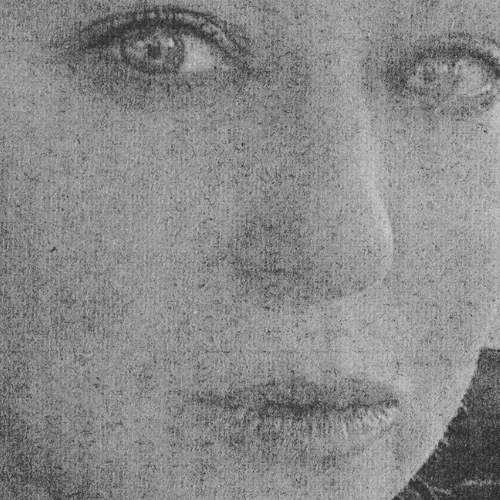
Brigitte Gerstl
Brigitte Gerstl is the program manager for the uterus transplant program at the Royal Hospital for Women (RHW). Brigitte played a pivotal role in establishing Australia’s first live donor uterus transplant research study program at the RHW, she is currently developing the deceased donor pathway within the program. In this role, she oversees patient screening, ethics, and governance, while also monitoring patient progress and clinical and psychosocial outcomes. Her involvement extends to several other women's health initiatives, including the management of the Australian Endometriosis Clinicians Collaborative (AECC) research study, and endometriosis data linkage projects (EndoLinked). Additionally, she has significantly supported changes in the oncofertility landscape in Australia, contributing to the inclusion of fertility preservation services in Medicare through her work with FUTuRE Fertility, Australia’s first oncofertility research study program. She has published widely in women’s health, mental health and oncology, actively mentors and supervises medical students and researchers, reviews for several leading medical journals, and participates in numerous influential health groups.
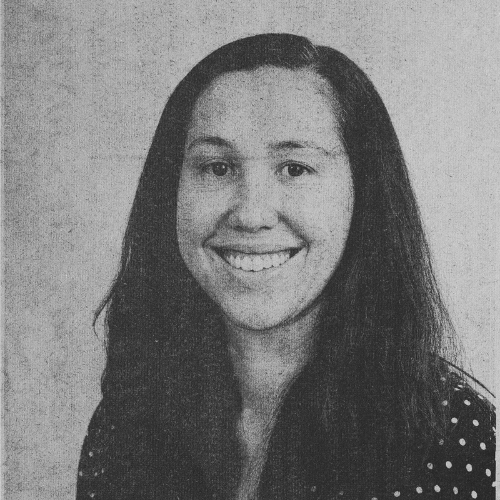
Luara Ferracioli
Luara Ferracioli is Associate Professor in Political Philosophy at the University of Sydney. She grew up in Brazil but moved to Australia in 2006. Her main areas of research are the ethics of immigration and family justice. She is the author of Liberal Self-Determination in a World of Migration, and Parenting and the Goods of Childhood.
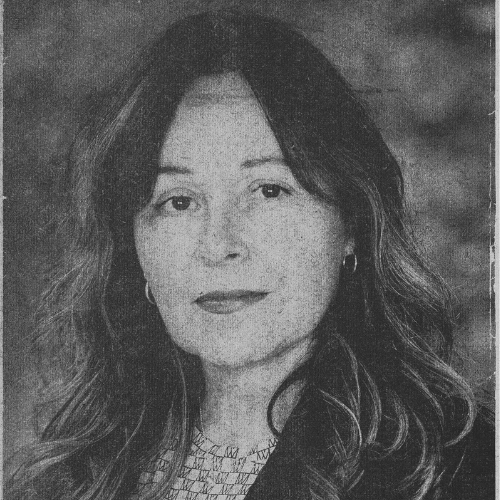
Mianna Lotz
Dr Mianna Lotz (she/her) is an academic, ethics advisor, and Associate Professor of Philosophy at Macquarie University where she specialises in and teaches ethics and applied ethics with a research focus on emerging reproductive technologies, adoption, surgical innovation, family ethics, and the welfare and rights of children and parents. She is co-editor of two books, the most recent of which is Philosophies of Adoption: Reflections and Perspectives. She is author of numerous journal articles and book chapters on the ethics of uterus transplantation, parents’ and children’s rights, cloning, and vulnerability, including in the Routledge Handbook of Philosophy of Sex and the Routledge Handbook of the Philosophy of Children and Childhood. She was Chair of one of Macquarie University’s Research Ethics Committees from 2011–2023; is a current member and former Chair of the Data Security and Safety Board of Australia’s first uterus transplant trial (RHW, Randwick); member of the Uterus Transplant Advisory Group of the Transplantation Society of Australia and New Zealand (TSANZ); and member of the Ethics Committee of the International Society of Uterus Transplantation (ISUTx). In 2023 she was the recipient of the inaugural Macquarie University Research Excellence prize for Excellence in Research Integrity.