
Business Behaving Badly
If you accept my argument that we're living through a second gilded age where corporations power has increased, market concentrations increased, and employee power has diminished radically – one of the dimensions of that is that the policies and contractual requirements now extend way beyond the workplace.
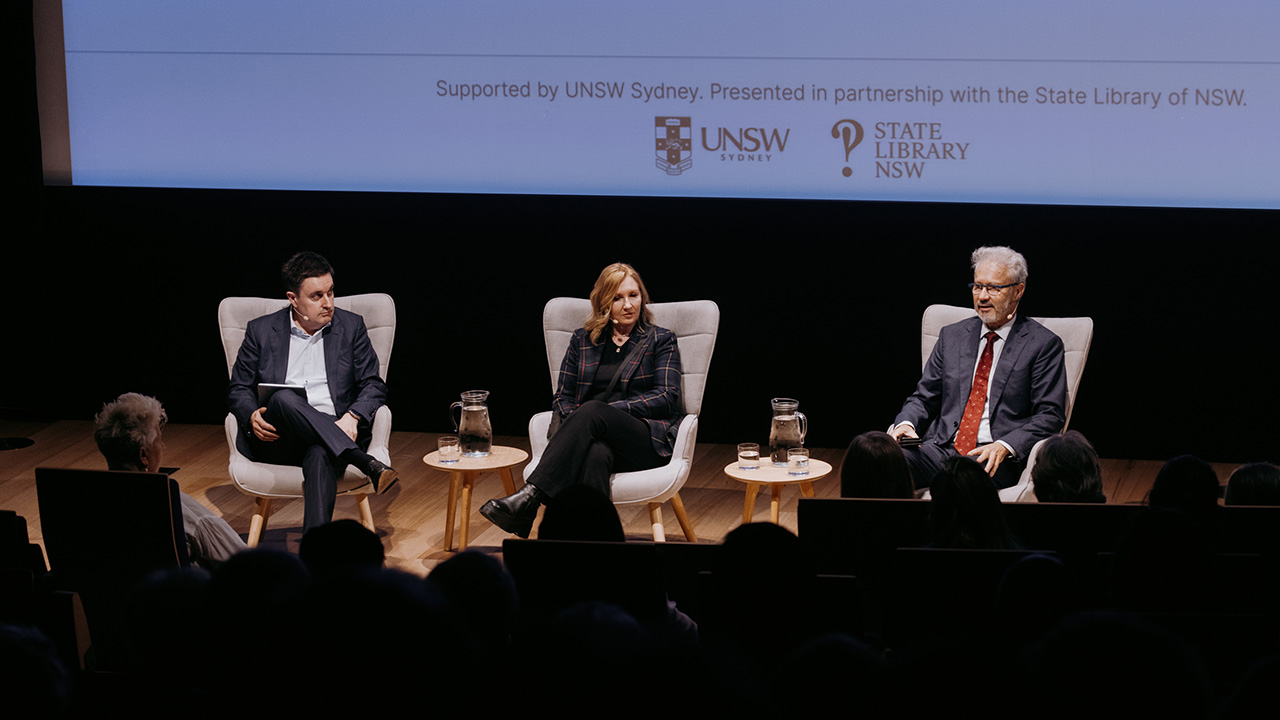
Soaring and crashing stock prices, resigning CEOs and out of control labour practices: what is going on with Australian businesses? Hear award-winning labour relations lawyer and author of Working for the Brand: how corporations are destroying free speech, Josh Bornstein and award-winning senior business writer and investigative journalist Adele Ferguson with host Richard Holden as they consider the state of business. Get your head around the latest scandals, analyse business-employee relations and discover the ethical challenges shaping the future of corporate Australia.
This event was presented by the Sydney Writers' Festival and supported by UNSW Sydney. Presented in partnership with the State Library of NSW.
Transcript
Richard Holden: Well, welcome everyone to this session of the Sydney Writers' Festival. My name's Richard Holden. I'm Scientia Professor of economics at UNSW Business School so it's good to see the advertising for one of Australia's great universities.
I'd like to begin by acknowledging the traditional custodians of the lands on which we meet today, the Gadigal people of the Eora nation, pay my respects to elders past and present, and extend that respect to any First Nations’ people who are with us today.
We've got a very exciting discussion that we're going to have with two people who've done as much as anyone to document bad business behaviour in Australia. So I guess I'm meant to be the sort of antidote as a business school professor, but we will dig into all manner of that behaviour.
Adele Ferguson is on my immediate, left is a multi-award winning investigative journalist, columnist and author whose work has driven parliamentary inquiries, legislative change and a Royal Commission. She's won nine Walkley awards, including the gold Walkley,
Audience Applause
Richard Holden: A Logie, the Graham Perkins journalist of the year, and many other awards. In 2019 she was appointed a member of the Order of Australia for her contribution to journalism. She wrote the best-selling unauthorised biography on Gina Rinehart and the award-winning Banking bad about which we will be talking today.
One step further to the left is Josh Bornstein, who is an award-winning lawyer specialising in Employment and Labour Relations Law, who has successfully sued a lot of badly behaved corporations
Audience Laughter
Richard Holden: and acted for employees who were sacked for expressing political views. He's a board member of the progressive Think Tank, The Australia Institute, and on the advisory board of the Centre for Employment and Labour Relations Law at the University of Melbourne. His book, Working for the Brand, how corporations are destroying free speech is published by scribe, and we will be talking about that today.
So I'm going to begin by asking our authors who have documented, I think, in, you know, with a very rich narrative, and they're both great storytellers, and so I'm going to ask them each to give us one or two stories about businesses behaving badly, and I'm going to start with Josh, who has literally just run across from the federal court where he's suing Qantas for $100 million.
Audience Applause
Richard Holden: So take it away, Josh.
Josh Bornstein: Thank you very much, and it's it's true, this has all come together at the same time as we're seeking a record penalty against Qantas over the unlawful sacking of 1,820 baggage handlers during the pandemic, and it's a spectacular hearing. So if you want to continue to be entertained after after the luncheon adjournment, the case will continue and finalize today.
Look perhaps one quick story that I think is apocryphal for this subject that I highlight in the book is about a mine worker in, I think, rural Western Australia, who his name's Hank Dovandans. Hank Dovandans was a 24-year delegate with the mining union. There was a enterprise a collective bargaining dispute, or enterprise bargaining dispute with the mining union, and BHP and Hank went along to the picket line with a sign that said, “scabs, no principles, no guts”, and that's because the company had brought in a crew of strike breakers during the period of what's called protected strike action. Hank then found himself in a position that a lot of people now find themselves in increasingly, which was that he was given a letter saying he was suspended pending a disciplinary investigation into whether he had breached company values.
Because if you read my book, you'll see a whole part of the book is dedicated to arguing that companies can't have values, and it's an oxymoron,
Audience Laughter
Josh Bernstein: but all companies now, and virtually all employees are subject to the same stipulations in their employment contracts and their policies, and even Adele and even Richard you'll be subject to, I think, similar obligations. The policies will say your contract, and the policies will effectively say you're bound to abide by our values. Our values include respect, integrity, decency, fairness and transparency and so on.
These are values that no human being can always comply with in their life, but the policies and the contract will say you are required to comply with them, 24/7, and so he found himself subject to a disciplinary investigation because he hadn't shown respect to the strike breakers who came through the gate.
Then the company considered what to do about him, and they decided to sack him. They said, “for this sin after 24 years, we're going to sack you because we don't think you've got sufficient insight into your wrongdoing and you're not capable of reform”. The case went all the way up to the high court. He won, he lost. Went to the High Court, which had the ultimate say in the matter. The High Court said there is a law that says you should not be allowed to be discriminated against because you engage in protected collective bargaining activity, strike action, industrial activity. But he wasn't sacked for that reason. We believe the company, the company, has given the evidence credibly that he was sacked for not showing respect.
This helps to explain why, in the book, Working for the Brand, I argue that we're in a situation now where millions of people in the labour market are facing censorship that no government could ever no legitimate or liberal democracy would ever dream of trying to impose on its citizens, effectively saying you're not allowed to do or say anything disrespectful or controversial, and that's because over the last 30 or 40 years, the labour market has been de unionised radically in this country, far more radically than virtually any other country in the OECD. And once you deunionise the labour market, and you silence or diminish the voice of the collective, an individual has no chance, and so his story, I think, in many ways, speaks to a lot of the issues that I explain in the book.
I will briefly just mention a second matter, which is one of the reasons I wrote the book is because I acted for Scott McIntyre, former SBS soccer journalist. For three years running, he tweeted his strong protests about the way we celebrate Anzac Day. It's what I would consider pretty conventional antiwar commentary, antiwar political speech. Nothing happened for the first two years. On the third year, Chris Kenny and other Murdoch journalists, Rita Panahi, Mark Textor, there was a liberal minister, Briggs, Jamie Briggs, I think his name was seized on his tweets and then sought to do what I've described repeatedly in the book, which is to visit his political views on his employer.
There was no rational connection with a soccer journalist at SBS, political views with SBS as the employer. But this is the culture we now live in, where there are online pile-ons, where we say, “We disagree with you. We're not going to actually argue with you, but we're going to tell on your employer, and we're going to demand that they be sacked”.
They also pressured Malcolm Turnbull, the then Minister for Communications, to intervene. He intervened and rang the head of SBS. Within 24 hours, an investigation had concluded he had brought SBS into disrepute, and he was sacked. And I explain in pretty graphic detail the calamitous impact which happened to Scott McIntyre and his family, and which is still being felt many years later like other victims of this vigilantism and this corporate brand managed tyranny. He fled Australia. He lost his career, and when I last interviewed him for the book he was couch surfing internationally, so I'm hoping… I haven't spoken to him recently, we're hoping things are better, but these things have devastating impact.
When someone's shamed like this in the Colosseum of the digital world, and then the employer adds to that, you get a black mark on your name that can be everlasting.
Richard Holden: Well you’ve already drawn out in that those two really powerful stories, a couple of threads that we'll come back to about the role of unions and also social media.
Adele, you literally wrote the book on banking, Banking Bad. And recently you've been documenting on the ABC some really appalling abuses in the childcare sector. So if you could share a couple of stories that have spoken to you.
Adele Ferguson: Yeah. So the banks that started in 2013 with a whistleblower who I spoke to, Jeff Morris, who had seen terrible things at Commonwealth Bank. It was forgery, fraud and a cover up of one financial planner called dodgy Don Nguyen. And what happened was, it was a total cover up. And so I did the story, thinking it was one dodgy financial planner. And you know, things that happened at the. Bank, and they'd covered it up as they would,
But when the story went to press the next day, my internet, my email, was just going, bing, bing, bing. Everybody was writing to me. We were getting hundreds of emails from people saying, “I'm also a victim of Commonwealth Bank. But it's not necessarily Don Nguyen it's other financial planners.”
And it turned out it wasn't one bad apple, as the bank was trying to spin. It was the whole barrel was basically rotten. And so the more I dug. And then there's other banks that came forward. It was whistleblowers from National Australia Bank, ANZ, Westpac, and what it turned out was it was the whole incentive structure.
So you had the bank tellers who people had trusted were actually getting bonuses, and had targets to get people to actually go and see the financial planner. They also were getting commissions, and it was going right up to the top. So that's that was the problem. And then you looked at the regulators and found that they were just totally missing in action. And that's really how the whole banking sector thing blew up, because it wasn't just financial planning, it was life insurance, it was bank loans, it was right throughout the entire banking system.
And it's very much what's going on with childcare.
We did a story for Four Corners in March, and we thought it was bad. We were looking at childcare, and it was, you know, few people had come forward, and again, we've had thousands of parents, workers who have just been writing to us, whistleblowers, just telling us that this industry is really rotten and that we need to do something.
And again, it's what's happened over the years, is the private sector has moved into childcare. And so you've now got, of long daycare, three quarters are the private sector, and many of them are private equity investment bankers, property developers, and they're putting profit before care. So you're seeing some terrible things happening, and then you marry that with what are the regulators doing, and you find again, they are missing in action.
Richard Holden: I want to come to this point about regulators.
So even the most ardent proponents of free markets acknowledge that free markets have to exist within a structure and a framework, and the regulators have a role to play, an important role to play. And when we think about banking, there's there's the Australian Prudential Regulatory Authority, there's APRA, there's ASIC. You know, some of these times the Reserve Bank was even had a role in banking supervision. In child care, you know, this is an area where we're talking about some of the most vulnerable people we can possibly imagine.
Where are the regulators and why aren't they doing their job? What's going wrong with the regulations?
Adele Ferguson: Yeah, well, there's a lot of captiveness going on. So what we found in the banks, with the Royal Commission, which was gobsmacking, really, that you had ASIC, which was sending out draft press releases to the bank to say, “what do you think of this?”
And of course, the banks would come back and totally rewrite the press release. That's how cozy it all was. That's just one example, and it's very much what's going on in child care.
You've got, you've got a problem with childcare, that there aren't enough childcare centres, and you haven't got enough workers, so there's a lot of problems going on, so the regulators don't want to go in too hard.
Richard Holden: and don't want to give the kind of penalties that would- might possibly actually deter this kind of behaviour. I think in one of your stories that you reported, there were, there were childcare centres that were, you know, clearly involved in systematic abuses, and they were opening more and more. They were, not only were they, you know, not being sanctioned in any serious way, they were allowed to open more centres while this was going on.
Adele Ferguson: Yeah, that's right, that's Affinity, which is, it's owned by private equity, and they've been allowed to open another 100 and odd centres in the last three years. Meanwhile, just in New South Wales alone, they got 1700 breaches for some of the most egregious stuff, and they got less than $2,000 in fines over that time.
Josh Bornstein: Can I say something about that. I've been on the other side of regulation because I represented unions throughout my career. What regulators do, who they prosecute, how hard they go, is a product of politics. And in this country, like many other countries, as a result of the neoliberal era, we as a as a society or as a country, have decided not to regulate corporations effectively.
There is a huge double standard.
I have been in cases about, well, there's been famous prosecutions of unions about, One, being a cup of tea that was had two union officials went to see a shop steward on a construction site to have a cup of tea, and they didn't exercise right of entry properly. That went to the federal court by the regulator. The judge was outraged.
Do you recall not all that long ago when 32 federal police raided the AWU. Do you remember that that followed Minister Cash writing to the regulator and saying, “I'm concerned”, an article appeared in the Australian they rigor. The minister writes to the regulator. 32 federal police turn up to the AWU, looking for minutes of a meeting 10 years earlier about whether the union had properly authorised a donation to Get Up. Right? And that ended up in litigation for years.
Unions have faced procurement policies to deunionise them, but also part of the process of deunionising the labour market has been very aggressive regulation.
There's now a union that's been deregistered the Commonwealth Bank. I mean, the sins that you exposed and were the subject of a Royal Commission included charging dead people fees, charging fees for no service at all, ripping off dying people or people who were severely ill about their insurance claims, knowingly calculating -
Adele Ferguson: Oh, absolutely, the policies they were writing
Josh Bornstein: Correct.
Adele Ferguson: You could never meet them.
Josh Bornstein: The list, the money laundering and so on, the list was extraordinary. If that was a union, they would have been deregistered.
Okay, this we have a very different standard, and it's a political choice that we've made, and still to this day, the regulators in your incredibly distressing reports recently on the 730 Report, show it is wet lettuce regulation. This does not happen in the sphere that I've been dealing with for my career, because political choices have been made about what to prioritise and what to achieve.
Richard Holden: Josh, since you brought up neoliberalism, that arguably the cradle of neoliberalism, the University of Chicago, you know, people might be aware that in the in the early 1960s a very famous economist and later Nobel Prize winner, George Stigler, coined the notion of regulatory capture. And you know, Stigler is a pretty kind of pro private-enterprise, pro-market, pro-business kind of guy, or maybe a little more pro-market than pro-business, actually.
But he pointed out that even if regulators are trying to do the right thing, even if they're empowered by governments to do the right even if we get the political choices right, even if there's nothing nefarious going on, being a regulator, and he talked about it in the context of railroad and transportation regulation, in the first instance, it's just very difficult to go and every day, go and interact with people and kind of, you know, punish them, and you've got to sit in a room with them and make them feel bad about themselves. You start to feel bad about it yourself. And it really speaks to this idea that even if we get everything right, regulations, only going to be able to do so much because it's just very hard for people not to get captured, even if they're well meaning.
Josh Bornstein: Except that's exactly what's happened for the last 30 or 40 years to trade unions.
So the hurt feelings, the self-doubt, it's all too hard, has not made a scintilla of difference to - and there's been a plethora of them, the registered Organisation Commission, the Fair Work Ombudsman, the building industry regulator and so on. And they have vigorously prosecuted unions over all sorts of relatively minor…
I mean, there's been some terrible stuff that I find horrific and embarrassing for someone who supports and thinks unions are critical to a functioning democracy, and strong unions are critical to a functioning democracy, but for all of that, they have been prosecuted time and time again by highly resourced, highly aggressive regulators.
And here's a good example of what I'm talking about. In 2007 just before Kevin Rudd became the Prime Minister, you may recall his wife, Thérèse Rein, had a huge business empire of job placement agencies. She'd bought another agency or business to add to her group. It was underpaying its staff. The government learnt of this and directed the regulator. I was very close to the action at that time, directed the regulator to drop everything and investigate and prosecute.
So this is a highly political politicised process. I'm not even sure it's possible for it to be devoid of politics, but we have made a deliberate choice not to regulate corporations properly, and we have seen monopoly power bloom and oligopoly power bloom. You and I might disagree about whether Australia is as bad as the US. But this is, this is a malaise that transcends Australia.
Adele Ferguson: I've spoken to investigators on the ground going into childcare centres who see terrible stuff and go back and report it. And they time and time again, letters are sent out to these organisations saying, “try harder, make sure your politics, policies are up to date”.
So the people on the ground of all these regulators, they're not feeling bad that they're going in. They're actually feeling the opposite, that not enough is getting done.
Richard Holden: Yeah, in addition to regulators, one wonders, where are the boards of directors of the companies in all of this, they have ultimate responsibility for the stewardship of the organisation, for holding management to account, ultimately, to the shareholders. They have an oversight role to play that seems in some of these instances to have been quite lacking.
They also, I guess, have a role in creating the incentive structures. And I think Adele, you know, you talk about private equity and childcare, which is very real. Private Equity’s business model, and I worked in private equity for four years, so I'm not the world's like, strongest critic of private equity, but part of what private equity does is kind of provide high powered incentives to try and get more out of people.
You talked about tellers getting incentives for signing people up, and it turns out that they were just, rather than signing people up, they were just forging their signature and things like that. Boards are ultimately responsible for the high-powered incentives that go on.
What role and what culpability and what could we do better about getting boards to take responsibility for this kind of behaviour?
Adele Ferguson: Yeah, because I think there isn't enough shaming of the boards. Often the CEO will be the target, as they should, but you just see this the board. You don't know who each of the individuals are, and they, at the end of the day, are signing off on this. And I remember with the Commonwealth Bank APRA, which is the prudential regulator, they requested a panel to have a look at the culture and the compliance of Commonwealth Bank.
This was in 2018 and a report was released, and what it said, and I think this applies to a lot of boards, and it should have been a blueprint. It said that that there was a tin ear by the board. They weren't listening to what others were saying. They were believing everything that the CEO and senior management were saying, because they felt that he was very intelligent, and there was too much collegiality. So there was none of the rocking the boat, challenging. And I think that's what happens a lot in boardrooms around Australia. There's a lot of fishing from the same pond, where you have a lot of directors going on different boards, and they don't want to rock the boat, it's a very lucrative place to be.
Josh Bornstein: I agree, although I think the problem is far more profound, which is it really goes to my point about inadequate regulation.
Boards and CEOs will not… will try and get away with what they can to maximise companies profit if there's not proper regulation and not a serious deterrent.
Qantas, this part, I can tell you, I think, without getting into trouble with the court, Qantas, after its recent episode of the unlawful sacking of 1800 people, selling tickets for non-existent flights, failing to refund hundreds of millions of dollars in customers whose flights were cancelled because every method that might work they didn't want to deploy all the other issues that Qantas has had. They they did a governance review, and it said pretty much the same thing.
Adele Ferguson: Yeah.
Josh Bornstein: I just think these things are pumped out in template form. We were mesmerized by a gun CEO who was so charismatic and so powerful that we forgot to do our job. I've sat on boards, many boards. I don't buy it. I do not buy it. This is a bigger problem. I'll see.
I've had my phone in front of me because I want to quote something to you and see whether you agree with this proposition. “The Corporation's legally defined mandate is to pursue relentlessly and without exception, its own self interest, regardless of the often harmful consequences it might cause to others”. Professor Joel Buccan, whose work I'm a big fan of, that's the truth.
This explains why boards are ineffective and CEOs are ineffective and other people are ineffective, and why we need to tame corporate power. Because that they will veer. Corporations will veer to harm consumers, the environment, shareholders, smaller businesses, employees, unless they're carefully and dynamically regulated.
Richard Holden: Well, I'll go you one better arguably, in terms of professors, Milton Friedman, who famously
Josh Bornstein: trumping me
Richard Holden: Yeah, no, that's the sort of privilege of the moderator, right?
Milton Friedman famously wrote an article in The New York Times Magazine in the 1970s whose title was words to the effect of the role of the corporation is to maximise profits, and even Milton Friedman - and that's a view with which a number of mainstream economists, including Oliver Hart, who is my doctoral advisor and is a Nobel Prize winner, Luigi Zingales At the University of Chicago, who runs the Stickler Center of all things have written strongly that that's not what companies should do. They should take care of what shareholders want. And that's not always profits…
Adele Ferguson: stakeholder capital
Richard Holden: even if you don't take the whole stakeholder view, just what shareholders themselves want, which is not always, to squish suppliers, treat employees badly, damage the environment.
Shareholders aren't all of one note about that. But even Milton Friedman is saying that said, but of course, that has to be done within the context of all the laws and regulations and rules and expectations and norms of society.
So even the most fervent advocate for that view of the world understood that the context in which this occurs is incredibly important.
I wanted to come to you, Josh, one there's many ways to frame your book and will come, I think one of the threads that comes through both your and Adele's work is is sort of about corporate power. I want to come to that. One other sort of lens through which to see your book is the demarcation, or lack thereof, between the private sphere and the work sphere. And you know, you make pretty compelling arguments about those things not having a clean demarcation.
Was that always the case, or is that arisen in relatively recent years? And what, what are the remedies that we have available? Is that, as a litigator, you might say litigation, and that's clearly part of it, but what are the other ways that we can try and get back, if there ever was such a distinction, to being able to have a private sphere.
Josh Bornstein: If you accept my argument that we're living through a second gilded age where corporations power has increased, market concentrations increased, and employee power has diminished radically. One of the dimensions of that is that the policies and contractual requirements now extend way beyond the workplace, so that brand management one of the things corporates have as their behavior has deteriorated and they've become more powerful, they've invested much more in brand management and inculcating wonderful brands that with impeccable company values, and I think that's part of their attempt to retain the legitimacy and to fend off proper regulation.
That's what I argue in the book.
If you say to someone as a condition of your job, you have to be respectful to everybody in your life at all times, and you're not allowed to say or do anything to bring us in disrepute or say anything controversial, you promulgate rules which will always be breached.
And you have a discretion about when to invoke a disciplinary process or a sacking, and you combine that with the online digital revolution and social media companies, which now make billions of dollars in eye watering sums from promoting rage and you have a cocktail so that anything you say outside the workplace gets visited on your employer, whether it has any rational connection with your employer in most of the cases I highlight, I say this has nothing to do with the AFL. This has nothing to do with BHP. But the culture that's promulgated online the Colosseum visits it on the Corporation, which deploys its brand management processes, and the easiest way to deal with it is off with the head.
Now, how do we try and restore a much healthier workplace? And also, I would say healthier democracy? I start from the proposition that everybody should be able to participate fully in democracy and to disagree and say, challenge the status quo and criticise ANZAC day or celebrate Anzac days, they see fit and shouldn't lose their job for it. And if we disagree with someone, debate it.
I love debating. Don't, don't try and punish them and deprive them of their livelihood.
If the only green shoots in my book, unfortunately, because there's not many, but the only things that I can highlight where there is hope is in your sector, the university sector, and that's because a form of free speech, it's different, but it's related, is called academic freedom, which applies to academics and the university sector in general.
That says you should be allowed to research, teach and debate and criticise and cause offense and not even always be respectful, because we benefit from the vital work universities do in promoting knowledge and enhancing democracy and the union in that sector, which has been weakened, like every other union has still managed to negotiate protections of academics or their academic freedom.
And so when I acted for Roz Ward, who people in Victoria will probably know more than in New South Wales, was someone who led an anti bullying series of work for young vulnerable students who are queer, she posted on Facebook a flag, a rainbow flag, that's right, with a joke to her friend, saying, “If this becomes the flag of Victoria, I think my work is done”.
She's got a very dry sense of humour. She's queer, she's Marxist, she's running this, and she jokes about the flag. You can imagine what the Australian does next.
Audience Laughter
Josh Bornstein: And so they start the usual campaign. The online campaign starts. She then faces like Hank, who I spoke about, she gets a letter saying you're suspended pending a disciplinary investigation to whether you've engaged in serious misconduct by bringing this university that you work in to disrepute for joking about a rainbow flag.
We sprang into action because her collectively negotiated agreement at the university, strong support of the Union, strong support from her colleagues. We wrote to the University, said, “you're acting illegally on multiple fronts. Stop this, or we going to seek an injunction on Monday,” that we wrote that on a Friday, and by Monday, they collapsed.
Now that is not the usual situation in the private sector, but because the NTU and the universities have negotiated to protect speech rights, to uphold democracy, We were able to avoid the usual denouement, grim denouement that goes on elsewhere.
Richard Holden: so that free speech rights is what I want to come to. I want to come to you in a second Adele on this, which is okay, so academics like me are very fortunate that there's a thing called academic freedom, although certainly around the world there are grave concerns about the degree to which that's being impinged upon. And you know, we used to talk about various parts of the world where that was happening. Now it's happening in the United States, which I never thought I'd come to see. And maybe that undercuts where I'm coming from.
Not everyone's going to be able to rely on academic freedom, a handful of people like me, to the extent that we can, but if we had stronger protections for free speech in Australia. So take it to an extreme. Imagine we had a US style, First Amendment in Australia…
Adele when you've been reporting, I guess it often takes sort of whistleblowers, or people who are inside, who know what's going on, who are willing to speak up, and sometimes those people are incredibly brave and put themselves at great risk in terms of doing that. And we do have some whistleblower protections and so on. Do we need to do more on those kinds of protections in Australia and and, you know, sort of to put it out there. Would some it's not an easy thing to just arrange, but would something more like a US style First Amendment really help in all of these issues?
Adele Ferguson: Yeah, because I just like to say our whistleblower protections in Australia are very weak. You know, we have David McBride, who is in jail. We have Richard Boyle, who was the ATO whistle blower, who is facing jail if he is found guilty. So we, we don't have a good track record with whistle blowers. They end up losing their jobs. Some of them become suicidal. There isn't a reward system in America. There is a reward system for whistle blowers.
Richard Holden: Yeah. Floyd Landis got $40 million I think, for dobbing in Lance Armstrong for doping, and that was ultimately how that came about. So…
Adele Ferguson: Yeah so they're rewarded in the US, there is even a whistleblower day to celebrate whistleblowers. We don't do that in Australia.
Audience Laughter
Josh Bornstein: We do not do that. And, going back to the CBA. Another way of framing what you've described is 1000s of people were involved in the bad behaviour. They got a lot of bonuses. Yes, there were two whistleblowers, Jeff and Benjamin Koh. Yeah, yeah, they lost their job.
Adele Ferguson: Yeah. So you know, in the case of Jeff Morris, he lost his job, he ended up with PTSD. His wife left him, and then they changed the whistleblower policy in the Commonwealth Bank to make it better. So Benjamin Koh, who was the chief medical officer in CommInsure, thought, “Okay, now they've changed their policy. I'm inspired. I'm going to speak up”. And he did, and they ended up finding that he breached the IT policy.
Audience Laughter
Josh Bornstein: Which is, which is a standard. It's a textbook thing. I do this. I see this a lot. You get a whistleblower, you hire a PR agency to smear them and background journalists to say they're unwell. You then get lawyers and others in HR to comb their files to see whether they've breached any policies. Often they will have emailed a document home.
Adele Ferguson: That's what he did, and they all do it.
Josh Bornstein: That's what he did, and then you sack them, because they've tried to raise the issue internally. They've been rebuffed repeatedly. They go they lose trust. So I'm going to say, I'll take, take this document, and I'll go to a regulator or a journalist, and then they’re…
Adele Ferguson: In the case of Ben Koh, it wasn't even that. He was sending work home, okay, it wasn't even that, he got sacked before he went to a journalist, which was me.
Richard Holden: yeah. So this might sound a bit apoplectic, and maybe it is, but like to think not, because I've said it in print on more than one occasion.
Audience Laughter
Richard Holden: These kinds of sometimes they're codes of conduct. Sometimes it's just about the employment contract. And what is you can correct me when I get this wrong, Josh, like a for-cause fireable offense, these things seem to be very widespread, and the comparison I've made is to sort of like the Thai junta, right?
They have a series of rules where everyone's in breach of them, laws where everyone's in breach all the time. So you basically are free in Thailand at the pleasure of the junta. And I sometimes wonder whether in corporate Australia, you know, and it sounds sort of silly when you point these things out, but rules like, you know, back in the day where we used to print things out, you know, people take a ream of copy paper home from work, well, that's theft, right? Even if you're taking it home.
Now, nobody's going to get fired for taking a ream of copy paper home to do work or make paper planes, even unless, unless they become unpopular with the firm, and these things seem quite widespread, and we were talking about employment contracts that talk about damaging the brand or bringing the organization into disrepute.
How widespread is that? And what can we what can we do about that?
Josh Bornstein: It's essentially across the board, now. You need to understand in HR land, the terms and conditions you find in contracts are the product of various fashions.
You know, psychometric testing was a fashion, 360 degree feedback was a fashion. Contracts of employment and policies work to a similar process. And so the stipulations I say that apply about not bringing the organisation into disrepute, complying with values that…
Your analogy is very, very powerful, because it really is a totalitarian system when you stipulate rules that everybody is breaching at some point, and then you have the discretion when to invoke them, and that's effectively what I argue in Working for the Brand. With these these policies are right throughout the labour market. They're in they're even at the ABC, they're in universities, they're in all of the private sector. So it's very hard to find anybody who's not subject to very similar stipulations.
Richard Holden: Well, maybe I'm going to ask Andrew Lee about this on Friday. So a little plug, two o'clock carriage works on Friday. I'm going to have the pleasure at the Writers Festival of having conversation with my friend Andrew Lee, who's recently sort of raised this idea of another thing that's in a lot of these standard form contracts, which is non-competes. And, you know, this is super extreme in the US where, you know, nurses and hairdressers have non competes and things like that, because-
Josh Bornstein: Just a casual contract in regional Victoria, six month restraint. I saw that four days ago.
Adele Ferguson: Childcare workers who are one of the lowest paid in this country, non-compete clauses.
Richard Holden: Because we wouldn't want a minimum wage childcare worker to go down the road and work for a competitor.
Audience Laughter
Richard Holden: And I think the government's argument, and Andrew's argument is that this is anti-competitive behaviour. And interestingly, in states like California and the United States, a lot of these non-compete clauses have been, courts have said are not enforceable.
You write whatever you want into the contract, doesn't mean we have to enforce them, you know. And maybe some of these codes of conduct and these kind of… you're always in breach type things, maybe Josh, you'll bring enough cases that we'll end up with the appropriate court in Australia saying these things are not enforceable.
Josh Bornstein: Most employees don't have the money to take on BHP or Qantas. Okay, so which these, these terms in contracts that I describe, and the restraints for minimum wage workers, which are an obscenity, are an abuse of power.
Okay, so we come back to the same proposition. When you confer so much power on an institution which, by its nature will, unless properly regulated, cause harm, then you're going to find multiple abuses in the labour market. That's why what I describe, so I've critiqued corporate power in Working for the Brand from the perspective of free speech, but I could have done it from the perspective of underpayment, excessive hours, zero hour contract, 80 hour weeks, or I could have done it for restraints as well. There are multiple abuses of corporate power in the labour market. I've fastened on one, the treatment of whistleblowers is another, and it all speaks to the same broader malaise about the failure to regulate.
Richard Holden: So that's a nice segue into what I took as the common theme of both of your bodies of work that we're talking about here, which is corporate power and the abuse of corporate power.
There's a line of argument in Australia which, I don't think this is there to defend abuse in any way. But when people say, you know, the supermarket sector in Australia is pretty uncompetitive, or the banking sector in Australia is pretty uncompetitive. Australia does have quite unusual what people in my line of work would call economic geography. We've got a country that's roughly the same size as the continental United States. You have to squint a bit about the deserts and stuff, but, you know, it's a good analogy. Yet we've got, you know, 1/13 or 1/15 of the number of people. So maybe it's not super surprising that we don't have, you know, eight large supermarket chains or a dozen banks.
How do you both react to that argument that there's kind of, it doesn't defend abuse, but in terms of laying the groundwork for oligopolies that Australia, kind of, we're in a little bit of a box given our economic geography, do you buy that when it comes to bankin, Adele?
Adele Ferguson: look, I don't buy it when it comes to many of the industries, you know, including airlines.
You've got, you know, one airline that is absolutely dominant and has been able to wield a lot of political power for a long, long time, and so you've had other operators come in and they just wither on the vine.
You know, that's got nothing to do with our geography.
Richard Holden: No, it's got perhaps more to do with the chairman's lounge than anything else.
Audience Laughter
Josh Bornstein: And who has access to terminals as well. But yeah, let me just answer it this way, because Adele's answer about Qantas is very on point. Qantas is as close to a monopoly in the aviation market as we have, and it cannot lose. Cannot lose, because, as our national carrier, if as the cycle in aviation, which is very violent, up and down. If it goes into a downturn and is in serious trouble, we bail it out.
Qantas received $2.7 billion during the pandemic, for example, 900 million was job keeper and other help. Virgin didn't get that help. If we're going to say, “Well, look,” and I probably disagree with you, but if we're going to say, “Australia is a special case where the competition rules don't apply”, then let's cut the pretense. Cut the pretense.
Why do they get all the benefits with the taxpayer guarantee, effective taxpayer guarantee and subsidy to sustain them? Why don't we share in the benefits when the times are good as well as the pain? Okay?
They will say to you, we're a corporation in a highly competitive market, paying too much company tax, as Alan Joyce used to say, while getting huge sums from the taxpayer. So let's cut the pretense.
Adele Ferguson: Yeah. And the other thing is, with the supermarkets, if you look at the margins of the supermarkets versus the margins overseas, inside the UK, where there is more competition, they're much higher here.
Josh Bornstein: The other issue, which is, when you get companies which Adele has rightly pointed out, have so much political clout that undermines democracy.
Let me read one other quote. I've prepared two quotes for you.
“Monopoly constitutes the death of capitalism and the genesis of authoritarian government”. That was said by the competition regulator in the US in 1938. We have forgotten, a whole period of policy and economic orthodoxy about monopolies and oligopolies has been swept aside and just blanked out of our history.
And one of the reasons I wrote the book is it drives me crazy that no one is looking at the power that corporations wield. If you look at the national party today, I mean, you can look at the antics of Clive Palmer. He's one billionaire who's trying to buy power. It hasn't worked, but sometimes it's not always guaranteed.
Gina Rinehart, on my estimation, has a fair bit of clout with a national party and a lot more clout than anybody else in this room. And when you produce these huge monopolies and oligopolies and huge wealthy companies, we've also produced now a new generation of billionaires who, I would say, are very active in undermining democracy.
So that's that's another reason why, even if Australia is special and different, which I not going to concede, but I'm going to just for argument's sake, except that this still has very damaging impacts on democracy.
Richard Holden: But, and I think it's fascinating that you bring up the chair of the Federal Trade Commission. I think it was in 1938 in the US.
So until very recently, another chair of the Federal Trade Commission, Lena Khan, who people may or may not be particularly familiar with, is a remarkable story. The youngest person ever to head the FTC, a woman who this may be the first and only time I can think of this happening, literally rose to fame based on as a third-year law student at Yale Law School writing an article that kind of went viral in the Yale Law Journal.
I didn't think it was possible for something in a law journal to go viral.
Audience Laughter
Richard Holden: Turns out, you just have to write a good enough law journal article. So I'll have to go back to the drawing board on that. But she became head of the FTC, and she really stood for a movement in antitrust called The New Brand ICN movement.
Very much contrasted with the old Chicago school movement of Robert Bork and people like that, a famous judge who didn't end up being confirmed to The Supreme Court after being nominated by Ronald Reagan and famously taken down by Joe Biden as chair of the Judiciary Committee once upon a time.
And there's been this whole movement in the US now, Brandeis himself really emphasised this point that you both bring up, which is Brandeis wasn't as concerned about, you know, margins and prices above marginal cost, although he certainly was concerned about that, he was really emphasicing political power of these large corporations and their ability to corrupt the political process.
So that sort of brings me to there's certainly some people who advocate that we can do a lot of things about billionaires, like take all their money away from them. I'm a little less comfortable with that kind of approach to things.
One thing we sure can do is get more serious about campaign finance laws. And so people might, Clive Palmer might have a lot of money. That doesn't mean we'll need to allow him to do anything he feels like, whether we don't have, you know, a First Amendment in Australia, as we were just talking about before, is there a way that we can stop companies and extremely wealthy individuals from polluting and compromising the political process? Who wants to take that
Josh Bornstein: Adele, do you want?
Adele Ferguson: Well that is a challenge, because if you go to Parliament House, it's just teeming with lobbyists and spin doctors and crisis management people who in the ears of government saying, “if you do this, all hell will break loose”, threatening that, you know, jobs will be lost. They'll move their headquarters overseas, etc, etc.
So yeah, there's a real problem, but you can sort of ban donations is a start.
Richard Holden: And interestingly, you know, we saw actually the Teals push back, you know, with some rationale against that at prior to the last election, wasn't going to take effect that legislation until the next upcoming election. But, you know, they sort of made the argument, “Well, we're only possible because of more or less unlimited corporate donations”. So does it cut both ways in some way? Or how do we, how do we make sense of that?
Josh Bornstein: Look, it does cut both ways and and the short answer is, you could. You could simply have a system of government funding of election campaigns, any system you've got to understand where something is ruthless as politics, any system that you promulgate, they'll try and game it, right?
So yes, I agree with you. Political Donations, which privilege wealthy people and allow them to have an extraordinary clout, is fundamentally anti-democratic, and we need to do something about it. But I think it's really another product of the same malaise, which is if you have big corporations that are too powerful and you don't moderate that by two things that tend to work over time. One is strong, dynamic, robust government and proper regulators, is part of that, who are serious. And two, union proper, union density in the labour market, which not only gives employees a voice in the workplace, moderates wealth of the corporation, but also is a countervailing force to the political rent seeking and lobbying that corporates can do.
Those are the two things that I argue in the last part of my book, is what we need to do to try and restore and regulate corporations properly so they're not so abusive and harmful to us
Adele Ferguson: and a strong media
Josh Bornstein: Yes. Yes. That's a very – yeah.
Richard Holden: So Josh, you've talked about the role that unions play. You talked about the decline of union density in Australia, even relative to the OECD, although there's been, as I understand it, a fairly significant decline of union density in many, many countries.
I'll do the same debating trick that you did. I'm not sure I totally agree that that's the answer, but you know, let's stipulate for the purposes of the argument, you know.
So if that is true, how do you increase union density in Australia?
Josh Bornstein: Union density is a product, again, a bit like regulation of government policy and law.
At the moment, the law has been in place for a long time, and it says this, if you're a union and you negotiate through your sweat, toil, and hard work and long disputation, improvements for people in the workplace, those improvements apply to not only your union members, but to people who pay nothing. It's called the free rider problem.
This is, this is another way of saying the same thing about how we make political choices about regulation.
If, effectively, unions are being told you have to sell or you have to offer services that you provide to 90% of the private sector labour market for free and only collect dues from the other 10% imagine if that was imposed on the private sector.
You have to give away your goods and services to 90% of customers, but you can charge for 10% what would happen to the private sector? So there's a huge free rider problem, which means union density really can't improve until that's overturned. That's considered too politically dynamite, because, well, the orthodoxy in the labour movement for the last few years is, if we run that, the Murdoch press will go berserk. The business community will go berserk because they don't want strong dynamic unions anymore in Australia, but until we get to confront that, it's a system that only operates in one other part of the world, which is in American red states.
It's in American red states, which are the hard-line right wing Republican states and Australia. Doesn't operate elsewhere like this, and our union density is now in such a trough that it's it's very close to American levels of union density.
There are 12 states in America which have higher union density than Australia. So until we address that and change that, we're going to have the same problem.
Richard Holden: He's good. You see what he did there, which is I asked him about union density. I told him I was skeptical. And then he trotted out like something that's totally core to every mainstream economist, like belief system, which is that the free rider problem is a bad thing, and you've got to internalise the externality, and who can argue with that? And then turned it back on me? So bravo.
Audience Laughter and Applause
Josh Bornstein: Thank you.
Richard Holden: Adele, I suspect we're going to see more reporting from you. I have mixed feelings about that, because I love your reporting, but I find some of the content quite wrenching.
Josh Bornstein: It's distress about childcare.
Richard Holden: We've got a government that was re-elected, you know, by a wide margin, in part, with a promise to make some fairly dramatic changes to the childcare system in Australia, at least, to expand access to it quite dramatically. And I believe the Prime Minister said he's going to take that to the to the next election. And obviously there's a plan for that. This is a hard question. This is a big question.
What would you do to fix childcare in Australia?
Adele Ferguson: Well, just going to what the Prime Minister said. He's focusing purely on affordability. He's not looking at quality. He is saying that we don't need a Royal Commission, that most centres are good. 90, 90 odd percent of centres are good.
My question is, where does he get those figures from?
Because if you look at the National Quality Standards, one in 10 centres have never been rated. They don't have a rating, and many of them are “working towards” which is a euphemism for they’re failing. Many centres have waivers. So when you put all that together, that's about 30% that have got questions.
And then add on to that, on average, every four years, centres get reassessed. So how good are these centres? We actually don't know.
So what would I do? I think you have to actually start from scratch with the National Quality System. There needs to be a review. The Productivity Commission came out in September last year. Part of it was about universal childcare. But it also looked at the regulation, and it said that the states lack transparency. There is not enough funding. There needs to be a national childcare commission that oversees so that's a start, but I think you also need to have an inquiry.
There is an inquiry in New South Wales, a parliamentary inquiry, because you need people to be able to come and tell their stories, workers to be able to come and tell what's going on, rather than just do these theoretical reports.
Richard Holden: Please join me in thanking Adele Ferguson and Josh Bornstein.
UNSW Centre for Ideas: Thanks for listening. This event was presented by the Sydney Writers' Festival and supported by UNSW Sydney. For more information, visit unswcentreforideas.com, and don't forget to subscribe wherever you get your podcasts.
-
1/5
-
2/5
-
3/5
-
4/5
-
5/5

Josh Bornstein
Josh Bornstein is an award-winning lawyer specialising in employment and labour-relations law who has successfully sued a lot of badly behaved corporations and acted for employees who were sacked for expressing political views. He is a board member of the progressive think tank The Australia Institute and on the advisory board of the Centre for Employment and Labour Relations Law at the University of Melbourne. His book, Working for the Brand: how corporations are destroying free speech, is published by Scribe.

Richard Holden
Richard Holden is a Professor of Economics at UNSW Sydney and President of the Academy of Social Sciences in Australia. He was formerly on the faculty at MIT and the University of Chicago and earned a PhD from Harvard University. He has published numerous paper in top economics journals and is a regular columnist at The Australian Financial Review.

Adele Ferguson
Adele Ferguson is a multi-award-winning investigative journalist, columnist and author, whose work has driven parliamentary inquiries, legislative change and a royal commission. She has won nine Walkley Awards, including the Gold Walkley, a Logie, the Graham Perkin Journalist of the Year and many other awards. In 2019, she was appointed a Member of the Order of Australia (AM) for her contribution to journalism. She wrote the best selling unauthorised biography on Gina Rinehart and the award-winning Banking Bad.