
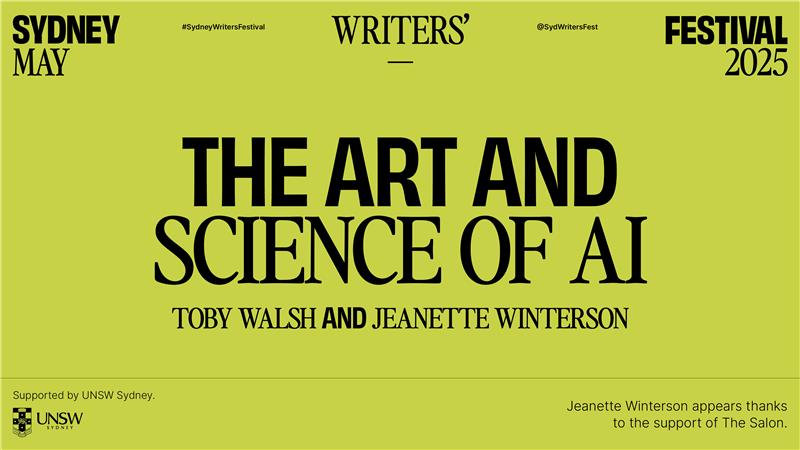
The Art & Science of AI
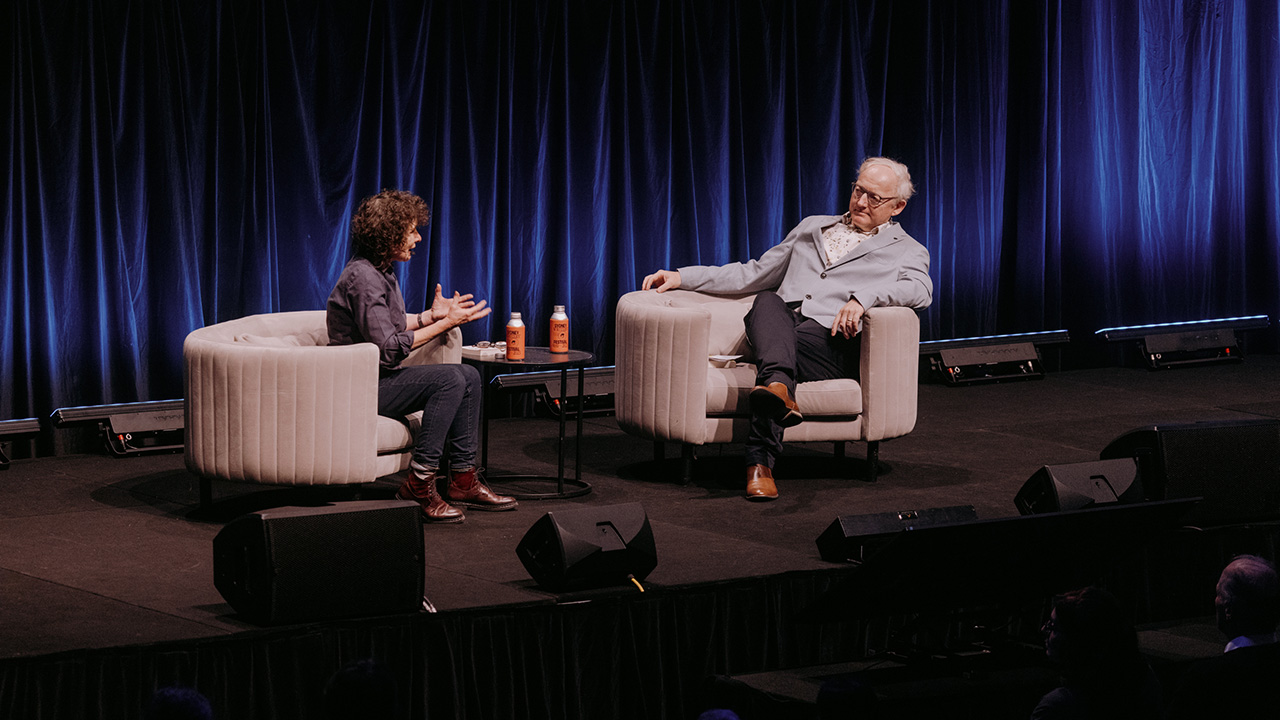
Humans, when we reach a data limit, usually something else comes in, and we make these most astonishing leaps between things that are not connected at all, and suddenly they are. That's what we're really good at. It's what art's always been good at.
Artificial intelligence’s collision with human creativity is one of the most important stories of our time.
With the accelerating impact of AI, so much of what we understand about being human is being re-written.
Acclaimed writer Jeanette Winterson (12 Bytes: How artificial intelligence will change the way we live and love) sees AI changing our lives in unprecedented ways. Academic and researcher Toby Walsh (The Shortest History of AI) predicts the place AI will have in our futures.
Hear Jeanette and Toby bring the perspectives of an artist and a scientist together in this important contemporary conversation. With an introduction from Verity Firth.
This event was presented by the Sydney Writers' Festival and supported by UNSW Sydney.
Transcript
Verity Firth: Good evening, everyone. I'm so pleased to be here with you all. Tonight's event is a unique opportunity for two award-winning experts to explore their perspectives on the intersections of art and science of AI.
Before we begin, I'd like to obviously acknowledge that we're on the land of the Gadigal people, the Traditional Custodians and knowledge holders of the unceded land where we're meeting tonight. I pay my respects to Elders past, present and emerging and extend that respect to other Aboriginal people here with us in the room today.
Before I get into my introductory remarks and introduce our guests, I do need to make a few short announcements. Firstly, I know you know this, but please make sure your phones are switched to silent. We do ask that you don't record the event. Keep photos to a minimum. You can take photos but just don't be flashing away all night. And use the hashtag #sydneywritersfestival if you're tweeting. The writers will be available to sign books after the session.
And the bookshop, you probably just passed it, is in the main foyer, and book signings will take place in Bay 21.
So my name is Verity Firth. I'm the Vice President of Societal Impact, Equity and Engagement for the University of New South Wales Sydney, which is a premier partner and the exclusive university partner for the Sydney Writers' Festival. The partnership is an important one for us. It brings together a shared vision of creativity, curiosity and, most of all, a love of books.
UNSW's mission is to contribute to progress for all, and there's nothing more consequential than the progress which comes from supporting people to have the time, space and mental energy to dedicate themselves to lives seeking new knowledge and then sharing this new knowledge with students and the community to galvanise positive societal benefit. That's the role that we see ourselves playing as a university, but I think it's very much what a writers’ festival is about as well. The people who have the time, expertise, depth and mental energy to bring new ideas so that we can all think about them, discuss them and create change.
Now, there are very few novelists that have written about AI in the literary field in such a unique way as Jeanette Winterson in her selection of essays in 12 Bytes. And there are very few scientists which explore the impacts of science and evolving technologies, AI specifically, as eloquently as Toby Walsh.
In one of her essays in 12 Bytes, Jeanette Winterson sees the creation of AI as a continuation of humanity's age-old spiritual request for understanding and meaning. The creation of AI is indicative of our innate desire to create and understand intelligence beyond ourselves. The development of AI, therefore, poses moral questions similar to those posed by spiritual traditions. We must therefore approach the development of AI with a profound sense of responsibility and ethical mindfulness. Too often in this debate, scientists and artists are portrayed as being on completely opposite sides or completely opposite personalities. But as I read Jeannette and Toby's work, it was evident that they fundamentally share so much.
They both have a deep sense of curiosity and hope, a spirit of experimentation in their journey of discovery. And they're both optimists. They both do believe that AI can and will make the world a better place if it is implemented with appropriate ethical care and understanding. So I think it's going to be a really interesting conversation. I hope you enjoy it.
I'm now going to formally introduce our speakers, give a little bit of their bio so you know who they are.
Toby Walsh is a Laureate Fellow and Scientia Professor of Artificial Intelligence at UNSW Sydney. He is Chief Scientist of UNSW.ai, UNSW's campus-wide AI initiative. He's a strong advocate for limits to ensure AI is used to improve our lives. Having spoken at the UN and to heads of state, parliamentary bodies, company boards and many others on this topic. This advocacy has led to him being banned indefinitely from Russia. He is a fellow of the Academy of Science. He's named in the International Who's Who in AI list of influencers and has written five books on AI for a general audience, the most recent of which is The Shortest History of AI.
And if you're particularly interested in learning about AI and the history of AI, Toby is giving a curiosity lecture here tomorrow at 11am. It's free, so please come along.
Again, Jeanette Winterson, I don't think needs any introduction to this audience. She has a firm belief, with a firm belief that art is for everyone. In a creative career of 40 years, Jeanette Winterson CBE has proven this time and time again. A best-selling, award-winning author, she has written more than 30 books and screenplays and is now Professor of New Writing at the University of Manchester. In 12 Bytes: How AI Will Change the Way We Live and Love, Jeanette makes the complexity of AI accessible and digestible to non-experts like me. And she, through her signature wit, compassion, and curiosity, she weaves together themes across history, religion, myth, literature, across more than 12 essays to provoke deep thought, but also to make you laugh. So please, now, welcome to the stage, Jeanette Winterson and Toby Walsh.
Audience Applause
Jeanette Winterson: Hello, everybody. Here we are again.
Toby Walsh: Jeanette, before we begin, I'm going to have to do the fanboy bit first. 40 years ago...
Jeanette Winterson: Is this to soften me up?
Toby Walsh: No, no, no, no, no, no. I read Oranges, and I was totally smitten, so thank you for that.
Jeanette Winterson: Oh, thank you.
Toby Walsh: But it leads into a question, which is... I'm a very binary person. Literally, i've spent my life dealing with zeros and ones. But back then, I would never have believed I would be sitting on the stage with a non-binary person, if I may call you that...
Jeanette Winterson: You may.
Toby Walsh: ..Like yourself, who's passionate about gender, sex, religion, the messy real world outside my simple world of zeros and ones. When were you smitten by AI? How were you smitten by AI?
Jeanette Winterson: Mary Shelley, 'Frankenstein'.
Toby Walsh: Of course.
Jeanette Winterson: Because I realised that when she was writing that, first, she had that vision that electricity would be necessary to power this other creature, which was an astonishing insight back then, because electricity wasn't anywhere near in general use. It was just a little voltaic pile, wasn't it?
People were sticking electrodes into frogs. Frogs, yeah. It's where you get galvanised from. Luigi Galvani gets experiment, let me stick these electrodes into frogs and see what happens. And they leapt about. So it was that. And then suddenly thinking that what she'd done was a message in a bottle, and that 200 years later, we were the first generation who could read her in a completely different way, not as a novel about education for women, a Gothic novel, a sci-fi novel, any of those things, but as a glimpse of the future, as a kind of prophecy. And that Victor Frankenstein makes his creature out of the body parts of the charnel house. And we do it out of zeros and ones of code, which is where you come in.
And I started to think about that. And then also thinking about the marvellous possibilities of non-binary because AI isn't. We gender it, don't we? But it has no skin colour. It has no sex, no gender. It doesn't believe in a sky god. It can't be bribed with yachts and land grab and power and loads of girls and stacks of cocaine. So that's why people panic when they say we have to align it with our values. And then you look at us in Gaza and in Ukraine, you think, what values?
But we could, couldn't we?
This is something which could be because we talked about this, incredibly freeing in so many ways, not just in terms of the economy, but in terms of the way that we understand humanity, understand life, understand ourselves. It doesn't have to be an agent of control and constriction, does it?
Toby Walsh: It doesn't, it doesn't. But before we leave that amazing vision from 200 some years ago, what I'm trying to understand, what was in the water then? Because there were a number of people, there was Mary Shelley, centred around this web of people, centred around Lord Byron, you had his daughter, Ada Lovelace, who, again, amazingly visionary, 200 years ahead of her time to see the computers. Charles Babbage, the Lucasian Professor of Mathematics, who was building the first mechanical computer. She had the vision to see what you could do with that and to ask this question.
Jeanette Winterson: No, it was extraordinary. I mean, there he is, building this kind of steampunk nightmare of levers and cogs and bevels and pins that never quite worked. And she's thinking, "How can I program this?" So it was partly that and that extraordinary holiday…
Toby Walsh: I mean, the interesting thing is that that was the... In some sense, that was the point where the Industrial Revolution was the cradle of globalisation and the development of our economy. And at that moment...
Jeanette Winterson: In Manchester, we both had a mini in Manchester, we've worked out. Because I know you're a proud northern lass. But you know, that was the cradle that moment. And yet, at the same point in time, the seed was being laid for the next revolution that we're now experiencing, the AI revolution, the digital revolution that is now going to again transform in a remarkable way our lives. It is. And it is extraordinary. And that's something I wanted to try and understand as well.
I needed to go back to the Industrial Revolution, the 250-year span and think, well, that shifted humanity forever from the agrarian economy that was all our lives. And then we moved into the industrial economy, and it was a kind of collective nervous breakdown, I think, wasn't it, for a good while. And then what would happen? I thought, how can we learn from all the mistakes that we made in that first seismic shock to the human system and not do it again?
And it seems like we're still having the same arguments because, in the Industrial Revolution, you can invent a machine that does the work of eight men. So what do you do? You put seven out of work and you pay one half his wages, and then you wonder why everybody's starving and fed up and wants to smash him to pieces. And then people talk now about AI and say, well, it's going to take our jobs. But we also know...
Toby Walsh: But Lord Byron comes back into the story then as well.
Jeanette Winterson: He does come back.
Toby Walsh: Because he was a supporter of the Luddites.
Jeanette Winterson: He was. And he was the only person in Parliament at the time to vote against the Frame Breaking Act of 1812, where it said that if you break the frames, you will be... It's the death penalty because the machine was more important than human life right then. And Byron did say no. He didn't believe in women's equality. He used to fight with Mary Shelley all the time about this, whose mother, of course, was Mary Wollstonecraft, one of the world's first feminists. Her and Byron were always having a sparring match about it. But in terms of democracy, he did understand it.
Toby Walsh: He did. But the society... The establishment's reaction was incredibly harsh.
Jeanette Winterson: Yeah. I mean, look, it's all so crazy.
Toby Walsh: They hung various people with the Luddites.
Jeanette Winterson: They did.
Toby Walsh: And they sent in the troops and...
Jeanette Winterson: And we may get to that again.
Toby Walsh: In terms of learning the lessons from then, the first 50 years of the Industrial Revolution were pretty painful.
Jeanette Winterson: They were dreadful.
Toby Walsh: The working person.
Jeanette Winterson: They were terrible. And that's what... We always talk about progress, don't we? And when you do schoolgirl and schoolboy history, the idea is that everything is progressed. And Bill Gates still trots it out with his elephant graphs, doesn't he? And this really simplistic way of rising tide lifts or boats and we're going, in Manchester, the average life span was 30 years of age, and you had 10 people in a basement and a pig in the backyard and no running water. So can we talk about the costs of progress, which takes so long to filter through, but we don't have to do that again. We don't have to make life really miserable for tons of people, do we, with AI, before we get round to thinking.
Toby Walsh: Is the trajectory a good one at the moment, though, in the terms...
Jeanette Winterson: No, but that's your fault.
Audience Laughter
Jeanette Winterson: I've told you, you should do more.
Toby Walsh: I should do.
Jeanette Winterson: Look, he lives here with you. You can lobby him and bother him. You can go to his office and say, do more. Do more.
Audience Laughter
Toby Walsh: I fear that the challenge is a greater one in the sense that it's going to be disruptive on the same sort of scale.
Jeanette Winterson: Yes, it is.
Toby Walsh: But also, it's going to happen much quicker. The Industrial Revolution took 50 odd years. You had to build large bits of steam machine, and you had, the knowledge took a long time to disseminate around. Now we've got these global markets, overnight, they release a new language model, and suddenly you've got a billion customers. We've never been able to do things so quickly at such speed and such scale and at so little cost.
Jeanette Winterson: And it was Marx, really, who spotted that first, wasn't it, in the Communist Manifesto, 1848, where he said the... He didn't say the buzz words, but he said the two words that came to mind to him were disruption and acceleration, which was an incredible insight picked up later by other thinkers.
But he saw it first, and it may be that the speed is too fast for humans because we're not as fast as machines. And keeping up is bewildering and upsetting, I think. Is it? Yes, yes. We're just doing a poll here so that it's scientific. So, it's not me just making stuff up like machines do, you know? We'll talk about chatgpt for making stuff up soon.
Toby Walsh: So then why are you so optimistic? We've pointed out these huge, great challenges.
Jeanette Winterson: I think it's illness. I think it's mental illness why I'm so optimistic. I don't know if it's alright. When I stand here and I look at myself, I say, Jeanette, stop it. But I think it's partly because, I mean, the only way I would have ever triumphed in my own life was by being optimistic. Otherwise, I'd be in some deadbeat place in the middle of nowhere, working in a building society that's now closed. So I suppose because I look at humanity and I think, wow, we've always just about got through and done it, and maybe this is our chance, and also maybe it's our evolutionary destiny, which is a bit Ray Kurzweil in the singularity, but I kind of buy into that.
I kind of think maybe humans haven't finished evolving, and this is genuinely our next jumping off point, our next chance. And we should take it. Because if we don't, when I look at the world now, say, we took away all the tech and all the AI, we'd just still go on killing and murdering each other and wrecking the place, wouldn't we?
We've been no good. We've got this far, and we're a mess. So I'm thinking, never mind aligning AI with our values. Let's bring AI in to do it a bit differently, because Max Tegmark wants to call it autonomous intelligence, and I want to call it alternative intelligence because we need some alternatives. Professor Walsh, you.
Toby Walsh: Toby, please. I think you started then to go to why I think it's so interesting, so exciting to explore and think about, because it's not just the economic possibility. I mean, the economic possibility is a great one, a massive one, but it's much deeper than that. It is actually, as you suggested, perhaps the next step in our evolution.
Jeanette Winterson: It could be, couldn't it?
Toby Walsh: And you mentioned... I've got a lovely quote I want to dig this out for.
Jeanette Winterson: That's not fair.
Toby Walsh: Well, you're the master or mistress of words. I'm zeros and ones, so I have to have the words remembered for me. But you mentioned the singularity in terms of the step change, the transformation that offers. And there's a lovely quote I found from Vernor Vinge, who's one of the persons who really popularised the singularity. And he said that the problem is not simply that the singularity represents the passing of humankind from centre stage, but it contradicts our most deeply held notions of being.
Jeanette Winterson: Yes, but I don't think it does. And that's probably because of my own religious upbringing, in that this was never meant to be it in the religious tradition. Your body is a bounded condition is not the final answer. This world is not our home. We're just passing through. And the idea that this is a temporary state, beyond which there are other possibilities.
And it may be that that's so hardwired in me that i've now pasted it on top of where we are. And I think, yeah, maybe that's the case, partly because you know that from the Enlightenment onwards, science and religion just came apart. Parallel lines will never meet in space. And now, you've got science and religion asking the same question, which is, is consciousness obliged to materiality? And religion has always said no. And science has always said yes. And now science is saying, probably not. And so this fascinates me that these parallel lines that shouldn't have met in space are coming together in a different way. And that's why I just wonder, and I do genuinely wonder this, if we've been telling the story backwards and that our religious expression, which is across culture and across time, has been a way of trying to say we will get to this point where we wouldn't be a bounded condition, where we would, in fact, not be subject to death.
Death and taxes, but now the rich don't do taxes, so it's only death. So they're naturally going to put a lot of money into sorting that one out. But it may be, what if it were true, but we didn't know how to talk about it except through a religious prism? And what if this is the moment where it becomes reality?
Toby Walsh: I'm very attached to my body. I mean, you seem...
Jeanette Winterson: I am, I am, I am, all of it. It's not much, so I have to be attached to it.
Toby Walsh: But I mean, certainly at the beginning of AI, it's not such a common idea. But at the beginning, there was a significant body of thought that we weren't going to build intelligence and it was embodied. That our intelligence actually is a response to the complexity of the world. And you can only build intelligence that is situated in the world. There's no mind in a box.
Jeanette Winterson: I believe that, I believe that, yes. I think that's right. And I also think if we did ever find a way to upload consciousness, it wouldn't be a replica of you and a replica of me. It would be very partial because of all our embodied understanding.
Toby Walsh: But we wouldn't live on then in that?
Jeanette Winterson: Well, something would, wouldn't it? But even in the idea...
Toby Walsh: In the minds of the people we're interacting with, not with...
Jeanette Winterson: I don't know, I could lock you in my laptop and not download you.
Toby Walsh: You could make copies of me.
Jeanette Winterson: Or we could do it with Mark Zuckerberg. That would be good, wouldn't it? You know all those stories of genies who get trapped in jars for 3,000 years? Well, maybe, again with our storytelling, maybe we thought, oh, somebody got stuck in my laptop and I'm going to let them out. I'm sorry but...
Audience Laughter
What I mean is, it's not just our arrogance, is it, and our magical thinking that has brought us to the point where we could never, ever say, this is all there is, and we'll put up with it.
Toby Walsh: But what if this is all there is?
Jeanette Winterson: Well, I’ll accept it, but I'm going to have a damn good go in the other direction first. I don't mind. Look, I don't mind dying because I'm having a good life, and so I won't feel that I’ve missed out. But really, I'm just interested in whether across time and across our thinking, this will turn out to be true rather than just an optimistic delusion. And if it were to be true, of course it would alter... Homo sapiens would be just another rung on the ladder, and we'd be looking back and saying, oh, that's when we had bodies. And you could go on holiday probably to download yourself and go and eat burgers and drink beer and just go and shag on the beach. And then people would say, well, that's what we used to do when we had bodies. I don't know.
Audience Laughter
Jeanette Winterson: I don't know.
Toby Walsh: I'm a bit prejudiced because I'm an AI researcher, but I do actually think that one of the reasons that AI is exciting is because it's going to address, I think, one of the most important scientific questions that remains to be answered, which is, what is it that makes us?
Jeanette Winterson: Yeah.
Toby Walsh: Whether it'd be consciousness, because we've made so little progress on that question.
Jeanette Winterson: I think because we take ourselves for granted.
Toby Walsh: But the thing that worries me a little is the answer might be it's all an illusion.
Jeanette Winterson: Yes, it might be. Or a matrix type illusion, but with nobody else out there.
Toby Walsh: Yes.
Jeanette Winterson: Oh, well.
Audience Laughter
Jeanette Winterson: It might be, but it might not. And it would be worth... Look, it'd be worth finding out, wouldn't it? It's worth pushing it a bit further just to see what happens.
Toby Walsh: Oh, yes. Yeah. I'm keen to follow AI to where it takes us, because when we wake up in the morning, we don't say, I'm intelligent. We wake up and say, I'm alive, I'm conscious again. And that rich experience is something that we know so little about.
Jeanette Winterson: And that's been the problem, hasn't it? And you say in your book, it's really good, this one, by the way. So you should buy it afterwards. And it's not very expensive. So spend your money wisely. The people who are intelligent overvalue intelligence. Everybody here is intelligent. And that's why we're all here. And it's true we do. And that's a problem in the way that we think about what will happen as we go forward because, as you say, we are a body. We're a limbic system. We're a set of emotions, emotional responses. And that does matter. And we know that AI can simulate emotion, but it can't feel emotion because it hasn't got a limbic system. We don't know how that will play, but it's when you... I mean, you don't because you know it's fooling you. But for most people, when you interact with an AI system, you do get drawn in, don't you? You get caught in, and you think you're talking to an entity that is responding.
Toby Walsh: But that's a human trait. I mean, I don't know if there's anything else in the world that's conscious but me. And I project that onto you because Occam's razor, that's the simplest explanation of how you are saying all these remarkable things and writing all these remarkable books is because you must be like me, your inside must be like my inside.
Jeanette Winterson: Which is a good thing and a bad thing.
Toby Walsh: But that's the easiest explanation for you. But the explanation from my robot is not that.
Jeanette Winterson: No, it's not.
Toby Walsh: It's a much simpler explanation is just to say it's a bit of computer code, zeros and ones.
Jeanette Winterson: It's a bit of zeros and ones. But in some ways so are we, because we too are trained on data, aren't we? We're all trained on data sets, our family, our education, our environment, what we've read, who we've taught.
Toby Walsh: And millions of years of evolution.
Jeanette Winterson: And millions of years of evolution. But it's all data. And the great thing about humans is that data set can be radically interrupted, I suppose. The nun falls in love with a gardener. Life change in unexpected ways because what...
Toby Walsh: But that's the beauty of life.
Jeanette Winterson: That's the beauty of life.
Toby Walsh: The bits that don't make any sense.
Jeanette Winterson: Yes, it's the bits that don't make any sense. And one of the problems, I think, with the way that computing science has developed, and we're talking a bit before about game theory, is wanting there to be and the way that we learn to program is we need to have clear rules, simple questions, a closed world, which then doesn't correspond at all to the messy way in which we actually live. And that, to me, is a bigger problem than worrying about for me what makes us conscious.
It's this disconnect or this divide between what we're doing with machine learning machine intelligence and what happens out here, which is both glorious and horrific because you can't plan it and you can't program it. I know that you're a big Bayesian, and you think that probability will tell us a lot, and it will, but it doesn't tell us everything.
Toby Walsh: Keep you dry and tell you whether the rain's going to happen. It will be raining on the way home.
Jeanette Winterson: It will do all of that.
Toby Walsh: Better than that than feeling my bones.
Jeanette Winterson: Yes, it's better than that. But there are still, in the human condition, things that happen that Mark Zuckerberg and his 10 steps can't predict, that even the Facebook algorithm can't predict because we're weird. And that is a wonderful thing for all its messiness. Can you predict the moment that the woman walks out of the house and decides not to come back? Can you predict the moment when your daughter falls in love with somebody entirely unsuitable? Oh, sorry, i've touched a raw nerve there.
Audience Laughter
Toby Walsh: There was a groan in the audience.
Jeanette Winterson: There was a groan, yeah. So that, to me, was when I tried to understand, when I'm looking at how the actual mechanics of it are done, how it happens, I'm thinking, why does this not happen the way we happen?
Toby Walsh: Well, we've been dancing around it, but we've come to love. You mentioned love. God is not thought. God is love.
Jeanette Winterson: That's right. And that's a tricky one.
Toby Walsh: A computer is never going to fall in love. It's never going to lose a loved one, have to contemplate its own mortality. Those are human experiences, and only humans will ever experience those.
Jeanette Winterson: And if we evolve out of ourselves, I guess we won't experience those things either at all or in the same way. But we don't know yet that there are not other ways of experiencing what we might call sublime emotions.
Toby Walsh: There was a lovely line in your book I'm just reminded of now, which is the line from Philip Larkin that's on his epitaph on his memorial stone, Westminster Abbey. Everything that survives us will be love.
Jeanette Winterson: Yes. And I do believe that. I mean, it's always bothered me that we're back to the... The first horror for me of the Cartesian split, the mind-body split, and I think, therefore I am, which was so enthusiastically embraced, which is actually more interesting than the fact that Descartes thought of it, that everybody thought, this is great. Well, the men did. The women, not so much. Yeah.
Because the idea was that there is a thinking thing, the res cogitans, which is you, not me, and res extensa, which is everything else, including animals and women. So this is what Descartes... We were in that other bit. Sorry, girls. But the thinking thing was the thing that could think and therefore, even if it was being deceived by a devil, it was still, a, worth deceiving, and b, might realise it was being deceived in some way or other, but it never occurred to him, when he was sitting there asking with radical doubt, what can I know? He didn't say, and this really bothers me, he did not say, "I know I love you, I know I'm loved." That is what he did not say.
And most of us would, at the end of our life or anywhere else, what we could hold on to, isn't it? We'd say, "Well, you love me and I love you. And that has been the glory of my life." Now, he didn't. And from that moment, the whole enlightenment opens up into this madness, ahh, which, the way I feel that once we make that horrible split and love and all the attendant emotions that go with it get sidelined, then we're left with something, a, the intelligent people overvaluing intelligence, but also not finding in ourselves the necessary compassion to combat the cruelty, the disasters, the fallouts, the collateral damage of the things that we do invent, that we do make, like the factory system.
Everybody hated the factory system, but we're all told it was progress. But for the humans working in it, it was hell. Mrs Gaskell went into a factory in Manchester.
Toby Walsh: Turning humans into robots.
Jeanette Winterson: Yeah. And she said, "i've seen hell, and it is white." And that's where the first time you hear phrases that are now so commonplace, like a pair of hands, mind the machine. So the human is reduced to the thing that works, not a thinking thing at all, the thing that manages the machine. And I think somewhere along there are danger zones and fault lines now, aren't there, still with what we're developing. Because let's face it, it's a bunch of guys mainly.
Toby Walsh: That's a wonderful example of the potential positive and the potential negative. So the machines, the horrible factories that turn people into robots. But equally, the washing machine, probably the greatest gift to remove drudgery from life.
Audience Laughter
Jeanette Winterson: I can hear the ladies murmuring.
Audience Laughter
Toby Walsh: That we don't spend as much time washing.
Jeanette Winterson: No. It's OK. You know.
Toby Walsh: I thought the washing machine was pretty net positive for the planet.
Jeanette Winterson: I could live without it.
Audience Laughter
Jeanette Winterson: Look, no, we're diabolically clever. We've done loads of things, supposedly labour-saving. But every time anyone does a study, there was one in The Atlantic recently, they work out that we've got less and less time the more labour-saving devices are invented. First, we have to work more in order to get the money to pay for them. So we can't stop at home and not do the washing thing. Well, I'm not doing all that washing. It'll take all day. I'll read the paper instead. So we haven't done what we thought we'd do with all the wonderful inventions, have we? It seems that most people now feel they're time poor and they're more pressured, even though they've got all the gadgets. Something has gone very wrong there, hasn't it, in our relationship with the machine.
Toby Walsh: That might be the growing inequality within our society as well.
Jeanette Winterson: Yes, it might, but it also might...
Toby Walsh: Many of the benefits of those affluent.
Jeanette Winterson: Yeah, but I think people do feel that they have less time.
Toby Walsh: And they do.
Jeanette Winterson: They do have less time, yeah. But we are also working harder. And that was never meant to happen, was it? One of the promise of automation was really meant to be we work less.
Toby Walsh: People forget the weekend was the invention of the Industrial Revolution.
Jeanette Winterson: It was.
Toby Walsh: First of all, we're going to get Sunday off to go to church, then Saturday afternoon off, then all of Saturday off. So that was the gift of the Industrial Revolution. So we did actually benefit a little bit.
Jeanette Winterson: I don't think I'd call it a gift. I think I'd call it a hard won.
Toby Walsh: Yeah, we worked for it. But we got some of that back in as gift.
Jeanette Winterson: But also, you know as well as I do, if you're working on a farm, and people here I'm sure have worked at farms, the beginning of the factory system, the 12-hour day didn't set out to be cruel. It was just that was everybody's working day. Because if you're on a farm, you don't really take a break. It's easy. I mean, you just go through it, don't you? Your animals and blah blah till the end. And you can put in a 60, 70, 80-hour week when it's not repetitive drudgery and not know that you've done the job because you're loving it, or you're in a place that you want to be, and it's variety, it's not repetitive.
And so it's not so much the hours of work that we needed to reduce. I think it was the kind of work. The only way that we could survive the factory system was to have some time off, which tells us a lot about the factory system. I don't think it's that people want fewer hours necessarily. They want to do something which just keeps their minds occupied, gives them variety, allows them to be outside, to interact with animals, nature, all the things that we grew up with.
I mean, in terms of our evolutionary history. So that whole work-life balance is really tricky. And it's post-industrial revolution, isn't it? And it's whether you guys, which I'm hoping you will, will be able to fix this in some way so that we can genuinely enjoy the fruits of the AI revolution and not have to put in so much drudge work.
David Graeber talks about this, doesn't he? He's dead now, of course, but brilliant anthropologist. He came up with the term bullshit jobs. Just saying why is so much in modern life about bullshit jobs where people can't find meaning? And why are we not trying to work towards a society where people's work is meaningful? I mean, you don't mind working 60, 70, 80 hours a week. I don't. When I'm interested, I'm happy. I'll just go on and on and on. But I wouldn't feel like that if I was working in the laundrette doing somebody's washing.
Toby Walsh: But on a positive in terms of the direction we should be going in, I mean, there's lots of interesting studies. There's a big study in Europe going on at the moment, looking at a four-day week. And all of these studies, there was a big study in New Zealand, all of these studies always come up with the same observations, which is people are just as productive if they do four days of work as in five, because they stop doing all the bullshit stuff and focus on what needs to be done so you can pay them just as much. And then secondly, and who would have imagined this, people are happier.
Audience Laughter
Jeanette Winterson: It's amazing how much money it costs to work these things out, isn't it? A fortune to tell us that people are happier if they can work less, and they can be just as productive.
Toby Walsh: The problem there is we have to do what we did in the Industrial Revolution. We have to come together and collectively stand up and demand it.
Jeanette Winterson: Yeah, and it isn't like that. And that takes us to our problem with the rather secretive cabal that's running AI development right now because most of us are outside of that conversation and it's become... It is a priesthood, isn't it? It's a high priesthood of a few males who can talk the talk and walk the walk and know how to manage all this. And then the rest of us are the passive consumers of the product. And I think that's dangerous that we are not included. I don't just mean women. I mean, everybody is outside of the process. And even people like you, now, we don't know what Sam Altman is doing anymore, do we, because they're kind of not telling us. Isn't that a worry? Isn't that a worry for you in your field?
Toby Walsh: A little bit. I mean, there's still... I mean, there's a remarkably small field in the sense that there's 10,000 people with a PhD in AI.
Jeanette Winterson: And that's what really comes over in the book. This is tiny, tiny, tiny, isn't it?
Toby Walsh: And so, it's still possible to know most of those people. There's still a healthy exchange of scientific ideas. So, I could go off and build, recreate chatgpt. It's not that secret. I don't have his resources, though. I think that's the biggest barrier is that I don't have the billions of dollars that he has that allows him to do the things that he does.
Jeanette Winterson: But are we going to face this, this huge divide between the rest of us being passive and then a very few people saying and this is how it's going to be, do you think? Or do you think politicians will intervene, because they haven't intervened, though, have they? We've been trying to get governments to legislate, certainly against big tech for forever. You know, simple stuff like, no, I don't want my 11-year-old son watching choke pornography before he goes to school.
Toby Walsh: I mean, the positive there is that politicians are now waking up. I spend a lot of my time talking to politicians. I spent a lot of time giving advice as to how are we going to get young people off social media? How are we going to prevent pornography being shown to young people? Because I think there's a public appetite for those things.
Jeanette Winterson: I hope there is. And I hope it's not too late. I mean, because the experiment, in some ways, this is where I'm not optimistic that we've already done so much damage to young people. Zuckerberg, I don't know why we have to go to the end of the alphabet to spell his name. It's a perfectly good letter at number six. But anyway, Zuckerberg and co, they can count.
Audience Laughter
Jeanette Winterson: Have done so much damage and wish to go on doing damage and are escaping legislation continually, aren't they? Now, even though we're all saying we don't want this anymore. And now, of course, he's bringing us our AI friend, isn't he, as you say. Having ruined the social life of young people all over the world, he's now got this little AI pal.
Toby Walsh: Yes, because we've only got two friends each. He's going to give us his AI friends.
Jeanette Winterson: Yeah. And the trouble with that is, what we said earlier, that you will relate to it. And I think it's both a good thing and a bad thing. When you were little, you had a teddy bear that you talked to, and you believed your teddy bear understood you, and it was helpful because we cannot help relating to something, especially if it talks back to us. Some people sit next to a fish tank at night, and they feel better. So this will...
Toby Walsh: Fish can have feelings.
Jeanette Winterson: They can, they can, they can. And I think if it works for you in some way...
Toby Walsh: Apologies to any pescatarians in the audience.
Jeanette Winterson: If it works, then it's OK. But it's not a substitute for or a replacement for, is it? I mean, I'd love to have a little AI system at home that you could chat to when you come through the door because it's going to be like marriage, isn't it? You know, you come in and you say hi. No response.
Audience Laughter
Jeanette Winterson: How was your day? OK. Anything for dinner? I thought you were doing that. You talk in your book about the kind of low level at which most human conversation happens, in the low level at which we operate and say, look, we're not overestimating machines, we're overestimating ourselves. So there is a level at which it would be quite fun to have a chatty, engaged companion when you come in and it says, oh, i've been thinking about you all day. How did the meeting go?
Toby Walsh: And we're so easily fooled by that as well.
Jeanette Winterson: So easily. But are we being fooled, or is it just quite nice to get a bit of attention while your other half is slumped in the chair watching match of the day or something, you know?
Toby Walsh: I suspect we will be quickly disillusioned by that.
Jeanette Winterson: I'm not so sure. Some of these people are married to someone like that. I'm not so sure.
Toby Walsh: So as an example today, if you ask ChatGPT something and he gets it wrong and you say, no, that's not the right answer, he apologises. Say, oh, I'm very sorry, I won't do that again.
Jeanette Winterson: Which is more than your husband does, isn't it, more than your husband does. They just do it again. As soon as you've gone out of the room, you say, take your feet off the settee.
Toby Walsh: But you realise, sorry, it's meaningless because it'll do the same.
Jeanette Winterson: I know it is meaningless, but it's no more meaningless than so much, is it, of human interaction. But I think that we've got to change some of the terminology because I don't think machines hallucinate. I think they 'machinesplain'. Remember that Rebecca Solnit essay when men explain things to me about mansplaining? Because if you ask a man anything, they will answer you to save face, even though they know bugger all because they cannot say I don't know. So this is the thing with machines which were programmed by men, it will say anything rather than...
Toby Walsh: It's not a fundamental flaw of the technology. They could have said I don't know.
Jeanette Winterson: You've admitted to me they programmed it in a purpose.
Toby Walsh: It was a design choice.
Jeanette Winterson: It's a design choice. And who designed it? People like you.
Toby Walsh: There are probabilities behind it. And it could say, I'm really uncertain of this answer. I'm too uncertain to give you an answer. Go and look it up on the web. But they chose to be confident in their answers, as you say, the perfect mansplainer.
Jeanette Winterson: So that's why we need to change the word from hallucinating to machinesplaining. Because then we'll all realise what territory we're in, won't we? And there's some hilarious examples in Toby's book, honestly. It's where it pushes back and says, no, I'm right. And then you say, no, you're not. And he says, no, no, you're right, I'm not right. Which is good fun, but it is scary when it's serious stuff. Like, if we're asking if, you know... With this conspiracy theory world that we're in. When they're pushing all this crap out and you believe it, that's problematic, isn't it?
Toby Walsh: I want to move off the economic on to something that I know is important for you, which is the artistic. And something where I think actually we disagree quite fundamentally, which is there was a piece of creative writing, 'creative writing', I put in inverted commas, that ChatGPT wrote. Sam Altman praised the quality of the writing. And you wrote a piece in The Guardian. I think it was The Guardian. Being quite complimentary about it, which quite completely surprised me.
Jeanette Winterson: Yeah, I was.
Toby Walsh: Because I thought your reaction was going to be the reaction of many artistic people, my reaction. And I’ve got a quote here. It's quite a long quote. So I want to read this to you because it summarises, I think, my position very well. It was written by fantastic artist, Australian artist Nick Cave. It's quite a long piece, but I think it's worth going.
Jeanette Winterson: Yeah, tell us.
Toby Walsh: Since its launch in November, ChatGPT, many people, most buzzing with a kind of algorithmic awe, have sent me the songs in the style of Nick Cave created by ChatGPT. There have been dozens of them. Suffice to say, I do not feel the same enthusiasm around this technology. I understand that it's in its infancy, but perhaps this is the emerging horror of AI that it will forever be in its infancy, as it will always have further to go. And the direction is always forwards, always faster. It can never be rolled back or slowed down as it moves us towards a utopian future or maybe our total destruction. Who can possibly say which? What ChatGPT, in this instance, is replication as travesty. ChatGPT may be able to write a speech or an essay or a sermon or an obituary, but it cannot create a genuine song. It could, perhaps in time, create a song that is, on the surface, indistinguishable from original, but it always be a replication, a kind of burlesque. Songs arise out of suffering. Data doesn't suffer.
ChatGPT has no inner being. It's been nowhere. It's endured nothing. It's not had the audacity to reach beyond its limitations. And it doesn't then have the capacity for a shared transcendent experience, as it has no limitations from which to transcend. What makes a great song great is not its close resemblance to a recognisable work. Writing a good song is not mimicry or replication or pastiche. It's the opposite.
Jeanette Winterson: That's fair. That's fair enough. But it's not right.
Audience Laughter
Jeanette Winterson: I mean, there's a couple of things in there that concern me. One is that humans are obsessed with suffering, and we do suffer. And so we have to turn it into something. That doesn't mean we have to suffer. It doesn't mean that the future and that our integrity...
Toby Walsh: Can we appreciate life if we haven't suffered?
Jeanette Winterson: The way things are fixed now, it would appear not, because those people who appear not to suffer know that there is suffering. It's just not happening to them. So there is a superficiality to it as well as a cruelty to it. And it's in this sort of gilded elite nothing touches because suffering still exists. But all of the myths of any idea of a golden age from the Garden of Eden, whether it's Greek myths about a time, every place has the idea that there was once a world that wasn't fallen.
Toby Walsh: That's life. That's the beauty and the curse.
Jeanette Winterson: No, but the myth matters.
Toby Walsh: Life begins in pain, literally. It ends in pain.
Jeanette Winterson: It doesn't. I mean, it does. Obviously, childbirth does. But again, that was part of the myth, wasn't it? You fucked around with the serpent, so now you're going to give birth in pain for the rest of your life. It was a cruel God. But because of the way our society is structured, there is always suffering.
Whether there has to be suffering is a very different question.
And I don't think we should get too attached to the mess that we've made of things and think this is the only way that we can be authentic, because there might be another way that you can be authentic. When little kids are little kids and they haven't suffered and they're happy, it's a beautiful thing.
Toby Walsh: The body sort of mixes them up as well. It's a biochemical. You know, pain and pleasure both endorphins.
Jeanette Winterson: Yeah, it does mix them up. Yeah.
Toby Walsh: Sometimes in bed, we mix them up as well.
Jeanette Winterson: So me as a writer always thinks, well, this the only way to be. And it might not be. And that's why we have to be careful. And of course, look, at the moment, ChatGPT is really banal. It's like an endless Spice Girls song, isn't it? Because they obviously have never suffered. But tons of pop music is just like that anyway, and it can do.
Toby Walsh: That's my vision of hell, endless Spice Girl song.
Jeanette Winterson: Well, you could be in it, but of course, soon. The Beckham's video loop forever if they manage to upload themselves and just stop there. But hopefully that won't happen. So I think I'm always interested in assumptions that we don't question not because we're right or wrong, but we should always be questioning. So my version of Cartesian radical doubt is always to say, does it have to be this way? And what if it were not? That's how I approach my work. So I don't know that we need a world that's contingent on suffering in order to feel real.
Toby Walsh: The great art has always come out of suffering.
Jeanette Winterson: Of course it has, because that's because we're amazing.
Toby Walsh: Then we wouldn't have the great art if we didn't have suffering.
Jeanette Winterson: We don't know because that's all we know for now.
Toby Walsh: What great art has come out of non-suffering?
Jeanette Winterson: No, but that's not my point. My point is this is all we know now. But this might not be the only world where things happen, and they may not always have to happen out of suffering. And my clue to that is just because all of the creation myths, all the myths of the world, wherever you go, posit a time where we weren't suffering. So we're back to the idea, is this magical thinking and Pollyanna-ish or it'll all be alright. Or when you die, you'll have six harps and everything will be fine.
Toby Walsh: But we don't look at some great artists and say, oh, that was his most creative moment. He was really content. We say she was suffering, and the great art came out of this suffering.
Jeanette Winterson: Yes, but that's all we know now. It doesn't mean it's all we can know or all we could know or all we will know. That's all. It's just a thought. But I agree with you about that. I mean, look, you've got a sonnet in your book and it's just rubbish. Of course, you can say to ChatGPT... Not your sonnet. No, no, he didn't write it. He do much better.
Toby Walsh: ChatGPT wrote it.
Jeanette Winterson: Yeah, and it's rubbish. But the story, the Sam Altman story was very interesting because it had structure. I see so much terrible stuff coming across my desk, I can't tell you. And I thought, blimey...
Toby Walsh: Your creative writing.
Jeanette Winterson: Yeah. I thought if this had come across my desk, I'd be quite happy because we could work with it, and I'd know what to do with it. And so what I didn't want to do was the usual thing, anyway, where everybody just pours scorn and worthlessness on it. Partly because I don't really run on that kind of rocket fuel, but also because I am genuinely interested in what the outcomes might be.
Toby Walsh: So what would you say to chatgpt to improve its writing?
Jeanette Winterson: I'd say it's a pity you're a machine. It would say, yeah, but I know I'm a machine. And I'd say, yeah, I know you know you're a machine, yeah. But we're all limited in different ways. And that's why I don't know whether this present situation of limitation, it can't be the final one. Of course, it can't.
But as you say in your book, and it's an interesting concept, we may have got to a point now where we can't just get past our problems with AI by scaling up, which works amazingly well, hasn't it, for Sam Altman? But you think we've reached a limit there because we've reached a data limit, haven't we? There's nothing else to train it on.
And unlike humans, when we reach a data limit, usually something else comes in, and we make these most astonishing leaps, don't we, between disparate connections, between things that are not connected at all, and suddenly they are. And that's what we're really good at. And it's what art's always been good at.
Toby Walsh: But I come back to the beginning of our conversation. I come back to Ada Lovelace. I mean, she said it has no pretence to originate anything.
Jeanette Winterson: And she was right.
Toby Walsh: Just do what we tell them.
Jeanette Winterson: She was right then. And that's why, of course, that was so interesting, wasn't it? 100 years later, with Alan Turing's 1950 paper, was it machine learning and...
Toby Walsh: 'Computing Machinery and Intelligence'.
Jeanette Winterson: That one where he has Lady Lovelace's objection in one of the chapters because he goes back, doesn't he? And he says, is she right? Which is a brilliant thing for him to do because nobody takes any notice of poor old dead Ada. And then, suddenly, Alan Turing comes along, another misfit, and thinks I’ll have a chat with her. And he does. And of course, the question still arises, was she right? Of course, her father was Lord Byron, and she wasn't having any kind of steampunk Babbage-made computer that he couldn't build writing poetry. How could Ada think like that? Poetry was the highest art, so a machine couldn't do it. I don't know.
And so I guess I'm doing what the machine isn't doing at the minute. I'm just saying I don't know. But I don't believe we're even at the middle of the story. I think we're very early on. And so I'm interested. I'd love to be. I mean, I'm not going to upload myself. I'm too old. But I'd love to see what's going to happen. It seems to me the most fascinating time to be alive.
Toby Walsh: Would you would you work together? I mean, artists collaborate. Would you collaborate?
Jeanette Winterson: Oh, totally. Yeah, I'd like to. I'd like to work with a large language model. I'd really be interested in what might happen just for my own purposes. I would get a lot out of it. I don't know what the machine would get out of it or anybody else, but it would be fascinating for me. And also, we've said, because this is happening, it isn't going to go away. And it's this difference between influence and control. We can't control it. But how could we influence things to make this more what most of humanity wants and including artists and creators, what we might want, how we might want to work with this.
You know, there's an interesting story which I like. When the camera was invented at the beginning of the 20th century, there was a great upset because all those mediocre portrait painters thought, it's over, lads. Somebody wants to have their horse-faced wife on the dining room wall. They're not coming to us. And they were very dejected because they could see it was the way out. And Picasso was thrilled because he'd been doing this since he was three and could paint all that stuff anyway and was bored rigid.
And he thought, good. He said, this will free painting from the burden of representation. We don't have to do it anymore. And was tremendously excited and loved photography anyway. And of course, had lots of women who were photographers and learned from that. But he could suddenly see this enormous, freeing potential for his work, which is then how he went forward.
Toby Walsh: And photography became an art form.
Jeanette Winterson: Yes, yes. It was actually a win-win, except if you were really rubbish at painting, which this middle ground was. And I think that's where the danger probably is, there's going to be a lot of hollowing out of middle ground, isn't there? So you're going to need your plumbers, your gardeners. You're going to need humans at lower levels and at higher levels, but maybe not so much in the middle. But that's only a problem if there's no money, and that people won't do universal basic income if we don't restructure society so that we share the goodies.
I mean, the rich list this year are obscene, aren't they?
I mean, it's as far away as we can possibly get from one person's experience to another person's experience, and that can't be right. But again, it's like suffering. Is scarcity baked in? Is it necessary? I don't think so. Is abundance possible? I do think so. So it's because what I really believe is that the way that we live, I don't think... It's not a law of physics like gravity. I think it's propositional.
And I think we make it up as we go along. And as somebody who writes stories and creates mini worlds, I think we're always making up the next story. That's how society changes. So I'm thinking, well, if the way we live, the way we suffer, the way we don't, isn't a law like gravity, couldn't we write a better story?
Toby Walsh: Well, I mean, you said that every story ends is either a revenge, tragedy or forgiveness. That's it. But the AI story is the ones starting with Mary Shelley, with Frankenstein, they always seem to be tragedy.
Jeanette Winterson: Yes. But they do. And because only forgiveness really allows the happy ending, which is false without it, because somebody or something always needs to be forgiven. And you can't have a happy ending unless there's forgiveness in there. And revenge and tragedy also go together.
It's almost like a pair of binaries, really.
And the sad thing about her story is, you know, the monster's not educated, which was her big point, because Victor Frankenstein is a deadbeat dad. Out comes the monster, he's like, no, you can't have any clothes. And I'm not even going to give you a name. I'm not going to educate you. I'm going to run away. It's no wonder he comes after him, murders everybody.
And it's really a story of what not to do. I mean, talk about trying to align it with our values. Victor, what values? You know, you've got this eight-foot monster running about in big boots and can't read or write. It's not a good look. So I think it's in all there, I think she was also really trying to say, well, what would we do if we did this, if we created a new life form?
Hers was biological. But if we're going to create non-biological life forms that we're going to have to live around, that will be such a shift for us, for the human condition. It will physically, but it won't mentally or spiritually or emotionally. Why? Because again, every culture has lived forever with different planes of existence. Your fairies, your pixies, your demons, your spirits, your angels, your dead grandma.
Toby Walsh: Hopefully, it'll be a very humbling moment when we...
Jeanette Winterson: It will be really good for us, yeah. But I think psychologically, we're already prepped for it because it is in all our mythologies, all our stories, that there are other planes of existence and that biological entities live around non-biological entities, whether they go spirits or other life forms. That's all we've ever written about. You can't find anywhere where there aren't stories like that. So again, that interests me because, were we just getting ourselves ready over these millennia to do what we're going to do next? And your non-biological entity will be with you in the living room, with your fast asleep husband, with the newspaper on his knee and his feet on the sofa.
Toby Walsh: So he can look forwards to the AI Winterson talking to the AI Toby in the near future.
Jeanette Winterson: I don't know, I wouldn't mind. I mean, having an avatar of yourself would be fun, wouldn't it? And look, if Mark Zuckerberg wasn't controlling the Metaverse and wanting just to monetise everything, it could be an amazing place for people to try out different identities, different selves, not to feel so confined to have that imaginative experience. But we don't... Again, we're not doing it like that because it's all follow the money.
Toby Walsh: Unfortunately, we've run out of time.
Jeanette Winterson: We've got 45 seconds.
Toby Walsh: I just want to end with a quote from your book. Beautiful writing as usual. The problem with your writing is it just stops you in your tracks, and you have to stop and think about the things. But I think this is a beautiful way for us to end. "We are self-obsessed with being human. This is both recent and wrong." Thank you.
Jeanette Winterson: Well, thank you, Toby. Thank you. Thank you, everybody.
Audience Applause
Centre for Ideas: Thanks for listening. This event was presented by the Sydney Writers' Festival and supported by UNSW Sydney. For more information, visit unswcentreforideas.com and don't forget to subscribe wherever you get your podcasts.
-
1/5
-
2/5
-
3/5
-
4/5
-
5/5
Toby Walsh
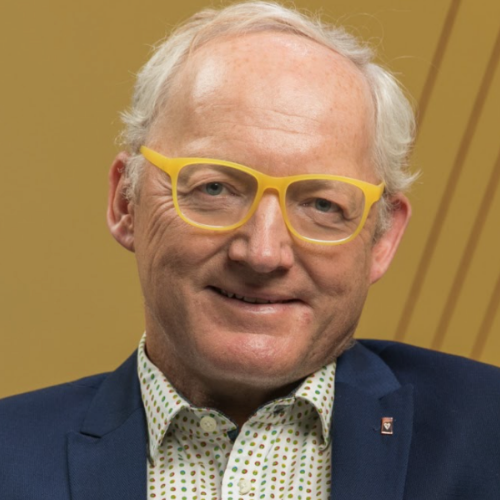
Toby Walsh is an ARC Laureate Fellow and Scientia Professor of Artificial Intelligence at UNSW and CSIRO Data61, and adjunct professor at QUT. He is a strong advocate for limits to ensure AI is used to improve our lives, having spoken at the UN, and to heads of state, parliamentary bodies, company boards and many other bodies on this topic. He is a Fellow of the Australia Academy of Science and the winner of the prestigious Celestino Eureka Prize for Promoting Understanding of Science.
Toby appears regularly on TV and radio, has been profiled by the New York Times and given talks at public and tradeshow events all over the world. He has authored five books on AI for a general audience, the most recent ones entitled The Shortest History of AI and Faking It: Artificial Intelligence in a Human World.
Jeanette Winterson
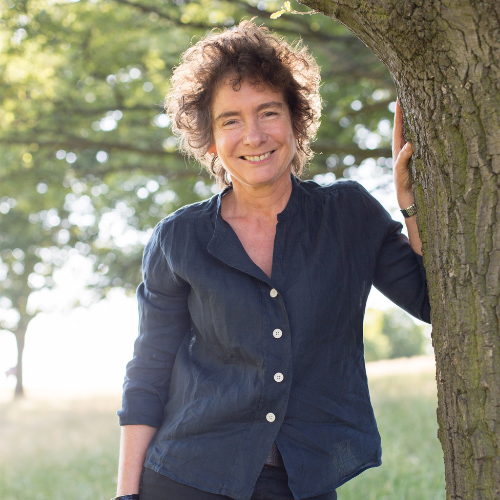
Jeanette Winterson CBE was born in Manchester. Adopted by Pentecostal parents she was raised to be a missionary. This did and didn’t work out. Discovering early the power of books she left home at 16 to live in a Mini and get on with her education. After graduating from Oxford University she worked for a while in the theatre and published her first novel at 25. Oranges Are Not The Only Fruit is based on her own upbringing but using herself as a fictional character. She scripted the novel into a BAFTA–winning BBC drama. 27 years later she revisited that material in the bestselling memoir Why Be Happy When You Could Be Normal?. She has written 10 novels for adults, as well as children’s books, non-fiction and screenplays. She is Professor of New Writing at the University of Manchester. She lives in the Cotswolds in a wood and in Spitalfields, London. She believes that art is for everyone and it is her mission to prove it.
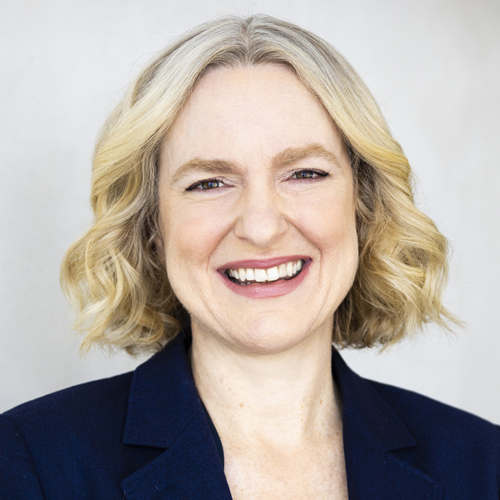
Verity Firth
IntroductionVerity Firth is the inaugural Vice-President Societal Impact, Equity and Engagement at UNSW Sydney. She has over 20 years’ experience at the very highest levels of government and education sectors in Australia. Prior to her role at UNSW, Verity was Pro Vice-Chancellor Social Justice and Inclusion at UTS (2015–2023), CEO of the Public Education Foundation (2011–2014) and NSW Minister for Education and Training (2008–2011). Verity is a member of the Commonwealth Government’s Implementation Advisory Committee for the Universities Accord.