
Andrew Leigh and Richard Holden on Inequality
Since the turn of the millennium, it's the rise in wealth inequality, the gaps between homeowners and non-homeowners, that's really been the most salient dimension of inequality in Australia.
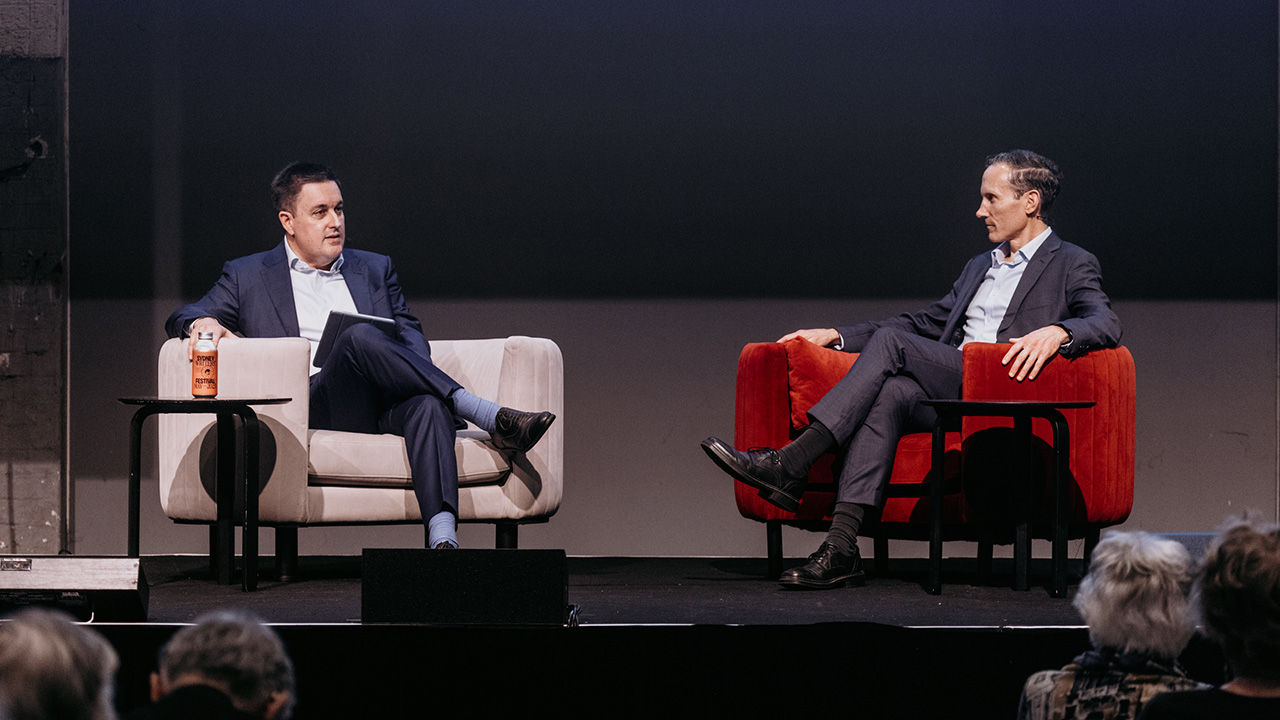
Economics Professor at UNSW Sydney Richard Holden (Money in the Twenty First Century) and Parliamentarian Andrew Leigh (The Shortest History of Economics) unpack economics as a global force that impacts wars, technological innovation and social change.
In our contemporary world, what are the causes and consequences of economic inequality? And can economics be used as a tool for justice for the oppressed?
This event was presented by the Sydney Writers' Festival and supported by UNSW Sydney.
Transcript
UNSW Centre for Ideas: UNSW Centre for Ideas, the Sydney Writers' Festival acknowledges that we meet on the land of the Gadigal people of the Eora nation, and pays our respects to elders past and present. This lecture features economist and politician Andrew Lee and author and UNSW Economics Professor Richard Holden, in a slightly different format. They're going to be having a conversation about inequality and how economics underpins change for the worse and for the better. After the talk, you can join Andrew and Richard in Bay 21 for book signing. But for now, please welcome Richard Holden and Andrew Lee to the stage.
Richard Holden: All right. Welcome everybody. It's good to see that sponsors announcements from one of Australia's great universities. My name's Richard Holden. I'm scientia professor of economics at UNSW business school.
I would like to begin by acknowledging the traditional custodians of the lands on which we meet, the Gadigal people of the Eora nation, pay my respects to elders past and present, and extend that respect to any First Nations people who are with us today.
I'm very lucky to be in conversation with my good friend Andrew Lee today, joking to, well, not really joking to people before that, this is a conversation we've been having for 20 something years about inequality. So inequality, so we ought to be okay at doing this.
I always learn something talking to Andrew, he'll be well known to anyone attending this session, for sure. He's been the member for Fenner since 2010 I believe, is the Assistant Minister for productivity, competition, charities and treasury, so sort of like more or less everything to do with the economy.
He holds a PhD in public policy from Harvard University, which I'm sad to say, as of this morning, is significantly harder get than it used to be, since all foreign students have just been banned from Harvard University by Christy Noem and President Trump.
He's a fellow of the Academy of the social sciences in Australia, author of numerous books, including Disconnected Battles and Billionaires, Randomistas, and I believe, most recently, The Shortest History of Economics. He's also, if that wasn't enough, revoltingly, he's an Iron Man triathlete, and actually really good at it, too. And as I say, we, we first met a long time ago through a mutual friend in 2002 and I was just starting my PhD at Harvard, and Andrew sort of knew the ropes already, and so he very kindly said to me, or come, come by on on Friday night, and viewers are going to go out for a couple of drinks. And I'll introduce you to some people.
I thought, okay, it's nice. And so we met, we went with some of Andrew's classmates, and I thought, Okay, let's go for a few beers. Friday night. Sounds good. Sounds like fun? I don't have any homework yet. It's good. And everyone had one beer, and then they said, right, well, that's it. I've got to get back to work, which was exactly the introduction to graduate school that I needed.
Audience Laughter
Richard Holden: So I'm grateful for that, among many other things.
Andrew, okay, so before we get into statistics about inequality and how to measure it and all that kind of stuff, one of the things you've written about in your books on on inequality in Australia is the kind of egalitarian ethos we have in Australia.
I can't remember exactly where you first talked about this, but if I recall correctly, you talk about, you know, people riding in the front seat of taxis. I think this was even before Uber. I don't know if people do that in Uber, or whether you get marked down by the driver for that and calling people mate, not sir, and things like that. And I always carry that image in my head when I get in the back seat of a taxi and call people sir, that I'm not really authentically Australian or something. Where does that egalitarian ethos come from in Australia? It seems unusual, if not unique. Where does it come from?
Andrew Leigh: Well, Richard, first of all, thank you to you for being such a generous host, and to UNSW. I, I do love the fact that an event about inequality at Sydney Writers Festival is free to attend. I would be slightly worried if we were charging $100 a head to hear a talk about inequality. So thanks to all of you for being here.
The tradition of Australia as being a country where Jack wasn't just as good as his master, but maybe better, seems to have its origins around the time of the Gold Rush, that moment where a whole lot of people from around the world come to Australia and get off the boat to try their luck. And that sense of coming from a class bound country with very little geographic mobility, as many of the European migrants did, landing in a place where you could move to wherever you wanted to and choose the occupation you wanted, that seems to have been a bit of a spark. And you see it carrying on through Banjo Paterson's poetry, there Henry Lawson's writings, even more so, and the Australian notion of egalitarianism that that carries through even at a time when the economic reality, as you well know Richard, is that there's a huge gap between rich and poor in late 1800s Australia.
Richard Holden: And so that gold rush period is part of why that's important, because the population expanded a lot at that period of time. What are the sort of … how big a shock were the gold rushes in Australia?
Andrew Leigh: Well, it is important to think about how the Gold Rush happens in Australia. We reduced the tenement sizes to, I think it's about nine foot by nine foot, which essentially meant that people were buying a lottery ticket, and it was quite hard for the land holders to expropriate most of the wealth. So a lot of the wealth actually ended up going to the diggers.
Contrast that with Argentina where a lot of the extractive industry was run by the landed class, with those who were doing the digging essentially just earning subsistence wages. South African gold mines operate on that much more hierarchical principle. It wasn't as though everybody who went into the gold rushes came out with success. But whether you were a success or a failure depended much more on luck than on your additional stay, your initial starting class position.
There is a great tribute to the way in which land was allocated in the Gold Rush and I think that does go to those nascent democratic institutions and the trade unions that were building at the time.
Richard Holden: So at the risk of doing a disservice to Manning Clark, he's famously got another explanation. I don't know if it's a competing explanation or a complimentary explanation, but I think it roughly goes along the lines of labor was very scarce relative to land. Obviously, there's a lot of land, you sort of smudge over the deserts and stuff like that. There's still a lot of land. And labor was relatively scarce because sort of, you know, hard to get to Australia and so on from Europe.
And that seems to be at least associated with a whole lot of quite kind of pioneering things, like the eight-hour day, very strong trade unions, relatively high wages, I think in Australia, do those explanations sort of mesh together? Or should I think about your Gold Rush story as being a superior story than the Manning Clark story?
Andrew Leigh: No, I think Manning Clark spot on there, Richard, if you look at the UK at that time, a huge number of workers and real scarcity of land, then they come to Australia with a huge amount of land and the scarcity of workers. So it's no great surprise that earnings of workers in Australia in the late 1800s were the highest in the world, and as I recall, about a third higher than in places like Chicago and London.
I suppose the other thing to talk about in terms of building these kind of male-bonded welfare states at the time is that Australia of that era is about as male dominated as our stage is right now. So there's a lot of… in some sense, there's a lot of similarities between the Australian male dominated working class, and that commonality did make it easier to build strong trade unions in a period where the Tolpuddle Martyrs in the UK are being transported to Australia for trying the very same thing
Richard Holden: I see. So in a sense, it's sort of the origin of this great idea of Aussie mateship. Might come from the fact that I think there were 23 male convicts for every one female convict, or something, which, as you say, to integer rounding is the sex ratio we have on stage at the moment. So yeah, maybe that's got something to do with it as well.
All right, let's, let's come to the sort of set the scene about inequality in Australia. So there are ways of measuring it that you can tell us about, things like the Gini coefficient and things like that. Tell me whether you think that's a good measure or a bad measure or, you know, the only one we've got sort of thing.
Where does Australia sit in terms of income inequality relative to other countries in the world, and how's that evolved over the last couple of decades or so in Australia?
Andrew Leigh: So the Gini Coefficient is a good measure, with zero being perfect equality and one being perfect inequality. One person has all the money. But it's not very intuitive. Corrado Gini was a terrific Italian mathematician who indeed used some Victorian data in doing his early examples of a Gini coefficient. But the Gini Coefficient isn't something you hear people agonizing about at dinner parties or running protests about.
So one of the ways that the inequality conversation has kicked off in the last couple of decades has been the popularization by my late co-author, Tony Atkinson, and even more so, Thomas Piketty, of the top 1%. And the top 1% only captures the very tippy top of the distribution, but it's a really clear metric in which you can you can understand what's being measured. So you don't have placards saying we are the Gini less than point three, but you do see placards of “We are the 99%” and so in that sense, measurement affects the political conversation.
And where do we sit? We're about midway through the advanced countries in terms of inequality, more equal than the United States or Latin America more unequal than the Scandinavian countries, whose levels of inequality Australia enjoyed as recently as 1980 but are now much more egalitarian than we are.
Richard Holden: So how do you think about… so a few things changed since 1980 including your political party, came to power, and opened up the Australian economy to the world, and did a lot of things that kind of dead center economists like me think were pretty good things. A lot of things changed.
How much of that rise in inequality as measured as we were talking about since 1980 is sort of the inevitable consequence of a globalizing world, and Australia was always going to be part of that and the question was, do we do it on our own terms, or do we sort of try and push against it until we couldn't?
How much of that do you think is a policy choice in a sense, and how much of it is the consequence of kind of global forces that are beyond our control?
Andrew Leigh: So I think of there as being three big drivers for the post 1980 rise in inequality. One is technology and trade, which Richard I would intertwine, because I think it's quite hard to unpack the distinct impacts of both of them. We opened up the economy, but we also saw the computer revolution.
The second big factor is the decline of trade unions. If you go back to 1980 half the workforce is in a union. Now we are down to about one in eight workers.
And the third big factor is the reduction in top tax rates, the fact that the tax system is less redistributive than it was back in 1980. Pushing against that, to some extent, is the rise in education.
We're a much more educated nation, thanks not only to the work of UNSW and vocational institutions and the like, but also to the fact that finishing school is now the norm rather than the exception. So technology and trade, de-unionization taxes, with education pushing back the other way.
Richard Holden: There's got to be some kind of irony about a treasurer and Prime Minister who didn't finish school being at the helm of or at the forefront of the revolution that you just spoke about. But I guess the other thing, if we're just being technical for a minute about these, whether it's 1% versus 99% or 10 versus 90 or the Gini coefficient or other fancy things, I guess there's also the role of the tax and transfer system.
So there's the income that people earn, and then there's the tax that they pay on it. And for people who are perhaps further down the income distribution, the various assistance programs, it could be the Family Tax benefits, it could be universal health care and various other things.
Does the tax and transfer system in Australia, which I think we generally think of as being quite, you know, more or less world leading in terms of helping rebalance things to some degree. Does that play a big role in how you think about where Australia fits into the global inequality picture?
Andrew Leigh: It certainly does. I didn't list transfers before, because the impact of the transfer system hasn't changed a great deal, so it doesn't explain the changes, but it certainly explains the level of inequality in take home pay.
Australia's transfer system is the most redistributive in the world. We have pension, which is means tested and asset tested. You only need to go as far as New Zealand to find a flat rate pension, where the same amount goes to everyone. We've got unemployment benefits which are flat rate rather than wage replacement. We've got family tax benefits which are targeted. All of that means a lot more paperwork to do to apply for income support in Australia, but a system which in which the tax and transfer safety net does a whole lot more redistribution than it does in other countries.
So for all of the pain that people face through effective marginal tax rates and through compliance burdens, our system is the most efficient inequality busting transfer system in the world. If it were bigger, it would do more, more inequality reducing role than it currently does.
Richard Holden: So it's intrigued. When you were talking about it's not surprising to me. Even at my dinner parties, we don't talk about the Gini Coefficient, right? So I take that as evidenced by some kind of transitivity that at no dinner parties, does anyone talk about that sort of stuff.
And I get that the sort of we are, the 99% is, is catchier. So at one level, that's like good marketing and sort of, you know, bravo to, you know, Piketty and Sayers and the folks in Zuccotti Park and so on for figuring that out. This may be a little bit of a tangent, so drag me back if, if it's too much of one. But I've just been reading Jake Tapper's book about Joe Biden, which is riveting and worrying and lots of other things. And one of the things that comes up in that is, and David Axelrod, former President Obama's chief strategist, emphasized that Joe Biden was telling Americans that the economy was great and it didn't feel great to them. I think that's a lesson that you and your colleagues learned.
My observation as a commentator for a second would be that you didn't make that mistake during the recent election campaign. Very careful, I think, across the board, to say “We think things are getting better, but we feel we acknowledge that things are tough”.
When it comes to inequality what's the visceral thing do you think that gets people thinking about inequality. Moments where people say, maybe, like now people say, really worried about intergenerational inequality? It's for sure, not that they're looking at the Gini Coefficient. They're probably not even looking at the ratio of the incomes of the top 1% to the 99%. My guess is it's something visceral. If that's on the right track, what do you think that is?
Andrew Leigh: So over the last 20 years, and particularly as we're having this conversation in Sydney, it's surely got to be house prices.
You go back to the 1940s and the typical home could be bought with three to four years of income for the typical worker, as recently as the 1980s that's only about five or six years of income will buy you the typical home. And then by 2000 it goes up to about seven. And then over the last quarter century, it's gone up to about 11.
So the duration to buy the typical home has approximately tripled in Australia since the 1940s. And as you know, as a careful watcher of the data, Richard the change in income inequality in Australia is really quite big in the 1980s and 1990s but that dimension of inequality has slowed down over the course of the period since the turn of the millennium. Since the turn of the millennium, it's the rise in wealth inequality, the gaps between homeowners and non-homeowners, that's really been the most salient dimension of inequality, I think, in Australia.
Richard Holden: So that's an almost too good segue to my next question, which was about income versus wealth inequality. So those are two different things. Does one matter more than the other? Income inequality or wealth inequality? Are they linked in an important way? How do you think about that?
Andrew Leigh: Yeah. So you worry about income inequality because the gap between what people earn is often a dimension of how people feel within the labor market, and people center their worth within a company. We have some pretty good evidence that on sporting teams more… a more egalitarian distribution of income makes teams more likely to win. Teams are more likely to work together. If the salary gap between the best and worst paid in the team is a little narrower… if you're thinking though, in an intergenerational sense, what probably matters is how much you earn over the course of a lifetime, or, not too dissimilarly, how many assets you have that's harder to measure.
You think for yourself how many questions you would need to nut through in your own head to figure out your income. Well, you start with your salary and add a few other things, and you'd figure out your income. Your wealth takes a bit longer to figure it out, because you've got to subtract off debts and so on. So we've got much better data on income, which is why economists have tended to look at it.
But wealth really matters in that broad intergenerational sense, and wealth probably matters too, Richard. In terms of the correlation between inequality and mobility, countries which are very unequal tend to be pretty class bound. There's not much class jumping in a place like Brazil, there's a lot of class jumping in a place like Sweden. So that dimension of inequality probably is wealth inequality. We're most thinking about in determining whether you can move up or down the ladder during the course of your life.
Richard Holden: So on that issue, so somewhere in this building at a different but kind of friendly, related festival, Festival of Dangerous Ideas. Last year, I spoke to my friend and co-author, John Friedman, who, as you well know, along with one of the great economists of his generation, Raj Chetty, have really documented social mobility and how it's changed over time in the United States.
There's some evidence on that in Australia and I know you've thought about this since you touched on it.
What's going on with social mobility in Australia and how concerned you talked about it? You know, Sweden, it's easy to sort of jump from, you know, the bottom quartile to the top quartile, comparatively speaking, in the US. I think the broad fact is that used to be somewhat common, now it's much less common. How's that going in Australia?
Andrew Leigh: Yeah, so I had a crack at this back in 2007 estimating the intergenerational elasticity of income in terms of how your parents’ earnings related to yours. I couldn't see any evidence that that had gotten better or worse. And as with inequality, our level of mobility seemed to place us sort of mid pack, not as socially mobile as Scandinavia, but more socially mobile in the United States.
One of the things that really strikes you out of the US is that there's this whole sort of mythology around being able to move from rags to riches, these stories about people who start off with nothing and make it to the top. But In terms of the data, they're really the exception. And as you mentioned Raj Chetty beforehand, Raj's analysis was able to quite effectively show that if you want to experience the American dream of going from rags to riches, you're better off to go to Canada than the United States to experience that. Or indeed, to Australia, which tends to have more social mobility, but we could do a whole lot more on this. And still, you see persistence in attendance at university. You know, kids who are first in their family to attend university are still the exception rather than the norm. And starting a business where, if you look at the startup master survey, there's pretty strong evidence that having parents who have access to mentors and money determines who becomes an entrepreneur.
Richard Holden: Okay, so, so I guess, broadly speaking, what are we doing right, and how can we do better on that? So it's quite tricky to kind of assign people better parents, or wealthier parents, or parents with better contacts in the venture capital sector or something like that. So even an Assistant Minister can't really control that kind of stuff, as far as I'm aware.
What, what are we doing right and what can we do better to help that mobility picture on the dimensions you just you just mentioned.
Andrew Leigh: well, part of it is the issue that your education research institution at UNSW, has been looking at, which is, how we ensure that kids in disadvantaged schools get access to the best teachers.
We have a system at the moment where within public schools, teachers tend, over their careers, to start teaching the most disadvantaged students and end up teaching the most advantaged students. It's more common for a teacher to begin their career in Blacktown and finish it in Paddington than the reverse. I think that's the opposite of what a policy of equality of opportunity would lead you to want. So that might be a dimension on which we could improve.
We do pretty well in terms of expanding our higher education institutions as demand increases, but we could do, I think, better on the entrepreneurship front. And I know there's, there's an appetite in some of those venture capital circles to think about how you find the lost Albert Einsteins, the lost Marie Curies and extend those entrepreneurship opportunities. Us economists like to think of it as a sweet spot policy, because we're not trading off equity and efficiency, but we're getting more growth and more fairness at the same time.
Richard Holden: Yeah ,that's always good if you can avoid trade offs. So it doesn't come along too often, but it's nice work if you can get it.
I'm going to come to a related issue. But I was just sort of struck that, you know, you talked about Australia as being sort of in the middle of the pack on a whole range of things there. And I think about this quite a lot when it comes to things like unemployment, which is, you know, we tend to have slightly higher unemployment on average than the US, and we tend to have quite a bit lower unemployment than a lot of continental Europe, for instance, even setting aside, you know, Scandinavia, I'm thinking about, you know, France and Germany and Italy and so on.
And tell me. Tell me what you think about this, and what's right or wrong with this picture. I think of that as we've struck some kind of balance in Australia between … and I love the US. I spent a decade there. But the reason I think they have lower unemployment is because they have an incredibly brutal labor market where you can fire people at will for most employees. Being unemployed in the US is is an even worse experience than being unemployed in Australia. It's just brutal. It's really bad to be unemployed so people try really hard not to be unemployed, and Europe's got maybe a bit more generous a system than Australia. When we're somehow in the middle, it sounds like we're sort of we've made some choice about our politics and our economics to be some kind of halfway ground between the US and Europe.
Is that the right way to think about it, or is there something else going on?
Andrew Leigh: Yeah, I think the levels of unemployment assistance are certainly relevant. The other thing you want to think about is people's propensity to move geographically or to reskill, and that's one area where Australians are quite have quite a high propensity to move within cities, but quite a low propensity to move within the country.
It was really striking to me that when the mining, the second mining boom was at its peak, almost no one was actually moving to Western Australia. The best that the mining companies were able to do was offer FIFO deals where you would fly over, do your shift, and then fly back home. But it's quite hard to get Australians to move cities. In contrast with the United States.
And the reskilling piece, I think we can probably do better on making vocational training cheaper is a part of that. But also, we know that lifelong learning is going to matter a lot. And you see, when you go into, say, a mechanics workshop, you see a whole lot of people learning through YouTube videos. Now that's pretty useful. It's a way in which I think a lot of lot of us are doing a hardware project at home. Now, YouTube is our tutor, but systematizing some of that, using some of the AI tools to improve ongoing learning, I think could be pretty important.
Richard Holden: So I'm intrigued by this mobility, geographic mobility point. So I've heard that mentioned many times, and it does indeed seem to be a pretty robust fact. But do you have a sense of why that is? Like people move around in the US, but they don't, till first approximation, move around nearly as much you know, across states in Australia.
I think of Australia's Federation as being a bit more integrated and coherent than the US. I mean, there's a lot of weird state-based stuff in the US. Like, it's really hard to switch over driver's licenses when you when I moved from Massachusetts to Illinois, I had to take this new driving, you know, computerized driving test. And, like, all the signs were, I didn't study for it. Like, who studies for that? And I sort of just wing it. And there were all these signs I'd never seen any of these signs before, certainly never seen them in Massachusetts. And I was like, Yeah, this, this doesn't seem to be, I'm guessing most of these questions doesn't seem to be going very well. And I went up to the counter, and the woman said to me, “Wow, you did really badly”.
Audience Laughter
Richard Holden: You know, a bit scolded and stuff. So maybe that's part of why it's hard to move. I think of Australia as being a lot more integrated. You know, you move to Victoria and, you know, you have to learn more about AFL or something like that, but it's not that hard.
Why do you think that is in Australia that people don't move as much?
Andrew Leigh: There's a little bit of the occupational mobility story. So we know it's hard for an electrician working in the Gold Coast to do or do a job in Tweed Heads because of occupational licensing challenges, which hopefully we'll get on top of in the next couple of years.
There's also, I think, some norms.
There is this line that that every discussion about growth and productivity ultimately ends in a blaze of amateur sociology. One of the pieces of amateur sociology that I observe is that Australians are more reluctant to leave home and go to another state to attend university, and I think that potentially shapes up Americans once they've made that one move to another state to attend university they've got a greater propensity to move through the course of their the rest of their lives. So that might also be a factor that plays into norms about Australian mobility.
I do quite like community. I do quite like the stability that comes when people live in neighborhoods for an extended period of time. So I've got to say, I'm a little conflicted on this, Richard, I'm not I'm not sure I'd want everyone moving in the most economically optimal fashion if that meant that we did damage to the propensity of people to have street parties and run local soccer games.
Richard Holden: I like my local community, but I don't know when I last went to a street party.
Audience Laughter
Richard Holden: You obviously have a lot more social capital in in your community, in the Canberra area, than than I have in mine.
Andrew Leigh: We put on one every summer. Highly recommended. It is very you know, as an economist, let's do cost-benefit analysis when you have the beauties of BYO and reusing last year's invitation means that the cost is basically zero, and the benefit is you get to know your neighbors, and your street becomes a much friendlier and safer place. As a result, putting on a street party easily passes a cost-benefit test, even if it wasn't for the fact which it's fun which it always is.
Richard Holden: OK. So I don't know whether we're going to get to the bottom of inequality today, but we've got to the bottom of the street party puzzle, which is, there are no street parties on my street. There are lots of street parties on Andrew’s street. And the answer is, Andrew hosts the street parties.
Audience laughter
Richard Holden: And I'm shy and retiring, and I, you know, can't do cost benefit analysis, apparently, so I don't so Okay, all right, Richard, more street parties. It's my mid Year's resolution. I'll take that, but
Andrew Leigh: you were going to say that, you know, you don't, you don't value that kind of street party community ethos very much, and you would more gladly trade that off for a more mobile Australia. Was that where you're going before I readily
Richard Holden: interrupted. No, no, no. Now I'm going to do amateur sociology on myself, which is more like psychotherapy, but I definitely value community, but community of like,…I like that my local coffee shop guy knows my name and I know his, but I'm not sure I want to just hang out with every random person on my street, so I don't know. I think actually, this will be resolved on my therapist couch, rather than in this forum. But…
Andrew Leigh : Let me push it into the realm that people are here to listen to. One of the points that Robert Putnam makes in his book Our Kids, is that in the United States, in the town in which he grew up in Ohio, community life has largely collapsed, and people are looking after their own families, not after those on the street.
So Putnam says, when he was a kid, if there was a child who was in trouble, the neighborhood would see it as their responsibility to look after that kid. If the parents were fighting and the kid couldn't live at home, someone else would offer a home if a kid needed a bit of help. And after school, the footy coach would step in, and he says that lack of community has caused a whole lot of people in poverty to fall through the cracks
I guess I see the potential for the community and my neighborhood to also have a kind of egalitarian impact. Many of the people who are involved in community life also help out on the food pantry, for example, which is a form of social support, but maybe your perception of community, or the way in which community operates in your part of Sydney doesn't act as a kind of informal social safety net.
Richard Holden: yeah, it's interesting…you know, you know, it also relates to the sort of John Height thing around kids, not, I mean, if you see a bunch of kids by themselves, sort of wandering the streets in my community these days, you'd be an instinctive reaction would, you know, certainly, at certain times of the day, an instinctive reaction would be like, what are their parents doing? What's going on? What's wrong? Not can I and and an instinctive reaction to, you know, middle aged male approaching a young kid and offering to help out would be be very afraid of that guy. And, you know, so I think a bunch of other things have changed, but you've given me a lot to think about good I know what our session for next year can be if we can convince the powers that be.
So, among other things, you're you have a very important role in competition policy in the government, and have had for for many years, and I know it's an intellectual passion of yours as well. I'm interested to ask you what and understand better, what role you think competition policy plays in determining inequality.
And I guess, to set the scene a little bit, in recent years, there's been more focus on, I guess, what people like you and me call monopsony, rather than monopoly. Monopolies, the one many of us will be familiar with when there's only two supermarkets, prices are probably higher than if there's six competitive supermarkets and so on.
There's monopsony is kind of the other side. Tell us a little bit about sort of unpack that a bit for us and tell me your thinking about that.
Andrew Leigh: Yeah. So I first wrote Battlers and Billionaires in 2013 and shortly after I'd put it out, my friend and mentor Tony Atkinson, wrote a book about inequality in which he argued that you had to think about competition as potentially a driver of inequality. So when I put out the updated version of Battlers and Billionaires in 2004 2024 it had more of an emphasis on competition policy.
Part of it, as you say, Richard, is monopoly power. Monopolies transfer resources from consumers to shareholders, and consumers tend to be a broad cross section of society. Shareholders are a narrower group, so monopolies worsen inequality.
But as you say, we've now also gotten interested on what happens on the worker side. So if you're a worker and you've got 10 different firms at which you can sell your labor, you more likely get a fair deal for your labor than if there's only one firm that can hire you. And this might well be one of the reasons why wages tend to be lower in regional Australia than they are in cities. If you're an architect in a regional town, it might be that there's only one place you can work, whereas, if you're an architect in Melbourne, there's a whole host of places to which you can turn up clad in black and get a good job.
Richard Holden: Okay, let me, let me be a bit of a pain about this monopoly and inequality point, at least in the context of Australia, and raise two things.
The first is, sure, consumers are a broader cross section of society than shareholders, except in Australia with compulsory superannuation, we're kind of all shareholders now, and by the way that's invested, we're actually all shareholders in the big banks and the big supermarkets. And sure, some have a bigger shareholding than others, and not everything's through superannuation and all of that. But at least relative to other countries… point one, isn't that gap between consumers and shareholders more muted in Australia?
And then the second thing is, Australia's economic geography is kind of weird, isn't it? Like, again, you've got to forget about the desert thing in the middle. But Australia is kind of the same size as the continental United States, and the US has 340 million people, and we have 28 [million]. Aren't we always going to have, like, four banks and two supermarkets and two and a half mobile phone companies? And like, you know, we could have 340 million people, and then we'd have a lot more supermarkets, but maybe we don't want 3 40 million people.
So is how much can we do about it, and how much of is just the consequence of the geographic hand we've been dealt, which is a pretty good one.
Andrew Leigh: So in terms of the spread of consumption versus shareholding, I think you want to be careful about looking at whether someone has any shares and how much, how many shares they have. So if we were to line up everyone in this room in terms of how much bread you brought last week, there just wouldn't be massive differences in the room in terms of your bread consumption. But if we looked at your shareholdings in Woolworths, there would be quite substantial differences. You know, 1000-fold differences in terms of your shareholdings. So shareholding, just as a matter of empirics, is more concentrated, even albeit that we have compulsory super.
In terms of Australia, yes, we're a medium sized economy, so perhaps we shouldn't expect we'll have the same degree of economic competition as a larger economy. But that doesn't answer why the problem should have gotten worse over the last couple of decades. We've had a couple of decades in which the population has grown, the economy has grown, and yet market concentration has worsened. We've seen increased aggregation in a whole host of sectors.
And so it's not just that we're a fairly concentrated economy, it's that we're an economy that's more concentrated than we were at the start of the millennium. And the problem getting worse does point to me to challenges like a merger system that wasn't up to scratch, and an inability to crack down on the misuse of market power.
Richard Holden: Okay… How much do you think the merger system now or the evolving merger guidelines deal with different parts of the economy in nuanced ways, and how much is it still a bit one size fits all. So what I always think about is, yeah, like, if we allowed Coles and Woolworths to merge, I'm pretty sure I know what's going to happen to prices going to go up. And you know, no treasurer would ever allow that to happen. Or if they did that, stop being treasurer soon thereafter, I imagine. And we've had the four pillars policy since, I guess Paul Keating was prime minister, or he first sort of enforced it in a serious way. And I don't think anyone's going to let any of the four big banks get away with merging with each other.
On the other hand, there are other parts of the economy, and so I think here about things like the platform company. So take ride sharing. What even like ride sharing or not ride sharing? I really like ride sharing, and I know you like the sharing economy too. I think so, you know it's good… there's something good about Uber having really high market share, right? Which is, if you're a driver on Uber, then you know that because Uber has high market share, there are a lot of riders who want it, and so you manage to not spend a lot of time searching for new rides, because there's lots of riders looking for rides. On the other side of it. The riders like it because there's lots of drivers on Uber. And so if we had, I mean, we don't even have Lyft in Australia, right, if we had six ride sharing companies with no interoperability, of course, then we'd have all this fragmented stuff. There'd be more competition, but it'd be like a lousy experience, right? And I think a lot about… maybe not a lot…I think sometimes about a policy that Elizabeth Warren had when she ran for president, where she, with a straight face, said we should break up Facebook into East Coast Facebook, West Coast Facebook and Midwest Facebook, and not allow them to connect with each other, because then there'd be three Facebooks competing with each other.
To which, like any eight year old would tell you, No, that will break Facebook. Now, maybe Facebook's bad, or maybe Facebook's good, but it's good that there's one of them rather than three of them. Are we doing if you maybe you don't buy that argument, yes or no, but if you buy that argument to some degree around, is our competition ecosystem nuanced enough in dealing with that sort of consideration?
Andrew Leigh: So I'm slightly nervous in answering this question, given that you are one of the world's experts in thinking about competition and how it applies to these kind of network markets, but I do think a little bit Richard about the stories of how Uber has reacted to collective organizing among its drivers and its potential to deregister drivers who are trying to put together an Uber union.
Now, I suppose what you'd say is the answer to that isn't to take away the value of a network in which you can get a car from here very, very speedily, but instead to think about some other system which ensures that Uber doesn't mistreat its drivers.
Certainly, though, a monopoly does have that power to mistreat either consumers or workers, and we see that in a host of other markets. And you know, I think more broadly, this is going to be a big issue with artificial intelligence.
So right now we've got a host of artificial intelligence engines, much as we had a host of search engines in the late 1990s but AI has many of the characteristics of search the data is important, the skills are critical. There is huge economies of scale. And if AI was to go the way of search, where you end up with essentially a single AI engine, and if AI is half the economy, rather than being half a percent of the economy, then that starts to create competition problems, even in an environment where maybe the network benefits kick in.
Richard Holden: Well, that that's fair, and that's compelling. And quite aside from that, in your AI hypothetical, that might not be too hypothetical. We'll see. I guess there would be, presumably, huge concerns about the power of you know, Sam Altman seems like a nice enough chap. But I'm not sure I want him, like, in charge of all AI, which is half the world, or something like that. And then there's, like, maybe it could be Elon. So, you know, I want to get your thoughts on a provocative and interesting new book by Ezra Klein of The New York Times and Derek Thompson called Abundance, which I think you're familiar with.
We wrote a book review of it, so I assume you've read it, and I wrote something about it, so I've read it, or sort of so roughly speaking, I think Ezra and Derek outline a progressive or a center left agenda, saying, you know, if we can do better at creating abundance, building lots of houses and creating a bigger pie in all sorts of different ways, get the green and red tape out of the way and just get better at making stuff like we used to make stuff.
They evoke the notion of high-speed rail in California, and what a debacle that's been. Arguably, there's both better economics out of that. We're not squabbling over a fixed pie in the same way. And maybe there's better politics as well, because we're not squabbling over a fixed pie and then getting populist politicians on the right and populist politicians on the far left. Is that part of the solution to our inequality problem in Australia, an abundance agenda, or some version of that. What's your take?
Andrew Leigh: Absolutely, I'm giving a talk on the third of June in Melbourne, talking about an abundance agenda for Australia. And I certainly I love both the politics and the economics and the idea that a series of well-meaning regulations can collectively add up to a thicket in which it becomes really difficult to build houses for for those who need them to do the research that's required for the next breakthroughs, to put in place the clean technology that we know we need. And I would go back to those drivers of inequality, just to say that the answer to reducing inequality isn't to wind the clock back. I talked about technology and trade de unionization and high taxes, I don't think we can stop technology. Cut ourselves off from the world. Go back to the era of closed shop laws, or the 70% top marginal tax rates that prevailed in 1980.
Instead, we need a new agenda. And what's exciting about an abundance agenda is its centred around getting more education, right across the board, more clean technology, and so we're able to reduce electricity prices more housing, and so we're able to have housing come back to being a consumption good, rather than an investment good, as it's become too readily recently. That's not straightforward to put in place, but I think it offers not a hair shirt politics of degrowth, but an optimistic politics of how we expand the benefits which the most affluent Australians already enjoy to the rest, if you like, an abundance agenda is thinking about how we help battlers live like billionaires.
Richard Holden: Oh, that's a good line. We didn't even rehearse that. That's incredible. And I didn't know about this talk in Melbourne. Sounds good. I'm going to be cheeky, since we're old mates, and just for you and your colleagues to think about whether inserting an EPA into the mix of things is going to help with the abundance agenda, or jamming in a Tertiary Education Commission on top to sort of, you know, put in a lot of red tape and bureaucracy around how universities do things. Just question whether that's going to help or hurt the abundance agenda.
But you know, as Sir Humphrey once said, I'm not privy to the deliberations of the high and mighty, so I'll leave that to you and your colleagues. Thank you for coming along and Thanks, mate, Thanks, mate,
UNSW Centre for Ideas: Thanks for listening. This event was presented by the Sydney Writers' Festival and supported by UNSW Sydney. For more information, visit unswcentreforideas.com and don't forget to subscribe wherever you get your podcasts.
-
1/4
-
2/4
-
3/4
-
4/4
Andrew Leigh
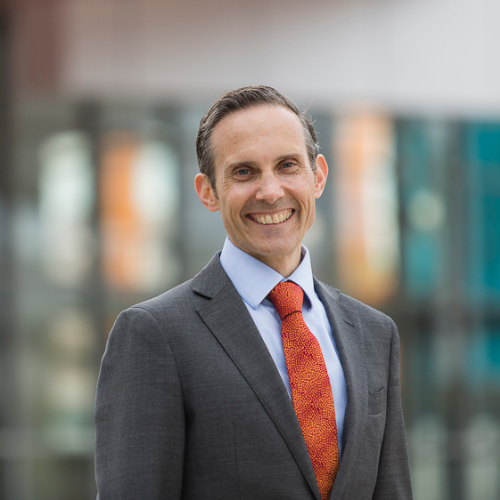
Andrew Leigh is the father of three sons and lives with his wife Gweneth in Canberra. He is a keen Ironman triathlete and author of over ten books, including Battlers and Billionaires: The Updated Story of Inequality in Australia and The Shortest History of Economics (both 2024). Andrew holds a PhD from Harvard University and was formerly a Professor of Economics at the Australian National University. He currently serves in the Australian House of Representatives.

Richard Holden
Richard Holden is a Professor of Economics at UNSW Sydney and President of the Academy of Social Sciences in Australia. He was formerly on the faculty at MIT and the University of Chicago and earned a PhD from Harvard University. He has published numerous paper in top economics journals and is a regular columnist at The Australian Financial Review.